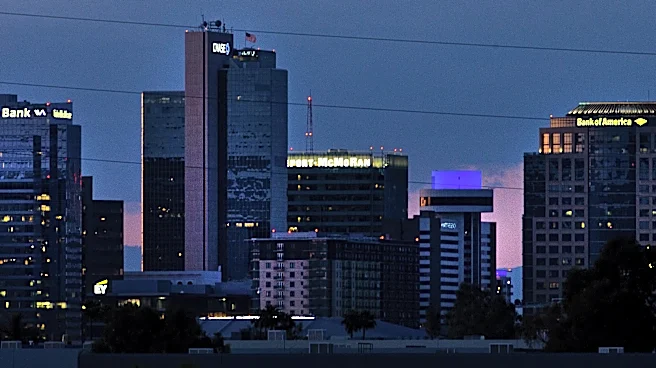






The view from the 24th floor of the Hyatt Regency Phoenix had fewer skyscrapers when it first opened 50 years ago.
At The Compass, the property's iconic revolving rooftop restaurant, people had an unobstructed view of Camelback Mountain before the skyline changed.
Hotel staff said the view was "a straight shot" to Camelback until the APS building at Arizona Center was completed in 1990. Longtime employee Jerry Herschede recalled pointing out landmarks to visiting guests.
Looking to the west, staff watched a new hotel join the skyline as the Denu Hotel & Spa was constructed. Looking the other direction, from the Denu Hotel, The Compass is visible from the 17th-floor rooftop pool and bar.
Hyatt Regency 'was empty' when it first debuted in downtown Phoenix
In 1976, four years after the Phoenix Convention Center opened
its doors in 1972 (then called the Phoenix Civic Plaza), the Hyatt Regency Phoenix hosted its first guests.
Joe Alegre, the hotel's director of sales, said the Hyatt Regency was one of the first major construction projects for downtown Phoenix. At the time, it was believed it would drive the local economy and downtown growth and expansion. At 693 rooms, it had the most of any downtown hotel until the 1,003-room Sheraton Phoenix Downtown opened in 2008.
"To look back now 50 years later at what downtown Phoenix has become, we're really proud that we've played such a pivotal role in the expansion of the city," he said.
Herschede, the hotel's longest-serving employee, who worked at The Compass for 50 years until retiring earlier this year, said the hotel was trying to attract the downtown business crowd upon its debut. But there wasn't much of a crowd at the time.
"This was empty when I started," she said.
That changed in recent years, in part thanks to investments in the city's sports teams, Arizona State University's downtown campus and the Valley Metro light rail, along with the development of a more robust dining, coffee and nightlife scene along Roosevelt Row.
Today, downtown Phoenix welcomes an average of 6 million visitors a year, according to Downtown Phoenix Inc. The nonprofit provides services to enhance downtown Phoenix such as planting trees, hosting events and marketing and advertising for the area and its businesses.
Hyatt is home to Arizona's only revolving restaurant
One of the biggest draws, both then and now, is The Compass, the state's first and only revolving restaurant.
It's hard to miss it in the city skyline, distinguished by its circular core shape with a sphere at the top of the building, which almost resembles a jewel atop a ring.
"We're so uniquely situated within the skyline, we're instantly recognizable," Alegre said.
Alegre thinks of The Compass not as a hotel restaurant, but as a destination restaurant. He said many guests who dined at the restaurant came to celebrate special occasions like proposals and wedding anniversaries.
The fact that The Compass has been part of the Hyatt from the beginning is remarkable, particularly because it's typical in the lodging industry for hotels to change their on-site restaurants over time to rebrand or modernize, he said.
"It's incredible that after 50 years, it's still here," he said. "I think the unique experience and being able to see the entire city through one setting is what continues to drive people here."
Herschede was a fixture at the restaurant in the hotel's first half-century as one of its waitresses. She was also the hotel's first hire.
"I'm older than the hotel," she said. "Because I started on the 18th of January (1976). The hotel opened up on the 25th."
When she started, The Compass wasn't a restaurant. It was originally a gentleman's club modeled on the Playboy Clubs, which featured entertainers and drink service by Playboy Bunnies. The Compass first served only alcohol, not food. But it eventually became a full-service restaurant. Items on the original menu included an eggplant biscuit and orange cornbread with honey butter.
Over the years the restaurant hosted many celebrity guests; Alegre recalled ESPN broadcasted from the restaurant during the 2023 Super Bowl, interviewing Travis and Jason Kelce as they had dinner. Herschede said one of the first customers she served was film icon Clint Eastwood, who she described as "amazing."
"He was filming a movie here, 'The Gauntlet', have you seen it?" she said. "They were filming right across the street and they had the bus over there that got all shot up. And he was filming there, so he would stay here. We've never been allowed to ask for an autograph or anything, but he came up and was trying to disguise himself with his sunglasses and hat ... and I had the honor to wait on him."
Hyatt Regency was alone in the downtown market for decades
Hyatt arrived in downtown Phoenix in a year of triumph and tragedy for Arizona. 1976 was the year that investigative reporter Don Bolles was murdered, the Phoenix Suns reached the NBA Finals for the first time, 17-year-old Dwayne Evans won bronze in the 200-meter event at the Olympics and pioneering wellness resort Castle Hot Springs was destroyed in a fire.
When it opened, the Hyatt Regency's only competition was the Renaissance Phoenix Downtown, which opened in 1975 in the former site of the Adams Hotel. The downtown lodging landscape during that time also included "some smaller motels," Alegre said.
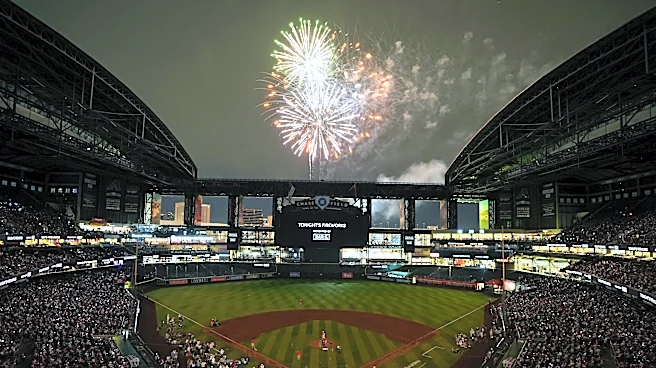
More downtown hotels opened in the years after the Phoenix Suns arena, known today as Mortgage Matchup Center, opened in 1992; and the Arizona Diamondbacks ballpark, known today as Chase Field, opened in 1998.
However, Alegre said there was a long gap before the next major convention hotel, the Sheraton Phoenix Downtown, arrived in 2008. With 1,003 guest rooms, the Sheraton overtook the Hyatt as the hotel with the most rooms in Arizona.
A couple more major hotels followed in the early 2010s with the openings of the Westin Phoenix Downtown in 2011 and the Kimpton Hotel Palomar, part of the CityScape development, in 2012. Hyatt even expanded its presence in 2021 with a second downtown hotel, a Hyatt Place on West Adams Street across from the Orpheum Theatre and two blocks from Arizona Financial Theater.
Following the opening of the 236-room Denu Hotel, downtown Phoenix lodging growth is expected to continue further. Las Vegas-based LaPour Partners recently announced plans to convert a 19-story office tower in Arizona Center into a 340-room JW Marriott hotel.
While it might seem unusual for a hotelier to want competition in the market, Alegre said he thinks more downtown hotels — especially another 1,000-room hotel like the Sheraton — could help Phoenix attract business from larger conventions. He cheers the upcoming opening of the Denu Hotel, which like Hyatt, will fill a void in downtown Phoenix, as it will be the corridor's first hotel with a full-service spa.
This matters, as the next 50 years of growth for Hyatt Regency will be driven by the type of convention business that Phoenix will attract in the future.
Why Hyatt welcomes competition in downtown Phoenix lodging
"Where we fall into some challenges sometimes is there's not enough hotel rooms down here for the major conventions," he said. "And so we'll lose some business to some of our competitive markets like Denver and Orlando and Vegas just because they can house those types of mega conventions where we can't."
As of April 2026, downtown Phoenix had a total of 4,769 hotel rooms, according to Downtown Phoenix Inc.
That pales in comparison to the estimated 13,000 hotel rooms in downtown Denver. It's a tiny fraction of the more than 150,000 hotel rooms near the Las Vegas Convention Center.
"These conventions really want to stay centralized instead of expanding out into Scottsdale and Tempe," Alegre added.
Vacancies in office towers downtown could be used for hotel space, with Alegre suggesting the Chase Tower and the top part of the Freeport McMoRan building could house additional rooms.
Such thinking inspired plans for the future JW Marriott at Arizona Center.
"The market has reached a pivotal moment with population growth, significant new multifamily investment, convention activity and tourism continue to accelerate, yet the market remains underserved when it comes to luxury hospitality," Jeff LaPour, founder and CEO of LaPour Partners, said in a statement. "Hard to believe Phoenix is the fifth-largest city in the U.S. yet the downtown business district lacks a hotel of this quality."
The proposed hotel, LaPour said, benefits from being close to "nearly every demand driver shaping the city's future," including the Phoenix Convention Center, ASU's downtown campus, Chase Field and Mortgage Matchup Center.
While it remains unknown how the upcoming JW Marriott will impact future convention business, Alegre is excited to see how current tourism and commerce trends will impact Hyatt Regency, starting with the convention center hosting SEMICON West, a semiconductor industry event scheduled for March 30-April 1, 2027. Phoenix will become the long-term host of the event starting in 2027, with events also confirmed for 2028 and 2029.
Phoenix has been a hotspot in the semiconductor industry since Taiwan Semiconductor Manufacturing Co. built a manufacturing site in the northern part of the city. It has plans to build four more fabrication sites in the metro area. TSMC's arrival was also a factor in Phoenix Sky Harbor International Airport getting nonstop flights to Taiwan via China Airlines and Starlux Airlines.
To ensure Hyatt attracts incoming convention and event travelers, Alegre feels "it's all about innovation" and offering outstanding experiences that make guests feel welcomed.
"We want to be the most desirable location for our colleagues and for guests, and to do that we've got to do things differently ... so we can stand apart for our travelers," he said. "These days, today's travelers are looking for the experience, it's not just a hotel anymore, but what the overall experience from start to finish is going to be."
And, 50 years later, it's still just the beginning. The company, looking to replicate their Phoenix success in southern Arizona, announced a new Hyatt Regency hotel near the Tucson Convention Center, which is scheduled to open in late 2027.
Looking for the best things to do in Arizona? Sign up for our newsletter.
Michael Salerno is an award-winning journalist who’s covered travel and tourism since 2014. His work as The Arizona Republic’s consumer travel reporter aims to help readers navigate the stresses of traveling and get the best value for their money on their vacations. He can be reached at Michael.Salerno@usatodayco.com.
Support local journalism. Subscribe to azcentral.com today.
This article originally appeared on Arizona Republic: Hotel that changed downtown Phoenix's skyline 50 years ago isn't done