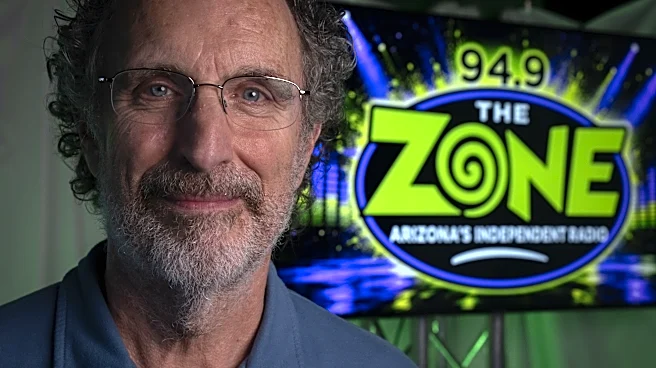





A new radio station has dusted off the call letters and format used by a beloved Phoenix station of the early 90s with a program director who helped that station find its footing in its early days.
KZON, The Zone, returned to local airwaves in mid-January 2026 at 94.9 FM and 103.9-HD2, adopting the adult album alternative (Triple A) format The Zone had when it launched in 1992 at 101.5.
For the week of July 27, the new station’s playlist was topped by soulful Southern rock from the Revivalists with Top 10 showings by Mumford & Sons (collaborating with Chris Stapleton), a new one by The Rolling Stones, Beck, Noah Kahan, Myles Smith, U2 and Lucy Dacus.
The new station’s program director, Dennis Constantine, served as a consultant for the original
Zone and hosted the station’s first show as a DJ to ring in the format switch on July 23, 1992.
The Zone program director has a storied history in the Triple A format
Constantine was brought in to consult based on his reputation as a leader in developing the format at KBCO-FM (97.3) in Boulder, Colorado, which rolled out its groundbreaking Triple A format in June 1977.
As Constantine recalls the impetus for Triple A, “I was working at our version of the old progressive rock days where the jocks could just play anything they wanted. We had a big wall of music in the studio. It was incredible. Early album rock stations played a wide variety, from Led Zeppelin to Stevie Wonder and everything in between.”
That station, KBPI-FM (107.9) in Fort Collins, Colorado, decided to streamline its playlist.
“They basically took the entire library out of the studio and left 165 songs in there,” Constantine says. “And that was gonna be our library to play. I saw that as an opportunity to create a new radio model that would play off of the Colorado sound, which was at the time singer-songwriters.”
It wasn’t long before the format he designed for KBCO was incorporating punk and New Wave.
“We started mixing in Talking Heads and The Clash,” he recalls. “And the next thing I know, we had this music mix that went from acoustic to New Wave, even some jazz-flavored songs.”
By 1990, KBCO had increased its signal, which in turn expanded its audience.
“It became the No. 1 station in Denver, which got the attention of the industry,” Constantine says. “A lot of stations started calling me wanting to know, ‘What can you do for us?’ I said, ‘Well, I can't just take the music we've created for Colorado and plug it into Austin, Texas or Washington, D.C. Every city has its own sound.’”
By the time he got to Phoenix, Constantine had helped get stations off the ground in not only D.C. and Austin but also Nashville, Tennessee.
This newsletter goes to 11. Sign up for weekly music news.
How The Zone brought Triple A to Phoenix airwaves in the early 90s
In 1992, Mike Jorgensen at Sundance Broadcasting brought Constantine to Phoenix to work his magic on The Zone.
“We created a very kind of Arizona feeling station, lots of Gin Blossoms and that kind of Arizona sound,” Constantine says. “And it took off. Then Mike sold the station, new owners came in and they had different ideas. It evolved to become what it did eventually with Howard Stern in the morning. So we lost our kind of unique radio station.”
The Zone went through many transformations over the years.
“It started out as pure Triple A," Constantine recalls. "Then it became more of a rock alternative. They went Adult Top 40. Then they went to modern rock. Then Howard Stern came on. When Howard Stern was on a station, he brought his listeners with him. And that was the problem. No matter what music format you did after he went off the air, about half the people wouldn't relate. So these Howard Stern stations found they had huge numbers in the morning and then nothing the rest of the day.”
How a Triple A pioneer became involved in helping stations use AI tools
Constantine continued his consulting work through 1997, helping more than 30 stations put their own spin on the format.
“I was flying around the country,” he says. “Every week, a different city. It was nuts. I put stations on in LA, Seattle, Minneapolis, Boston, New York, Philadelphia, pretty much all the major cities and some smaller markets too. It was a crazy time, going into a city and saying, ‘OK, what's the music community here like? Let's talk about that. Let's figure out what the music mix should be.’”
After multi-year Triple A program director stints in Portland, Oregon and San Francisco, he went the internet radio route at Live365 before landing in Flagstaff, where he served as a Triple A program director at KVNA-FM (100.1) from 2017-2025.
“And it did really well,” he says.
“But the owners decided they wanted to save money and went with a satellite delivery service. This is happening all around the country. Everybody's looking for ways to save money. The big classic rock station here in Prescott just fired their morning show host. And he'd been there for 30-some years.”
The same year he left KVNA, Constantine co-founded SonicTrek, which helps radio stations save money by incorporating AI tools.
“We have a program called TopicPulse, which basically plugs into trending news that applies to each city,” Constantine says.
“So we can get up-to-the-minute information on the air. The problem with a lot of stations is they're voice-tracked. They have DJs that usually cut their tracks a day or two ahead of time. So if something big happens in a city, they're not gonna have that. We have the opportunity to plug directly into what's happening in the moment and talk about it using AI.”
'I mentioned The Zone. And he said, yeah, The Zone. That's perfect'
SonicTrek also constructed a format called PhoebeFM: Curiously Alternative, which, as Constantine explains, is hosted via AI by “this kind of wacky, irreverent DJ Phoebe, who says crazy things and plays lots of 90s and 2000s alternative music, along with current stuff.”
Mike Cutchall at Zelus Media Group in Phoenix heard a PhoebeFM sample and reached out to the company behind it.
“He said, ‘I love this music, but we don't want to label ourselves as alternative because we've already got 93.3 here in Phoenix, and we don't want to confuse listeners and make them think this is a copy of what they're doing,’” Constantine says.
“I mentioned The Zone. And he said, ‘Yeah, The Zone. That's perfect. We can bring that back. It can play all that 90s and 2000s alternative music, and then our current music could be more adult.’ It's a combination of various styles again, not just alternative music. It’s rock, acoustic, whatever.”
Cutchall calls himself “a longtime Arizona kid” who grew up in Tucson. “I've been in this business the last 40 years,” he said. “About two years ago, I purchased these radio stations in Phoenix. So I'm back in my home state, doing what I love to do. I've always been passionate about radio and its impact on the community and people's lives. So that's what we hope to achieve with all our stations.”
'What would be something unique that we could create in Phoenix?'
In addition to The Zone, Zelus owns Power 98.3, a heritage hip-hop station; The Wow Factor at 95.1, a classic hits radio station; Hot AC at 103.9 and 97.5; and Xtasis 96.1, a Spanish adult hits format.
With all those stations in the mix, Zelus had an extra frequency that wasn’t being used.
“So we started brainstorming,” Cutchall said. “We thought, ‘What would be something unique that we could create in Phoenix?’ And we couldn't help but have The Zone pop up. It was one of those stations that was driven by passion and music and fun on the air and entertainment. We thought, ‘Why don't we recreate that?’”
As luck would have it, he already owned the call letters. “Years ago, a company that I was operating acquired the KZON call letters,” Cutchall says.
“The old Zone frequency switched to Live, so they dropped the call letters a couple years ago. When I saw that they dropped them, I said, ‘I've always loved those call letters. I don't know what I'll ever do with them, but I want them.’ So we basically had them parked, not even with the concept that years later we'd be doing something like this. But it happened to all fall into place.”
Station hopes to take what worked for KZON and 'make it for today'
The idea behind the station is to take what worked in that first iteration of The Zone and “make it for today,” Cutchall says.
“When the Zone was on, it was targeting the 20- to 30-year-olds and now it kind of targets 40- to 50-year-olds.”
To Cutchall, the timing is right for the Triple A format to mount a resurgence in Phoenix.
“Right now, the top station in Chicago is WXRT, which is adult alternative,” he says. “People are tired of all the same music and all the same algorithms programming that music. Let's create something new and exciting.”
Knowing what he knew about Constantine’s background, Cutchall figured, “If you're gonna do an alternative station, Dennis is the guy, right?”
In addition to putting the playlist together as program director, Constantine hosts the morning show.
“It doesn't scream at you,” Constantine says of the music they’re spinning.
“It's not rocking in your face. We do rock, but a lot of the stuff that we play is mid-tempo. Death Cab for Cutie is a great example. Bleachers, bands like that, that fit the kind of overall feeling of the station. Mumford & Sons is a great example. Their stuff is perfect for us.”
It’s music with a vibe he feels will suit a lot of people’s lifestyles.
“I honestly believe people pick radio stations to help create a mood because it's something they put on in the background while they're working or talking or whatever,” Constantine says. “They're doing something else. Is this the mood I want to be in right now? This music, it creates a mood.”
'Like kids in a candy store getting to do a radio station like this again'
He’s hoping it’s a mood that speaks to those who may have given up on radio.
“We do believe there’s a large group of people who are disenfranchised with radio,” Constantine says.
“They've given up because most stations now are running these ridiculously long commercial breaks of, like, 8 or 9 minutes. So they've trained their listeners that when we start playing commercials, you don't want to listen anymore because it's gonna be forever before we get to the next song. Our goal is to find those people.”
They’re getting the word out and building an audience one listener at a time.
“We got a nice early buzz based on just friends who knew The Zone and were connected to The Zone,” Cutchall says.
“So I do think it's going to be word of mouth. And we just did a back-to-school event where we gave away 1,500 backpacks with the city of Phoenix. So we're out in the community telling our story. It may take a couple of years to really get the kind of traction that we want.”
In the meantime, Cutchall says he’s thrilled to be involved in bringing a station like The Zone to Phoenix.
“We're like kids in a candy store getting to do a radio station like this again,” Cutchall says. “We thought these kinds of stations were gone.”
The Zone is on a small signal for now.
“We'd love to get a stronger signal, but we're on South Mountain right now and we're raising the tower up higher to get a better line of sight to the whole Valley, because FM radio is line of sight,” Constantine says.
“If you can see the tower, you can hear it. But because we have so many mountains inside the city, there can be shadow areas behind the mountains. But most of the big stations are 100,000 watts. And we’re 250 watts. So we're the upstart. But that's a good place to start.”
Ed has covered pop music for The Republic since 2007, reviewing festivals and concerts, interviewing legends, covering the local scene and more. He did the same in Pittsburgh for more than a decade. Follow him on X and Instagram @edmasley and on Facebook as Ed Masley. Email him at ed.masley@arizonarepublic.com.
This article originally appeared on Arizona Republic: Forgotten Phoenix radio station is reborn. Inside its unlikely revival