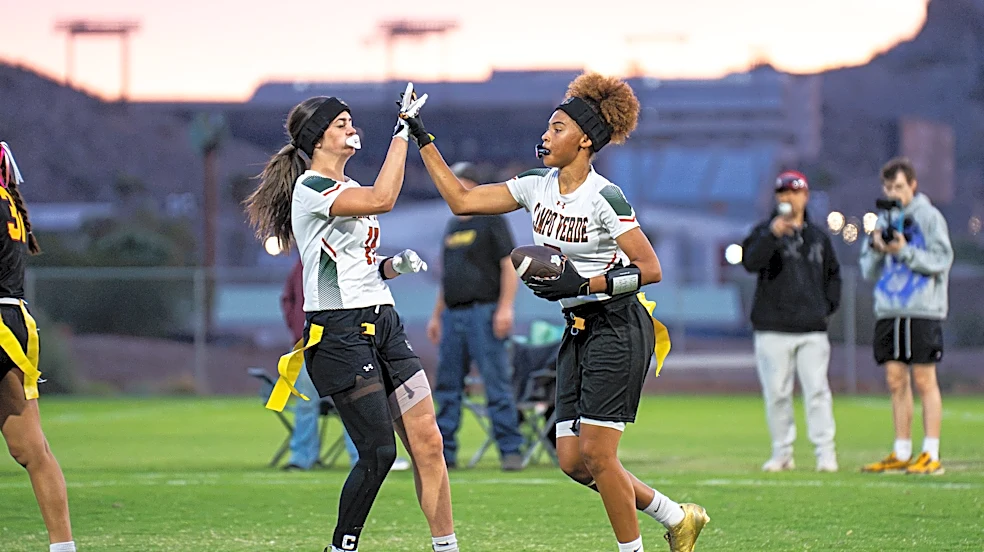





The Fiesta Bowl hosted its second annual Copper State Invitational from Oct. 15-17 at Arizona State University, bringing together the state’s top flag football teams across all divisions in a tournament. Gilbert Campo Verde, the Republic’s No. 2-ranked team, beat Tucson Salpointe Catholic 42-14 to win the tournament.
Here’s what we learned from the state’s premier in-season flag football tournament, which featured upsets and historic performances.
Campo Verde reasserts itself
Immediately after the season-opening loss to Gilbert Highland, Campo Verde coach Brian Coger was already looking ahead to the tournament and another chance at the Hawks. That game, plus last week’s loss in California to the consensus No. 1 team in the nation, JSerra Catholic, proved to be valuable lessons
for Campo Verde.
Campo Verde avenged the loss to Highland with a 28-14 semifinal win.
“That’s one thing we’ve always said as a staff. When we have a loss, we’re going to learn from it,” Coger said. “And if we get another chance to play those teams again, we expect to have a better result.”
The Coyotes were the only undefeated team, going 5-0 in the tournament. Sophomore wide receiver and defensive back Jaiyana Bogan-Jacobs was named tournament MVP with a dominant effort on both sides of the ball.
Campo Verde enters next week as the state’s top-ranked team.
“It tells us more how we feel about our team,” Coger said. “We knew that we didn’t put our best effort out there the first game (season opener). Even JSerra, that wasn’t our best effort. When we come out and put out our best effort, we think we’re one of the top teams in the nation. I think a lot of people got to see that.”

Highland isn’t invincible
Heading into the tournament, Highland looked like the clear-cut best team in the state. Highland was outscoring opponents 277-35 and was 5-0 after taking down fellow ranked teams Campo Verde and Glendale Mountain Ridge with ease. The Hawks were nationally recognized as well, coming in at No. 8 in USA TODAY and No. 12 by MaxPreps.
Then came 4A Salpointe, with star sophomore quarterback and linebacker, Isla Collins.
Salpointe, which has been just as dominant to open the season, stunned Highland with a 26-13 win in the final game of pool play on Oct. 17. It was the first loss for Highland since the 2025 6A semifinals. Highland coach Kenny Golladay wanted to be tested in the tournament and got his wish, and then more.

“I think the second halves of most of these games were exciting,” Golladay said. “We’ve been getting challenged in that first half because we don’t know who these teams are. We tried to get as much film as we can, but unfortunately we can’t get everything. This is kind of a first look.
“But for it to work, my coaches’ brains need to rewire and adjust is a good challenge. That’s what we need. It’s always a good thing, humility.”
While Salpointe didn’t win the tournament, it was still historic for the Lancers — a 4A school taking down a 6A school, which was also nationally ranked. Salpointe’s win was the exclamation point on a strong showing from small schools at the tournament.

Small schools prove themselves
The Copper State Invitational was the first extensive look at small schools getting to play large schools in flag football with 3A Scottsdale Christian Academy and Salpointe — and it was a resounding success.
Salpointe, which was just coming off a win over 6A Mesa Red Mountain earlier in the week, got the tournament started by taking down 6A Tempe Corona del Sol 21-3.
Then SCA, which is a 2A school but plays at the 3A level in flag football, took down 6A Peoria Liberty 27-7. While Liberty was missing starting quarterback Marlie Phillips due to AIA transfer rules, the Lions still feature wide receiver and defensive back Makenna Johnson, one of only two preps in the state with an offer from Nebraska (the lone Power Four school offering scholarships for flag football).
Salpointe beat 6A Anthem Boulder Creek 21-3 a few hours later in its final game on the first day of the tournament on Oct. 15. It was a monumental weekend for the Lancers.
“We needed to come and grind some games out,” Salpointe coach Barrie Pedersen said. “We haven’t been tested yet, frankly, all year. To come up here — it’s a long day for us — compete and finish the way we did, I couldn’t be prouder of the team. It’s a good moment for the program. We knew that we could compete at this level.
“We want to put our program on the map because it’s good for the game; it’s good for the city of Tucson. There’s really only two programs that are competing at a really high level. We need to raise the level of competition, not only at Salpointe and Marana, but at all the other schools. There are few budding programs. If the visibility of this tournament draws a few more girls into their programs, then we’re all better for it.”
SCA ended the first day with another win over a 6A school by beating Marana 21-7. While Marana was also missing its starting quarterback, Isabella Garcia, it was still a big win for SCA. The Eagles finished pool play 2-1, losing to Campo Verde in the final game. SCA was one of the four schools to make the semifinals.
“I thought we represented 40 schools, because we’re a 2A school,” SCA coach Ryan Fisher said. “We play pretty good football at that level. There’s a lot of good teams, good coaches. I’m happy for our program that we got to compete. I’m glad we got the invite.”
Invitational has a bright future
It was the first time that each conference was invited, with 2025 featuring just 6A, 5A and 4A schools.
“We started our foray into flag football by doing a Game of the Week, as we do on the boys side,” Fiesta Sports Foundation CEO Erik Moses said. “And the feedback we got from the teams was that they wanted the best to play and they wanted the opportunity to play other teams that they normally wouldn’t schedule during the regular season.
“That’s why we created a midseason tournament, so you could see these kind of matchups you normally wouldn’t see. I think it’s great for the athletes, for the schools and for the sport. The distribution of talent in this sport doesn’t necessarily have to be at the biggest schools.”
Moses told The Republic that the tournament is going to be around “indefinitely.” There’s a chance the field could expand beyond eight teams in the future, but only if the Fiesta Sports Foundation feels that it could deliver the same type of hospitality to the schools, Moses said.
AIA should consider an Open Division
This tournament — for the first time — showed that small schools can compete with big schools in flag football. SCA’s total enrollment is 268, and it still made the championship bracket.
It doesn’t matter how small the school is — Salpointe and SCA proved that.
That’s why it may be time for the AIA to consider adding an Open Division for the sport. Flag football is in only its fourth season sanctioned by the AIA, but has grown tremendously. What started as a two-conference sport has grown to four.
The performances by both Salpointe and SCA are enough to show that adding the Open would be worth it. The format could be similar to what the AIA first introduced for tackle football, which combined the top three conferences into one field, but instead taking all four for flag football.
Having an element of the current Open — which allows for re-seeding after the first round, placing losing teams back in their respective conferences — could make sense. This would be identical to what the AIA adopted for basketball and soccer.
Logan Stanley is a sports reporter with The Arizona Republic who primarily focuses on high school, college and Olympic sports. To suggest ideas for human-interest stories and other news, reach out to Stanley at logan.stanley@usatodayco.com or 707-293-7650. Follow him on X, formerly Twitter: @RLSscribe.
This article originally appeared on Arizona Republic: What we learned from the Fiesta Bowl Copper State Invitational