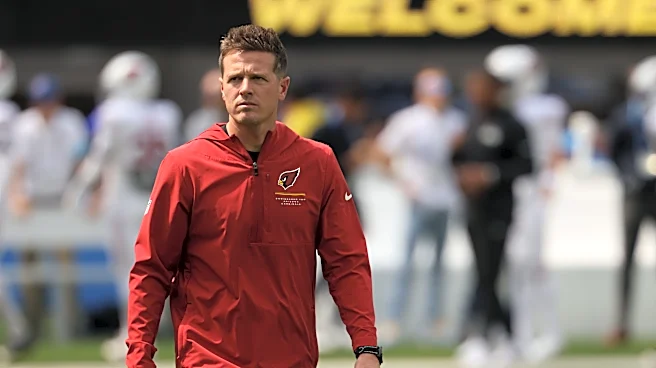



INGLEWOOD, CA — Standing at the podium after the greatest moment of his nascent Arizona Cardinals career, Mike LaFleur said all the things that head coaches are supposed to say.
The personal satisfaction was “nothing right now.” He was “proud” of the players and “happy” for them. “Humility,” he reminded reporters, “is a day away in this league.”
But a few minutes earlier, LaFleur had let his emotions crack. With Jacoby Brissett in a kneel-down formation, a wide smile slipped across the head coach’s face. He slapped his hands together for a few emphatic claps.
He allowed himself to feel, just for a moment, the emotion shared by fans across this state. Joy. Relief. And best of all, possibility.
Could this be? Could the Cardinals have finally found
the answer at head coach? For years, the NFL has sorted its finest young offensive minds into top jobs, from Los Angeles to Green Bay to Jacksonville. All the while, Cardinals fans have watched from the sidelines, seeing two defensive hires flail and one offensive attempt sputter out spectacularly.
The Cardinals still have a long way to go before they can join that list. It will take far more than one 26-14 win over a talented but flawed Los Angeles Chargers team.
But as Arizona high-fived its way into the visiting locker room here at SoFi Stadium, it was hard not to dream big. LaFleur, after all, had accomplished something none of his 13 most recent predecessors did: He won in his debut. The last full-time Cardinals coach to match that feat was Don Coryell, back in 1973 — 15 years before the franchise moved to Arizona.
And LaFleur did it with a tenet that is both basic and — around here — refreshing: competence.
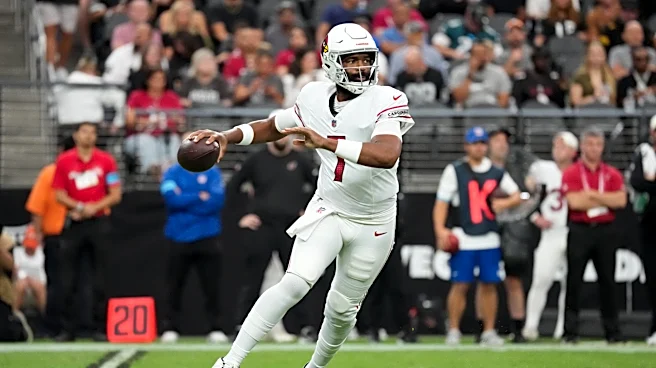
Outside of three pre-snap penalties, the Cardinals did not beat themselves. Instead, they allowed the Chargers to take on that title. It was the Chargers who fumbled when their running back collided with one of his own players. It was the Chargers who repeatedly messed up their protections, allowing free rushers at the quarterback. It was the Chargers who had a punt blocked, surrendering possession in the red zone.
Measured by operational cleanliness, the Cardinals won by TKO. When was the last time that held true? It feels like it was about as long ago as Coryell’s debut win.
Afterward, LaFleur wanted to focus on what he did wrong.
He didn’t like one play call in the red zone, when he felt that he became too predictable with his protection schemes. On a late third down, he regretted rolling Brissett to the short side of the field. Even Trey McBride’s touchdown reception was, in LaFleur’s words, “not a very good play design.”
That, in itself, is a welcome change. After losses last season, Jonathan Gannon would repeatedly say he “loved” the Cardinals’ play calls, no matter the outcome.
It also obfuscates that LaFleur got far more right than he did wrong, by leaning into the beliefs that have been promised all offseason.
“The marriage of the run and pass, that's gonna be a strength for us,” wide receiver Michael Wilson said during training camp.
Six weeks later, in the locker room of SoFi Stadium, center Hjalte Froholdt explained the Cardinals’ win by pointing to their “mixture of runs and passes,” which he said “opens up” the playbook, preventing the Chargers from getting into a defensive rhythm.
LaFleur’s impact was perhaps most clear with the Cardinals’ use of pre-snap motion. Last season, they motioned on just 21% of offensive plays, per the CBS broadcast. On the first drive alone, they did so on six of 11 snaps.
The benefits of that motion came to fruition on Jeremiyah Love’s touchdown. Tight end Elijah Higgins sprinted across the formation to block the back side edge rusher. That movement sucked a linebacker into the core of the formation, while Marvin Harrison Jr.’s blocking effort helped eliminate a defensive back.
The play was initially supposed to hit inside the left tackle, but with the Chargers’ defense all flowing to the right, Love was able to bounce his run down the left sideline for a touchdown.
Tyler Allgeier, Love’s backfield partner, was hesitant to divulge too much of the Cardinals’ playbook, but he acknowledged that the use of motion makes life simpler for running backs.
“It just comes down to the scheme,” Allgeier said. “Just knowing if one guy's motioning … seeing where that can affect where the combos and stuff are. It's a lot of good eye candy.”
It wasn’t just the motion, as the Cardinals operated out of every flavor of pre-snap look. There was a heavy dose of three tight end packages, as well as one play-action pass out of jumbo, with Jayden Williams as the sixth offensive lineman.
On three different plays, they lined up with both Love and Allgeier in the backfield, before motioning Love out left. Each time, they accessed something different.
All of it was designed to muddle the equation for Los Angeles’ defense. And indeed, the Chargers looked uncertain all afternoon, as if they were a step behind Arizona’s offense.
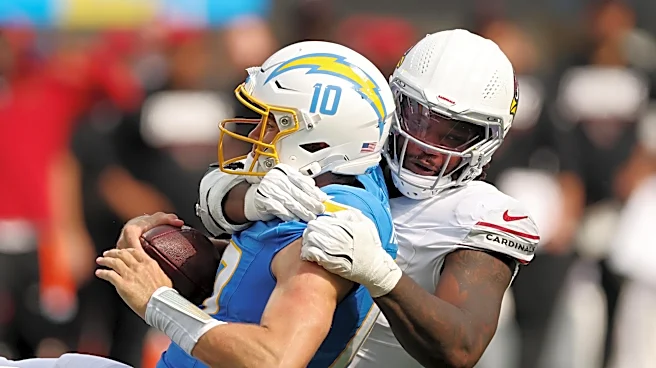
Look no further than their pass rush. On paper, that group is more talented than the Cardinals’ offensive line. In reality, they managed just eight pressures and zero sacks on 39 dropbacks, per Pro Football Focus.
“When the right play needed to be called, he called it,” Brissett said of LaFleur.
That doesn’t mean LaFleur was perfect. Beyond the pre-snap penalties, he made three fourth-down decisions that reduced the Cardinals’ win probability, based on ESPN Analytics’ calculations.
Two came on early field goal attempts, including a miss by Chad Ryland. The third was a fourth-and-1 from the Cardinals’ 40-yard line in the fourth quarter. It worked out, because Justin Herbert missed an open receiver on third down and the Cardinals blocked the ensuing punt. In future games, against more opportunistic opponents, LaFleur might consider for more aggression.
But that’s the minutiae. On this day, it was outweighed by an organization marching in the right direction.
This article originally appeared on Arizona Republic: Why Mike LaFleur's debut stirred optimism for Arizona Cardinals