







While on a path to becoming a banker like his father and his grandfather, William Eaton could not shake his love for music.
"I remember getting to college, and I thought, OK, time to grow up now," Eaton said. "Take your business classes seriously. Your dad's a banker."
Still, even after getting rid of all his guitar equipment, Eaton's love for music could not be silenced while away at college. He even asked his parents to send him an old guitar he'd left at home. However, the small guitar mailed to Eaton by his parents only left him wanting more.
"Oddly enough, this guy was going door to door to sell this guitar he had made at Juan Roberto Guitar Works and I looked at it. It was different than any other guitar I'd seen," said Eaton.
Rather than
buying the guitar, Eaton wanted to know where this instrument came from and what else was available. However, when meeting the creator of the guitar, John Roberts, instead of buying a guitar Roberts suggested he make one.
"I thought no, I've never done anything like that, but he kind of planted the seed, and I remember going home that night and said 'I'll give it a try.' You know, I'll come in on weeknights and weekends," said Eaton.
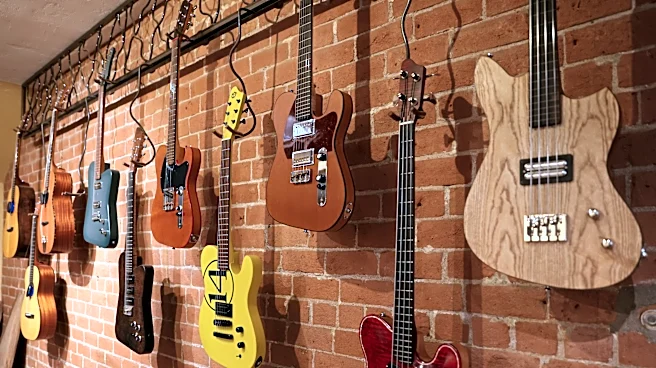
The seed Roberts planted in Eaton grew into something much larger, into something greater than either of them had ever expected — it birthed the Roberto Venn School of Luthiery in downtown Phoenix.
From yachts to guitars, this wood has a story
Although Roberts was Eaton's mentor, Roberts never planned to make guitars either.
Before opening Juan Roberto Guitars Works, Roberts had been collecting wood from Nicaragua in the 1960s during his time as an executive pilot for Robinson Lumber Company with the dream of using the wood to make a yacht.
However, this wasn't typical wood; the lumber Roberts had been collecting was rosewood and mahogany, two extremely luxurious and rare woods that have strict trade limits in the U.S. But when Roberts' wife started to develop health issues, they had to return to Arizona without making the dream yacht, bringing back large amounts of the rare wood.
When local guitar makers Carl Samuels and Ron Carriveau discovered the wood Roberts had collected, they convinced him to use it to make guitars, eventually teaching Roberts luthiery, which gave Roberts the skills to start Juan Roberto Guitar Works.
Eaton's apprenticeship with Roberts only drew him closer to music, and using the business knowledge he'd gained from the Stanford Graduate School of Business gave him the confidence to start the Roberto-Venn School of Luthiery.
The creation of Roberto-Venn School of Luthiery allowed Eaton to do what the school has done for many students: use their passion for music and turn it into a viable career.
'Individualized and signature to everyone'
For many students and music lovers, luthiery was a better fit than a traditional college or university.
"I was in veterinary medicine. And it was so formulaic, the way they almost herded students like sheep through this massive program with lecture halls of 500 people," London Holley, a luthier who graduated from the Roberto-Venn School of Luthiery, said. "I think in my time there I had precisely one meeting with my instructor where I was able to ask for help. Here I can darken their doorstep whenever I need to and get that one-on-one expertise in areas where I need more explanation, have questions, want to develop something a little bit further and reinvent the wheel."
Courses at Roberto-Venn are completed over a five-month period, which seems short compared with a four-year bachelor's degree. However, the school is not for people simply looking to acquire a new craft. It is for those who are truly looking to pursue a career in luthiery.
"If we determine from the application process that they're here for a hobby, then we'll advise them this isn't for them," Eaton said.
Nine hours a day, five days a week, the Roberto-Venn School is more of an unpaid job than a class, but for those passionate about it, it can offer an entryway into the elite world of professional music and craftsmanship.
"Five months is a short time, and it preps them, and the companies are interested because they have built an acoustic and electric guitar. They know the terminology, they've had experience, they're no masters, but they know a lot about guitars at that point, and so they're trainable," Eaton said.
An accredited certificate in luthiery allows graduates to work for companies that specialize in handcrafted guitars, work in guitar repairs or become an entrepreneur, making custom pieces for clients.
Nearly all the instructors at the Roberto-Venn School graduated from the school as well, collecting a solid case that the proof is in the pudding.
"I feel blessed to be teaching a subject that, one, I love and, two, people love," said Brady Shreeve, an instructor and graduate of the Roberto-Venn School of Luthiery, "All these students here really want to know the information I know, so you couldn't ask for a better bunch of students. They just really want to do what you're doing, unlike most people's teaching experiences, forcing students to learn something that they're not interested in."
With creative freedom and experienced instructors, students are not constrained to one design; they are encouraged to find their own style.
50 years of luthiery
To preserve the history of the school, the Roberto-Venn School of Luthiery has gifted the wood from Roberts' collection to alumni and guitar companies.
"The yacht would have been a dream that (Roberts) had, and that dream would have propelled his imagination into something beyond himself, and that's what a guitar does," Eaton said.
The aged wood posed many challenges for luthiers as the sun had worn it, making it brittle and hard to work with. Still, rosewood is an ideal guitar material that made the hardship worth it.
"The tonal qualities of rosewood are very ideal for a guitar, especially acoustic guitars," said Bart Applewhite, director of the Roberto-Venn School of Luthiery. "That, and then just the story makes this stuff really special too; it's part of the history of the school."
Using the original rosewood, Eaton created a guitar with a spiral pattern across the body, symbolizing a cyclical journey of growth, along with copper and turquoise details, representing Arizona and its history.
"For me, guitars and stringed instruments provide a total landscape of infinite possibility," Eaton said. "From studying the materials and understanding the materials, the chemistry, the biology, the trees, and all of that morphing into the engagement of designing things, putting it on paper, putting all the materials together and making that instrument, stringing it up, is like the ultimate. You hear those strings for the first time, every student is out there, and it's a very moving experience."
This article originally appeared on Arizona Republic: This Phoenix guitar school keeps a rare craft and its stories alive