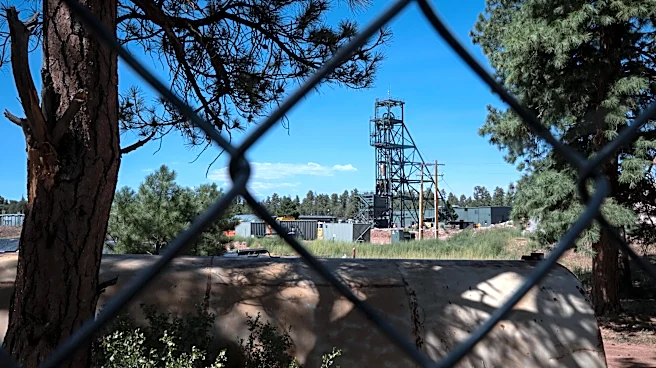








A state appeals board has dismissed the Havasupai Tribe's challenge of a decision to increase allowable arsenic limits in a well at Energy Fuel's Pinyon Plain uranium mine near the Grand Canyon.
The Arizona Department of Environmental Quality approved the higher limits earlier this year for a monitoring well at the mine, concluding that the revised guidelines were in line with naturally occurring arsenic. The Havasupai tribe asked the Arizona Water Quality Appeals Board to reverse the decision.
The board affirmed the state agency's ruling on Sept. 9 and dismissed the tribe's case. The tribe argued that the board failed to allow its scientists, as well as scientists from ADEQ, to be examined and cross-examined on key issues, including groundwater
pathways, fractured and karst geology, arsenic transport and the potential connection between the mine and the Havasu groundwater system.
Havasupai officials contended that, by limiting that testimony, the board failed to conduct a full evidentiary hearing and instead dismissed the tribe’s appeal at the threshold.
"That hasty decision does not make the water safer. It does not resolve the scientific uncertainty surrounding Pinyon Plain Mine. And it certainly does not change the fact that ADEQ approved higher arsenic thresholds at a uranium mine located in the greater Havasu watershed while serious questions remain about groundwater movement and contamination," tribal officials said in a news release.
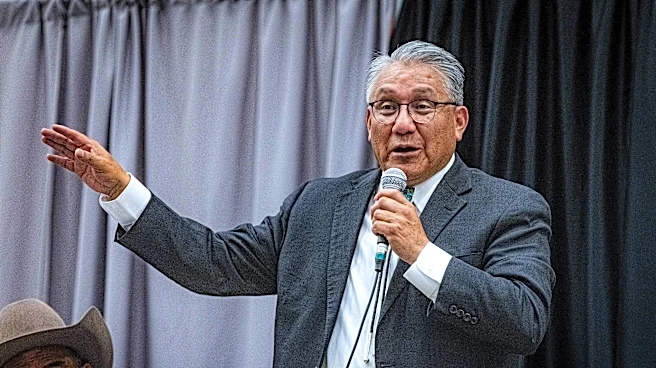
Denten Robinson, representing the Havasupai tribe, argued during the Sept. 9 board meeting to discuss possible dismissal that ADEQ’s motion should be denied because it applies the wrong standard. According to Robinson, ADEQ is asking the tribe to meet judicial standing requirements and essentially prove its groundwater case now.
He said that statute, AR-49-323(A), "requires only that the appellants show that they may with reasonable probability be adversely affected. Whether ADEQ's experts or the tribes experts are ultimately correct is a merits question for the evidentiary hearing."
During the Sept. 9 meeting, the three-member board ruled that before considering the case on its merits, the appellants must first establish that they qualify under statute to bring the appeal. The department emphasized that the hearing was not focused on the credibility of witnesses, but rather on the status of the documents and the allegations presented by the appellants.
Under the law, an appeal can be brought by someone who has been adversely affected by an ADEQ action or who could, with reasonable probability, be adversely affected and who exercised the right to comment, said Chairperson Michele Van Quathem.
The main issue is whether the appellants have standing — meaning whether they qualify under the law and can show that they have been, or could reasonably be, affected by ADEQ’s decision.
"And so looking at the documents, we would look at the complaint to see if all of the facts have been alleged," said Van Quathem. "And that if proven true at the hearing, would establish that the people listed as appellants are either adversely affected by the action or may with reasonable probability be adversely affected."
Tribe 'will continue this fight' to protect water
In June, the tribe raised concerns about the proposal to allow higher levels of arsenic in a groundwater monitoring well near the Pinyon Plain uranium mine south of the Grand Canyon, warning that the changes threaten Havasu Creek, the tribe's sole water source.
By July, ADEQ agreed to revise groundwater arsenic limits for the well concluding that higher arsenic levels in the well were naturally occurring.
The arsenic alert level at the monitoring well was 0.040 mg/L. ADEQ raised it to 0.050 mg/L. ADEQ also increased the aquifer quality limit from 0.050 mg/L to 0.055 mg/L.
The Havasupai Tribe said it has consistently asked a simple question: Why should ADEQ allow arsenic levels to rise higher before requiring monitoring, investigation and action?
“For generations, the Havasu ‘Baaja have protected the water that gives life to our homeland. We are not going to stop now simply because a government board has closed one door," said Havasupai Tribal Chairwoman Melinda Yaiva on behalf of the tribe. "We will continue this fight in every lawful forum available to us. Our water is too important, our people are too important, and the consequences of getting this wrong are too great.”
Robinson said ADEQ’s own motion demonstrates why dismissal is inappropriate. The parties and their experts materially disagree about groundwater pathways, travel times, arsenic transport and the effects of mining and pumping. He said section AR-49-323(A) answers the threshold question for the board.
"It authorizes an appeal not only by a person who is already adversely affected, but also by a person who may with reasonable probability be adversely affected by ADEQ's action and who exercise the right to comment," said Robinson.
"The Legislature added a second important phrase in the next sentence, 'the board shall hold a hearing if questions of material fact are at issue in the appeal.' Those words matter," Robinson said. "The Legislature did not require the tribe to prove today that arsenic from Pinyon Plain mine will inevitably reach Havasu Springs. It expressly allowed an administrative appeal where a person may with reasonable probability be adversely affected."

Why Havasu Creek is important to the tribe
The importance of Havasu Creek water extends far beyond the residents of Supai Village. Tourism centered around Havasu Creek is a critical part of the tribal economy, officials said, and provides revenue that supports tribal government, services, employment and the community.
When this water is contaminated, officials said, they don't only lose a drinking water source, they "risk losing a sacred resource, a central part of our culture and identity, the foundation of our tourism economy and something that can never be replaced."
Supai Village has no alternative municipal water system waiting to replace Havasu Creek water when it becomes contaminated, tribal officials said. That is why they have fought for generations to protect "this sacred water, and it is why we will continue to fight now."
Throughout this process, the tribe said they have presented credible evidence from highly qualified scientists that raises serious questions about ADEQ’s assumptions concerning groundwater flow, faults, fractures, karst geology, preferential groundwater pathways and the movement and persistence of arsenic.
"The appellants are not members of the general public asserting an abstract objection to uranium mining," said Robinson. "They reside in Supai and personally depend on Havasu water, and the tribe itself is a direct governmental has a direct governmental interest in the water supply upon which its remote community depends. These appellants live at, drink from, use, and depend upon the water resource they see attacked."
In the end, board member Fred E. Brinker said it was difficult for him to imagine "a reasonable, probable case for them (Havasupai Tribe) being adversely affected, based on everything I've seen so far."
He said it’s a two-part analysis: First, what is the discharge and its magnitude; and second, what would be its impact on the aquifer after traveling roughly less than 63 miles?
"And then when it gets there, then what is the impact to the aquifer?" said Brinker. "None of that's been even speculated on, let alone described, right? It's all very kind of hand waving, maybe someday kind of thing. So in my mind, it doesn't even begin to rise to reasonably, probable adverse effect."
Van Quathem said it was suggested that the tribe could be affected by changes in arsenic levels or delays, but "they haven't alleged the link to the specific injury that they will suffer. It's implied that they will suffer from arsenic changes or delays, but there's no link."
"The Tribe strongly disagrees with AWQAB’s conclusion that these risks are too remote to justify a full hearing," Havasupai tribal officials said. "Environmental protection should not require a community to wait until contamination arrives at its source of drinking water before its concerns are taken seriously. The purpose of groundwater protection is to prevent contamination — not to explain it after it happens."
Arlyssa Becenti covers Indigenous affairs for The Arizona Republic and azcentral. Send ideas and tips to arlyssa.becenti@arizonarepublic.com.
This article originally appeared on Arizona Republic: State drops Havasupai challenge of arsenic levels at uranium mine