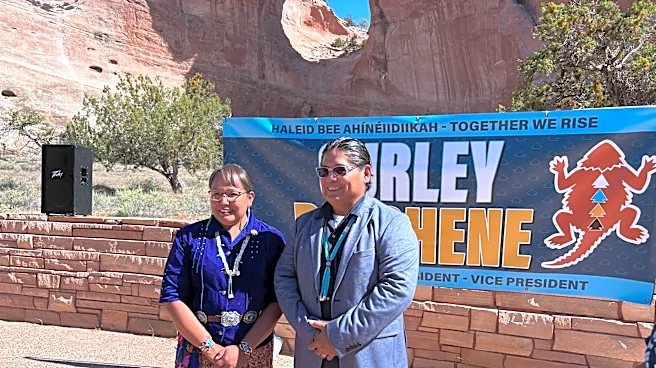




WINDOW ROCK — Navajo Nation Speaker Crystalyne Curley has named Chris Deschene, a former Arizona state legislator, as her running mate as she begins her presidential campaign for the November general election.
Curley and Farmington attorney Justin Jones advanced to the general election in the July 21 primary.
Curley said her decision, announced in Window Rock on July 27, on a running mate was guided by prayer and careful consideration as she prepared for the general election. She is the second Navajo woman to advance beyond the Navajo Nation presidential primary.
"It was clear and no hesitation," Curley said. "I've known Chris for many years, and I've looked up to him. I have seen the things he's done with his experience, military service, with his connection
internationally, federal and state, bridging that with my type of leadership, capacity and my goals, I think it aligns. I know I made the right choice."
Deschene is a U.S. Marine Corps veteran, engineer, and licensed attorney. He has served as an Arizona State representative and the director of the Office of Indian Energy Policy and Programs at the U.S. Department of Energy.
He said Curley's work on the council, along with the conversations they had shared over the years about Navajo issues, convinced both him and his wife to support her campaign. Those same factors also influenced his decision to join the ticket as Curley's running mate.
"There's a lot of the same thing has happened over the years but a lot of the same problems still exist," Deschene told The Republic. “I am proud to stand alongside Crystalyne Curley because she has demonstrated courageous leadership and an unwavering commitment to the Navajo people."
'I have not been absent' in work for Navajo Nation
Deschene ran for Navajo Nation president in 2014 and advanced to the general election. He was disqualified after it was determined that he did not meet the Navajo-language fluency requirement for candidates. He was replaced on the general election ballot by Russell Begaye, who had finished third in the primary election. Begaye went on to defeat former Navajo Nation President Joe Shirley in the general election.
Although Deschene said it wasn't about language, the aftermath of the election prompted a referendum to eliminate the Navajo-language requirement for presidential candidates. Many presidential candidates who are not fluent Navajo speakers have run for president since then, though none has been elected as president.
"I've been working on projects that have been helping income streams, workforce development, making recommendations on policy matters to every administration since 2014, whether they took it or not that's on them," Deschene said about how he continued to work with the Navajo Nation since the 2014 election. "I have not been absent in terms of my support and work with the nation."
As the Navajo Nation continues to grapple with energy development and mining issues — concerns that voters have repeatedly raised with tribal leaders — Deschene brings firsthand experience to the discussion and said he would advocate for responsible energy policy. As an attorney, he worked on the proposed Desert Rock Energy Project, a planned 1,500-megawatt coal-fired power plant on the Navajo Nation in northwestern New Mexico. The project was ultimately canceled amid strong community and grassroots opposition, along with other economic and regulatory challenges.
"We know the Earth is in a precarious spot but energy transition is still happening," Deschene said. "While we are shooting for the goals of zero, we are still working through that transition and that is a balance to the needs of the Nation in terms of economy, revenue stream, you have to find the balance that looks at the resources the Navajo Nation has. This team will have the expertise to weigh in on energy matters, local matters, cultural matters and find that right balance."
Campaign is a chance to bring people back together
In a full-circle moment, Deschene, now running alongside Curley, will once again face Jones, who represented former presidential candidate Hank Whitethorne in the 2014 complaint that led to Deschene's disqualification. Jones worked alongside attorney David Jordan, who represented Dale E. Tsosie in the case.
"I think he's done," said Deschene, with Curley agreeing, on how he felt that they will be running against Jones and whoever he chooses as his vice president.
Before the primary election, people took to social media and suggested writing in Deschene's name as a candidate. Although write-in votes are not permitted in Navajo Nation presidential elections, the idea nonetheless became a topic of discussion online.
"I knew I was always going to serve the nation," Deschene said. "My heart has always been in helping the nation. Its time for me to focus with the Navajo Nation to help the new president to make those matters real for the nation. We still have economic problems, revenue issues, we are working to bring a measure of trust back to leadership, build the government in terms of its operations. We can improve that. Why not have the Navajo Nation take the lead to a lot of these measures that affect Indian Country?"
Curley said since the 2014 election, there has been a separation among the people, especially for many in the younger generation, including herself. She said even though she is a fluent Navajo speaker, who left for college and came home, it was difficult for her to relearn her language.
"There was already that tension because of what Chris went through, it mirrored across the board of what our younger generation feel — like we weren't good enough or capable of being in leadership roles," Curley said. "But every day we see younger professionals, leaders and entrepreneurs challenge that everyday. We want to bring the people back together, its not between speaking Navajo or you don't speak Navajo, or whether you live on the nation or you live off the Navajo Nation. We shouldn't be divided by language, state lines or jurisdictional boundaries. We are one people."
Deschene is a 1993 graduate of the U.S. Naval Academy who completed two tours in the Persian Gulf as an infantry and reconnaissance officer and currently holds the rank of major in the U.S. Marine Corps Reserve. He earned a law degree through Arizona State University's Indian Legal Program. He said being Navajo is more than just a language.
"It's our families, it's our teachings ... we are all members of this Nation," Deschene said. "It shouldn't be like what's happening at the national scale, where there is a certain group that is defining what an identity is. The diversity of the Navajo Nation is what makes us strong."
Arlyssa D. Becenti covers Indigenous affairs for The Arizona Republic and azcentral.com. Send ideas and tips to arlyssa.becenti@arizonarepublic.com.
This article originally appeared on Arizona Republic: Navajo Speaker Crystalyne Curley picks Chris Deschene as running mate