







A high-profile mission with Arizona roots failed to save a sinking National Aeronautics and Space Administration observatory. But people involved in the ambitious plan say that while the rescue attempt wasn't successful, it built a foundation for future missions.
The Neil Gehrels Swift Observatory, first launched in 2004 to study powerful gamma ray bursts, was losing altitude. Atmospheric drag is typical for spacecraft orbiting Earth without a propulsion system, but a wave of solar storms accelerated Swift’s descent faster than expected.
In 2025, Swift detected an "orphan" black hole devouring a star, a rare event that raised questions about the movement of supermassive black holes from their typical spot in the center of a galaxy.
The robotic
spacecraft sent to boost the observatory reentered the atmosphere on Sept. 25 after failing to raise its orbit. But company and federal officials said the mission was still valuable.
Shawn Domagal-Goldman, the astrophysics division director at NASA’s headquarters in Washington, D.C., called the mission “high-risk, high-reward.”
“Without intervention, Swift was going to re-enter the atmosphere by year’s end,” Domogal-Goldman said in a statement. “And while we’ll be sad to see Swift’s mission come to a close, we knew this boost effort would be worthwhile either way ― advancing U.S. spacecraft servicing technology, challenging us to meet unprecedented mission timelines, and testing how we operate satellites to extend their time in low Earth orbit.”
In 2025, Flagstaff-headquartered Katalyst Space Technologies won a nearly $30 million contract to try to save the observatory from a fiery reentry into Earth’s atmosphere. The company had less than a year to design a robot capable of “boosting” Swift’s orbit by grabbing and lifting the observatory.
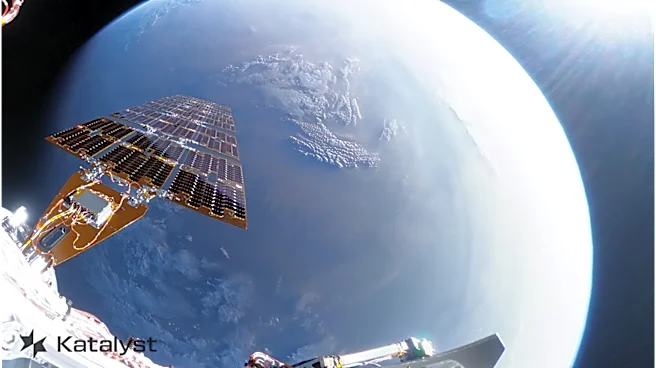
The company developed the robotic spacecraft LINK, which launched in July.

Katalyst is one of several commercial space companies and startups that are growing in a changing industry. Arizona, a hub for space sciences, is looking to cement its position in the new space economy alongside standard bearers like Texas and Florida. Gov. Katie Hobbs in 2025 created a new Arizona Space Commission.
Erika Hamden, a professor of astrophysics at the University of Arizona, said there has been a recent "explosion of activity" in the nation's space industry. After the retirement of NASA's fleet of space shuttles, Hamden said there's been an influx of commercial space operations.
Hamden said the once-expensive cost of launches has come down as more providers have entered the market, in some cases boosted by investment from NASA.
"We are seeing the fruits of that investment because now, it's much cheaper to get things into space," Hamden said. "There's way more launches, launching from more locations. And then as a result, there's been this proliferation of smaller companies doing a bunch of different parts of the space life cycle."
Mission produced data for future space missions
NASA partnered with Katalyst, a private company, for the high-profile rescue mission.
The mission encountered issues, as LINK went into an unexpected spin and lost some functionality as a result. Katalyst was able to address the problem, but the fix expended fuel at a higher rate and LINK was left without enough fuel to reach and boost Swift’s orbit as planned.
The $500 million telescope is now roughly 200 miles above Earth’s surface. If it drops another 15 miles, roughly the distance between Mesa and downtown Phoenix, the National Aeronautics and Space Administration said the observatory will start losing functionality before it eventually reenters the atmosphere. That's expected to happen by the end of the year.
Katalyst Space Technologies was founded in 2020 and set up a Flagstaff office in 2021. The company received early support from the city as a former member and grant recipient of its Moonshot program for startups.
The company has grown since then, acquiring in 2025 a Colorado space company and its facilities in Broomfield, where LINK was developed.
Katalyst has already secured additional federal contracts for NEXUS, a multipurpose robotic spacecraft. Founder Ghonhee Lee said the company’s work will build on flight data collected during LINK’s nearly three months in space.
“Every mission after LINK will start from a stronger foundation,” Lee said in a statement. “We have the flight data, operational experience, and the team that has solved difficult problems on orbit in real time. We will carry those lessons forward to strengthen and expand the capabilities we bring to the next mission.”
Arizona seeks a larger role in space exploration
Hamden said the University of Arizona became a top school for space science based on geographic advantages. The mountains around Tucson, dark skies and dry climate were all a boon for celestial observations through telescopes.
The expertise developed at the ground-based instruments translated well into space science, Hamden said. Now, as more commercial space companies thrive, they are looking to Arizona.
"The state is becoming a location for companies because of the high quality of life," Hamden, who sits on the state space commission, said. "We have a really educated workforce. Some of them are startups that started in the state, and some of them move here."
But Arizona might fly under the radar, Hamden said. The space commission is working within a limited state budget and available incentives to boost the state's space economy, but she said there are several opportunities including a proposed spaceport in Yuma and reentry site in Sierra Vista. The state is also vying to be the site of a proposed NASA space academy.
"I think that in general, people don't know how much of their life is dependent on space and that connectivity," Hamden said. "Even things as basic as, like, the satellites in orbit that do atmospheric monitoring are the reason that we have good weather forecasts. And it's linked in so many different aspects of people's lives."
Alaina Mencinger covers tech, energy and utilities for the Arizona Republic. Reach her at Alaina.Mencinger@usatodayco.com.
This article originally appeared on Arizona Republic: A mission to save a NASA observatory failed. Here’s the silver lining