





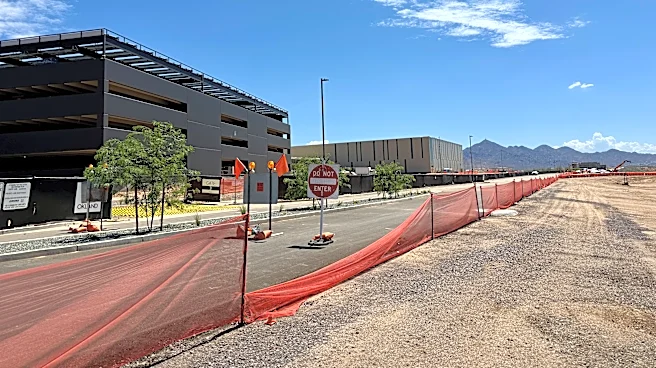
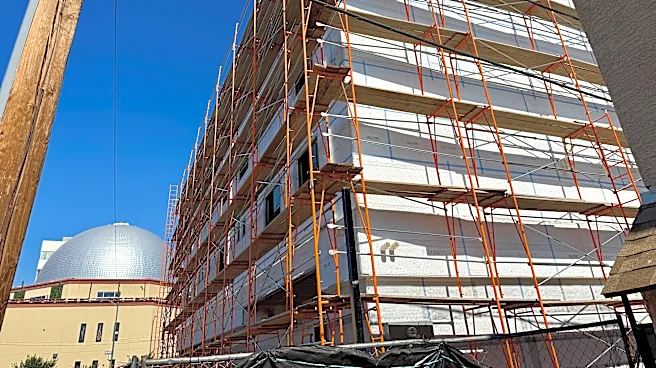

A string of litigation over apartments has tied up Axon's plans to build a $1.3 billion corporate campus in north Scottsdale.
Taxpayers Against Awful Apartment Zoning Exemptions, the local group behind the complaints, recently approached the Taser-maker with a proposal: agree to a deed restriction capping the number of residential units and the lawsuits go away.
Axon, though, has rejected that offer, arguing that its recent deal with the city already limits the size and scope of the project’s housing component.
While the rejection means TAAAZE's cases will proceed, it's also given the group further political ammo to question Axon's commitment to the city.
One of the lawsuits is under appeal after a lower-court judge ruled against the group, while
another moves through Maricopa County Superior Court.
Here’s the latest on Axon's embattled project:
Where do TAAAZE’s lawsuits stem from?
TAAAZE has two lawsuits.
One is against the state and stems from a controversial state law that protected Axon’s project.
Under Senate Bill 1543, often referred to as the “Axon Law,” developers can build apartments and hotels on land zoned for light industrial so long as such projects are tied to a company’s international headquarters in midsized cities.
When lawmakers passed the measure last year, it effectively nullified TAAAZE's referendum challenging the apartment plans. The group collected enough signatures to get the referendum on this November's ballot so voters could settle the matter.
Afterward, TAAAZE challenged the state over the legislation, alleging that it restricted voters’ rights and was unconstitutional in Arizona because it gave Axon special treatment.
While that case proceeded in Superior Court, Scottsdale leaders and Axon inked a new deal last fall.
Under the agreement, Axon will build an even mix of 1,200 apartments and condos, down from the 1,900 multifamily units the council initially OK’d in late 2024.
In response, TAAAZE filed a separate complaint against the city earlier this year, claiming that Scottsdale didn’t follow proper meeting procedures when the agreement was considered and approved.
Both of TAAAZE’s cases fell to Maricopa County Superior Court Judge Michael Herrod.
Why is Axon’s development on hold?
Axon can’t apply for building permits until the Arizona Court of Appeals rules on whether the Axon Law is constitutional.
Herrod issued that order on July 17 — roughly two months after he ruled against TAAAZE by upholding the law. He found that the measure was not a “special” one that solely benefits Axon.
“Its provisions are not limited solely to the City of Scottsdale and Axon,” he stated in his May 12 ruling.
He agreed, though, to freeze Axon’s plans for a month while TAAAZE pursued an appeal.
Presiding over TAAAZE’s case against Scottsdale last month, Herrod extended that order, which came at the request of both sides of the courtroom.
The city asked for the stay to continue because it didn’t want to be put in an “untenable decision” over Axon’s permit applications. If the appeals court determines the law is unconstitutional, the city argued, then the new deal between Scottsdale and Axon is "irrelevant."
Maintaining the pause would preserve both judicial and taxpayer resources, the city stated.
In court filings, Axon objected to the city's and the group's request, arguing that Herrod’s earlier ruling — that the law is constitutional — should be enforced.
“In Arizona, laws passed by the Legislature are presumed constitutional,” the company stated. “Thus, SB 1543 was presumed constitutional when it passed, which this Court validated in the State case.”
What's the latest in TAAAZE's appeal?
Similar to Axon’s project, TAAAZE’s appeal in the state case is also in limbo.
According to recent filings, the appeals court is waiting on the lower court to submit a signed copy of Herrod’s ruling before proceeding with its review of the case.
What did TAAAZE propose?
In March, TAAAZE proposed a settlement.
It asked Axon to sign a deed restriction stating that the company will only build 600 apartments and 600 condos.
Axon has balked at the demand, arguing that its negotiations with the City Council last fall were done in “good faith,” leading to the latest agreement, or Memorandum of Understanding, which restricted the development to 1,200 units.
“That was Axon’s compromise, which is significant,” it said in a court filing, adding that “there’s nothing else that’s necessary.”
TAAAZE has noted that a deed restriction is more enforceable and legally binding, whereas an MOU is more of a statement of intent.
The group's request came as its political allies and other Scottsdale residents have expressed doubt that Axon will keep its stated promise under the MOU.
Campaigning in the July 21 primary election, incumbent Councilmember Barry Graham and Bob Littlefield, who founded TAAAZE, claimed the company wants to build far more apartments than what it had agreed to. They did not cite a source.
They’ve also pointed to the campaign spending of a new political action committee with close business and financial ties to Axon to accuse the company of trying to buy the election and install “rubber-stamp” loyalists.
The Better Together PAC spent more than $250,000 to support incumbent Councilmember Solange Whitehead and to oppose Graham, Littlefield and former state lawmaker Michelle Ugenti-Rita.
Whitehead, the top vote-getter, won her seat outright and was reelected for a third consecutive term. The latter three will compete against Raoul Zubia for the two remaining council seats this fall.
Like this story? Get more East Valley news straight into your email inbox by signing up for our free weekly East Valley Newsletter, which comes out Wednesdays.
Shawn Raymundo covers Phoenix and Scottsdale. Reach him at sraymundo@gannett.com or follow him on X @ShawnzyTsunami.
This article originally appeared on Arizona Republic: Why legal battles are tying up Axon's HQ development