



State prosecutors are reviewing claims that a group with close business and financial ties to Taser-maker Axon failed to properly disclose its major donors on political signs and ads campaigning against Scottsdale council candidates this summer.
After determining this month that the Better Together Political Action Committee likely broke state campaign finance rules, the Arizona Secretary of State’s Office referred the case to the Attorney General’s Office.
Largely at issue is whether the size of contribution disclosures displayed on Better Together’s physical signs meet state requirements.
Richie Taylor, the Attorney General’s Office spokesperson, confirmed on Oct. 14 that it’s reviewing the matter, but has not yet determined whether any wrongdoing
occurred.
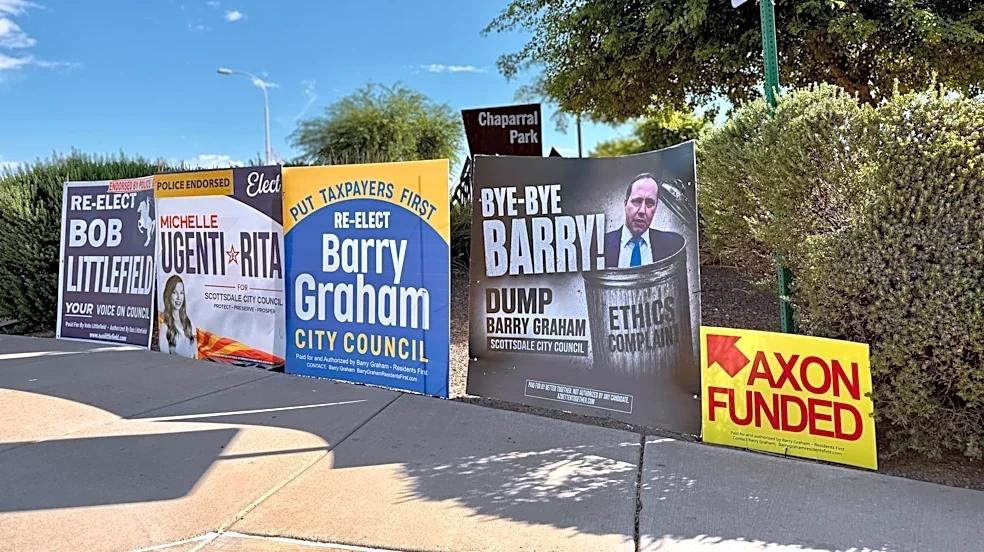
The dispute stems from a citizen complaint against Better Together, which spent $335,000 to defeat incumbent Councilmember Barry Graham, former state lawmaker Michelle Ugenti-Rita and former Councilmember Bob Littlefield in Scottsdale’s July 21 council primary election.

In its ads, Better Together highlighted some political scandals, namely ethics complaints, surrounding Graham and Ugenti-Rita, and questioned Littlefield's voting record on police funding and taxes.
This election season, the candidates ran on a joint conservative platform against overdevelopment, often railing against the 1,200-unit apartment and condo community that Axon plans to build alongside its new corporate campus near Loop 101 and Hayden Road.
Pointing to Better Together’s leaders who have been closely associated with the company, the slate of candidates accused executives of trying to sway, or “buy," the local election to install loyalists on the council.
David Leibowitz, the treasurer and spokesperson for Better Together, has maintained that Axon was not directly involved in the council race.

Campaign finance reports haven’t directly linked Better Together’s war chest to Axon. However, they did show that the executives’ money was part of a pattern of payments that flowed between political action committees.
Alex Logvin, a Tempe resident who runs a website that tracks political spending and dark money contributions, filed the 34-page complaint with the Secretary of State’s Campaign Finance Division on July 5.
He alleged that Better Together’s roadside signs and digital advertisements attacking the candidates violated Arizona’s rules that regulate how political action committees disclose contributions on campaign materials.
On advertisements, a group is required to name the political action committees that made the largest aggregate contributions exceeding $20,000, to state the percentage of funds it received from out-of-state donors, and to make electronic disclosures readable. The height of a disclosure display must also be at least 10% of a physical sign’s vertical height.
Better Together’s funding all came from National Horizon Inc., a Virginia-based super PAC that made three separate contributions totaling $335,000 in June.
Logvin claimed that the group should have made those details clear on its signs and ads.
The disclaimers on the signs, he noted, only stated: “Paid for by Better Together. Not Authorized by any Candidate.” They were also only half an inch in height when they should have been nearly 5 inches, he alleged.
Thomas Basile, an attorney representing Better Together, downplayed the accusations in a letter responding to the complaint.
He noted that the disclaimers were readable while the size discrepancy was negligible. He also argued that the group followed rules set by Arizona’s Citizens Clean Elections Commission, which has jurisdiction over the matter, not the Secretary of State.
“If there were any dispute concerning whether Better Together complied with these specifications, the Secretary has no jurisdiction to resolve it,” Basile wrote.
The Clean Elections Commission is a nonpartisan group that handles campaign finance enforcement. Executive Director Tom Collins declined to comment on Basile’s argument, noting that he's unaware of the overall case.
In an Oct. 7 letter to the Attorney General’s Office, Secretary of State Chief Legal Officer Luke Douglas stated, "There is a reasonable likelihood that a violation of Arizona law occurred and that the complaint comes down to a factual dispute over the actual size of the disclosures printed on the signs.”
Leibowitz was not immediately available to comment on the case’s referral to the Attorney General’s Office.
With the Scottsdale council race continuing this fall, Better Together has remained quiet. Since the summer primary, it hasn’t been actively campaigning or posting anything new on its Facebook account.
Leibowitz, however, declined to state why.
Only incumbent Councilmember Solange Whitehead won a seat outright in July.
Ugenti-Rita and Graham finished second and third, respectively, allowing them to compete against fifth-place finisher and self-described political moderate Raoul Zubia for the final two spots in the city’s runoff election on Nov. 3.
Littlefield, who finished fourth and qualified for the rematch, bowed out of the race to give his allies a better chance of gathering votes.
Like this story? Get more East Valley news straight into your email inbox by signing up for our free weekly East Valley Newsletter, which comes out Wednesdays.
Shawn Raymundo covers Scottsdale and Maricopa County. Reach him at sraymundo@gannett.com or follow him on X @ShawnzyTsunami.
This article originally appeared on Arizona Republic: Why AG is probing finances of Scottsdale PAC | Exclusive