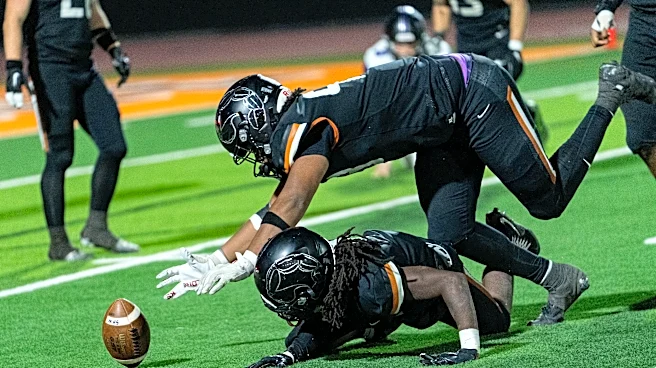




A huge influx of high school football transfers each year keeps bringing back the debate over whether Arizona is doing enough to limit the number of players who switch schools from year to year.
The Arizona Interscholastic Association transfer bylaws state that, unless a hardship is approved, the athlete has to sit out the first half of the season (five games for football) before becoming eligible for the rest of the season, including the playoffs. A second transfer would require the athlete to sit out a full calendar year to the date of the second transfer.
The rule applies to high school athletes in all AIA sports, both boys and girls, but has become a particular issue in tackle football, where top ''destination'' schools that tend to draw attention
from college recruiters can attract top players. Students are easily able to transfer between public school districts because of Arizona's open enrollment law.
At Scottsdale Saguaro, a prolonged search for a head football coach this past year resulted in 35 football players leaving amid the uncertainty. Eighteen of those eventually had transfers fast-tracked to other schools, nine within the Scottsdale Unified School District and nine others to other districts, according to Stephen Cervantez, SUSD athletic director.
A fast track is when the AIA stamps its approval for a player to be immediately eligible if the athlete meets any of six criteria:
- A change of legal custody.
- Alleged student harassment, intimidation or bullying.
- Bullying or harassment from the school's coach or employee.
- A financial change of circumstances.
- A bona fide family move from one part of the state to another.
- Or if there is some other hardship.

The AIA fast-track policy started in 2021, AIA executive director Jim Dean said, as a way to avoid backlogs with hardship appeals just before the season starts.
"It's those that clearly meet the hardship," Dean said. "The receiving school of the student initiates it. They have to submit documentation with components. Then, the sending school has to sign off and agree that it does meet that piece.
"If it doesn't meet the criteria, it goes to the hardship process. That's part of the process that's in our bylaws. I will say it's been used successfully. And it's hundreds and hundreds of student transfers for hardship requests that have been approved by that process."
Dean said there have been more than 100 hardship requests this year from schools and districts across the state. He said all districts and schools are treated equally.
Saguaro transfers left the program depleted to the point where it has opted to consolidate about 35 players left in the program onto varsity and forgo freshman and junior varsity seasons this year.
Cervantez said among Saguaro players who were fast-tracked, "Everybody was treated the same," insisting there was no favoritism afforded the players.
1-time exemption, sitting second half
With so many transfers every year, coaches have opinions on what changes might be needed. Other states offer examples.
The Ohio High School Athletic Association transfer bylaw requires the athlete to sit out the second half of the season, including the playoffs, if the athlete doesn't meet a full-season exception. They're allowed to compete the first half of the season, the opposite of Arizona.
In Texas, the athlete must sit out a full calendar year if it was not a bona fide family move and if it's determined the transfer was motivated by athletics.
"Why penalize a kid and his family for doing what’s best for them?" Tempe coach Sean Freeman asked. "Not every high school is ideal for certain kids and not all coaches are a right fit for that particular player.
"At the end of the day, parents and players should get a one-time free transfer. So know, you have to really do your research and make sure that the school you want to go to is the best fit for you as a person and player."
Glendale Copper Canyon football coach Rodger Schenks said he would support Arizona following the Ohio transfer model that penalizes the athlete in the second half of the season.
"Letting a transfer play the first five games but requiring them to sit the last five region games, including playoffs, would make the penalty meaningful," Schenks said. "Those are the games that have the biggest impact on a team's postseason chances, so it could discourage programs from bringing in players specifically to make a playoff run."
He cited a related issue.
"The bigger issue, though, is enforcement. If some schools are openly recruiting players and nothing happens, then the transfer rule isn't really addressing the root problem. There should be consequences for the school, coaches, or adults doing the recruiting, not just the student who transfers."
Chandler coach Ty Wisdom, who led a Nebraska school, Millard South, to a state championship two seasons ago, believes the transfer rules need to be reformed and simplified.
"I would be in favor of allowing every student-athlete one free transfer during their high school career without an athletic penalty, similar to what some other states, including Nebraska, have done," Wisdom said. "After that first transfer, I think the rule should be very clear: If you choose to transfer again, you sit out for one full year in that sport, unless there is a legitimate hardship or extraordinary circumstance."
He added: "To me, that creates a fair balance. Kids and families get one opportunity to make a change if they feel another school is a better fit, but it also prevents kids from continually moving from school to school strictly for athletic reasons."

The college comparison
Phoenix Brophy Prep coach Jason Jewell said there is no perfect answer. "I just don't want to see high school football turn into what college football has turned into," he said.
The proliferation of the college transfer portal has turned into a money machine couple with NIL and players making major bank from the highest bidder.
"You want to see commitment and loyalty to a program," said Scottsdale Notre Dame Prep football coach George Prelock, who saw his two biggest stars leave for other schools in the offseason. "Unfortunately, this is the reality of the world we live in now.
"We saw it in college. It was only a matter of time before it was going to trickle down to the high school level. The biggest thing is, we can't worry about that," he said. "We're going to possibly be at a disadvantage simply because with our values and everything at Notre Dame, it's a four-year experience. We just don't have our players graduate early. We know that's kind of working against us. But ultimately, we feel we like we offer a lot more. We're trying to develop the mind, body and soul."
Prelock sees this as an ever-changing landscape that is "probably going to get worse before it gets better."
Tucson Salpointe Catholic lost a few key players who transferred to other schools, including into the Phoenix area, since the end of last season.
"It's the world we live in now in high school football, probably all over the country," Salpointe coach Patrick Ryden said. "It's the high school transfer portal now. Kids are transferring and they post it all over the place on social media. I think to an extent it's getting out of control, but I don't think it's going anywhere. It's going to continue to happen."
Richard Obert has been covering high school sports since the 1980s for The Arizona Republic. Catch the best high school sports coverage in the state. Sign up for Azcentral Preps Now. And be sure to subscribe to our daily sports newsletters so you don't miss a thing. To suggest human-interest story ideas and other news, reach Obert at richard.obert@arizonarepublic.com or 602-316-8827. Follow him on X, formerly Twitter:@azc_obert
This article originally appeared on Arizona Republic: Does Arizona need to reform its high school sports transfer rules?