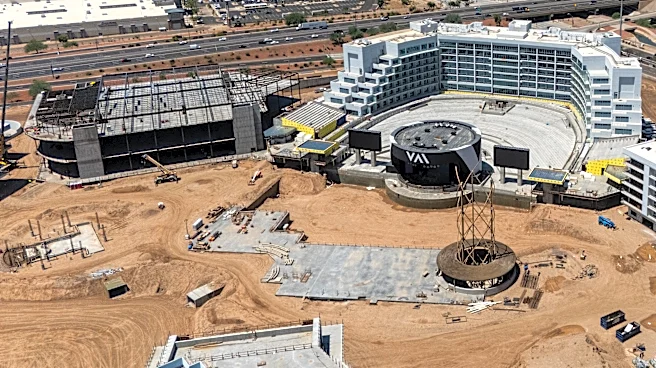






VAI Resort, a $1 billion project under construction in Glendale, is attempting to bring Las Vegas-style hospitality to Arizona.
But five years into construction, some city leaders remain divided over whether the massive project will transform the city or become a costly disappointment.
The project, at Loop 101 and Cardinals Way, is aiming to be the largest hotel development in the state and has been touted as a gamechanger for Arizona’s tourism industry. It's centered around a concert amphitheater, a white sand beach and will include a Mattel-branded amusement park.
Glendale City Manager Patrick Banger said there are about 1,000 vacant acres in the city’s entertainment district that could support the development of more resorts, with VAI as a catalyst.
“Our opportunity is going to be focused on active, entertainment-type resorts clustering there,” he said.
But Lupe Conchas, a Glendale councilmember who has been critical of VAI in the past, said the city will suffer if VAI does not succeed.
“It would be an eyesore,” he said. “It would be bad for our reputation as a business-forward city.”
While Glendale leaders disagree on VAI's prospects, VAI's success will ultimately depend on more than finishing construction. Hospitality experts say the project faces the same challenges every large scale resort will: finding a niche in the market, adapting to adjust to changing trends and getting construction across the finish line.
Here are their takeaways.
Glendale leaders split VAI Resort outlook
Banger said VAI has the chance to put Glendale on the map as a resort destination and hopes it will generate momentum and drive other resort operators to the city’s entertainment district.
“It’s so singular and unique, I think it will be a huge benefit to our community,” he said.
Conchas said the project was presented to the city as a boon for tax revenue, which has yet to pan out. However, he said, it is important to the city that the huge development crosses the finish line.
“This project is too big to fail at this time,” Conchas said. “We really need the doors to open and construction to finish.”
The council does not have much power to enforce any timeline or demand progress, he said.
Conchas’ district does not include VAI, but he said he has heard concerns from constituents that the city is focusing too much of its efforts on the Westgate area.
“We believe it’s a vanity project, essentially,” he said of VAI, adding that most of his constituents will not be able to afford to go there, or if they can, it will only be on rare occasions.
Dianna Guzman, the Glendale councilmember whose district includes VAI, said she has been encouraged by the progress made on the development.
Delays and long construction schedules are to be expected with a project of that magnitude, Guzman said.
She said the resort’s opening will further her goals of bringing jobs to Glendale, so residents do not have to commute out of the city for work.
“I’m excited to have it in Glendale,” she said. “I absolutely look forward to cutting that ribbon. It will be a great asset for Arizona.”
Big resorts take years to build
The first phase of the project covers 67 acres but is expected to expand after the developer bought another 33 acres in late 2025. As the project has grown since its 2021 launch, the timeline for construction has extended. Glendale leaders said they have been told the resort will announce an opening date when they are 12 months away from completion.
Construction timelines of large-scale resorts can vary greatly, resort development experts said. Under ideal conditions, a project of that magnitude would take about two to three years to design and another two to three years for construction, James Horvath, a Las Vegas-based architect who focuses on resort and hospitality development, said.
Large-scale Las Vegas resorts have varied greatly in construction time, Glenn NP Nowak, an associate professor of architecture at the University of Nevada, Las Vegas, said.
The Aria Campus development in Las Vegas, formerly called CityCenter, took about five years to develop, he said. That project is one of the largest resort developments in the world, with multiple hotel towers and two shopping malls.
The most recent resort to open in Las Vegas, the Fontainebleau, took about 16 years to build, but there was no progress at the development for about 12 of those years.
Every attraction is a 'calculated risk'
Horvath said some resorts will wait to design some components until late into the construction period.
“Sometimes the restaurants are not started until the overall project is closer to completion,” Horvath said. “This allows more current trends and concepts to be incorporated rather than opening a resort with an idea from five years prior.”
Nowak said when planning a resort development, developers need to consider competitors’ offerings, the characteristics of the site, industry trends, economic potential and other factors.
“As amazing as The Sphere is, or the Colosseum, or the Eiffel Tower, they are each a calculated risk,” he said. “Not every resort can have every amenity.”
Trends that drive business to a resort also change over time, he said. Las Vegas resorts used to have pools visible from the street as a roadside attraction. Now, to maximize space and developable area, many are on rooftops.
“Developers and their architects don't want to simply meet expectations and do what has done well in the past,” he said. “Resort architects are constantly trying to exceed expectations and outdo their competition in one strategic way or another.”
Megaresorts can't rely on one customer base
Offering amenities that appeal to broad audiences, like VAI is aiming to do with a concert venue and an amusement park focused on children’s brands, is a common strategy for resorts, he said.
“Designing for broad appeal can make a lot of sense, but it is very nice when a resort has unique elements that speak to individuals at a more personal level,” Nowak said.
Horvath said broad appeal is essential for large projects.
“One thing Las Vegas has taught me is that you cannot focus on a single demographic,” he said. “You need to diversify and find a balance between different groups. Though concerts and a Mattel-themed amusement park don’t seem to mix, families and extended families who travel to the resort can find something that works for everyone.”
Being able to react to changing trends can also determine whether a resort remains successful.
“The mix of uses must satisfy the needs of the guests staying within the resort, and if they start to feel the need to go outside the resort, that is the sign to reinvent and renovate,” he said.
Corina Vanek covers development for The Arizona Republic. Reach her at cvanek@arizonarepublic.com. Follow her on X @CorinaVanek.
Like this story? Get more West Valley news straight into your email inbox by signing up for our free weekly West Valley Newsletter, which comes out on Tuesdays.
This article originally appeared on Arizona Republic: Takeaways on the future of Glendale's $1 billion VAI Resort