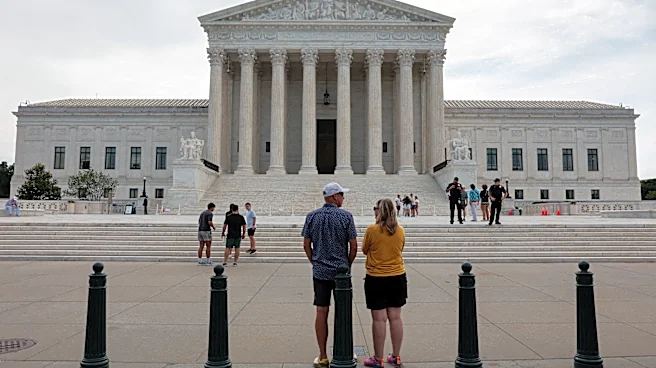

Arizonans can expect even more political campaign ads this year, thanks to a recent decision by the U.S. Supreme Court that massively increases the spending power of some national groups.
The court's June
30 decision struck down limits on how much money political parties can spend in coordination with candidates.
The changes will unleash millions of dollars in Arizona's competitive U.S. House districts, touching off a spending frenzy as party groups benefit from a massive discount that was usually only available to candidates, legal experts and political strategists told The Arizona Republic.
The decision is expected to make it significantly cheaper for parties to buy television ads, a major cost of political campaigns, though that rule is still pending final review.
With three months before Election Day, national and local strategists were still in the process of understanding how exactly they would operationalize the new rules.
The reforms are generally expected to benefit Republicans, who rely more on big donors and have significantly outraised Democrats in the run-up to the 2026 midterms. Their fundraising advantage will likely translate into T.V. ads supporting the GOP nominees in Arizona's two most competitive U.S. House districts, former Arizona Cardinals kicker Jay Feely and incumbent Rep. Juan Ciscomani.
The decision will reshape Arizona's campaign finance landscape in the longer term.
For years, the country's campaign finance landscape has been dominated by "super PACs," the political groups that can accept unlimited contributions but can't coordinate directly with the candidates they are supporting.
The new decision will give political parties a leg up on those groups, helping to swing the pendulum back towards Democrats' and Republicans' official organizations, said Brett Johnson, elections lawyer with the Phoenix-based firm Snell & Wilmer.
"Political parties now have a competitive advantage," Johnson said.
Decision gets rid of stumbling block
In the past, candidates could only spend a small amount of money directly coordinating with national party groups.
The amount ranged from $65,300 to $130,600, depending on the population of the congressional district, according to a report by Johnson and others, a vanishingly small sum in the country's key swing races, which often draw millions or tens of millions of dollars in spending.
To surpass the tight limits, big donors often chose to sidestep the party and give money directly to super PACs.
The June 30 Supreme Court decision will change that calculus.
Unlike super PACs, the country's political parties — including the alphabet-soup organizations such as the Democratic Congressional Campaign Committee (DCCC) or National Republican Campaign Committee (NRCC) — can now reap all the benefits from coordinating with candidates, including the TV advertising discount.
Buying TV ads at the discounted rate will be a "key" part of the DCCC's media strategy for supporting candidates this cycle, said Nebe Betre, deputy communications director with the organization.
Democrats had argued the reform would give large benefactors more influence in politics. The decision will counter-balance the Democratic Party's longtime advantage when it comes to raising money from grassroots donors.
"Republicans have consistently relied on ultra-wealthy donors to prop up their candidates," Betre said in an interview. "This is their attempt to erode House Democrat candidate momentum, more so than anything else, because Democratic candidates have consistently beaten their GOP opponents in grassroots fundraising, and continue to do so."
Democrats had been preparing for either outcome this cycle, Betre said.
Others predicted the decision will make the country's campaign finance system more transparent, since it may siphon money towards political parties and away from "dark money" groups that shield their donors from public view.
Rep. Richard Hudson, R-North Carolina, the NRCC chair, called the decision "a major win for the integrity of our political system."
"The Supreme Court made clear that the federal government has no authority to place arbitrary limits on how political parties support the candidates they nominate," Hudson said in a written statement following the June 30 decision.
President Donald Trump celebrated the changes.
“The Supreme Court just took restrictions off political spending!” the president wrote in a Truth Social post, adding the decision was “A BIG WIN FOR REPUBLICANS and, more importantly, the First Amendment!”
This article originally appeared on Arizona Republic: Why a Supreme Court decision may unleash more campaign ads on Arizona