



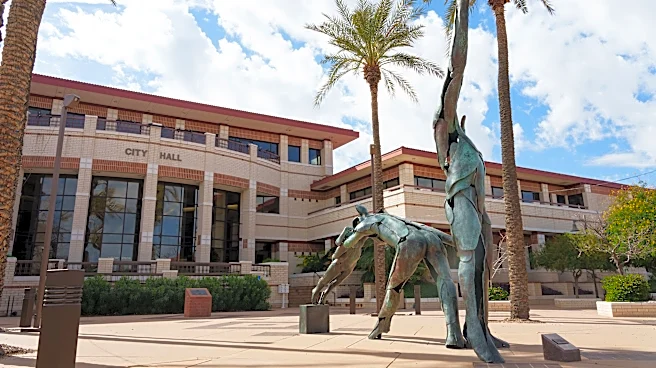

Glendale's city attorney is pushing back against an Arizona Attorney General's Office investigation into councilmember stipends, arguing the state lacks clear authority to review the city's policy absent a lawsuit.
The investigation stems from complaints that Glendale's stipend and vehicle allowance policy effectively increased councilmembers' compensation without voter approval. Most city officials maintain the payments are lawful reimbursements for expenses incurred while serving in office, while Attorney General Kris Mayes' office is examining whether public funds were used appropriately and whether the city complied with state law.
City Attorney Michael Bailey said in an Aug. 20 letter obtained by The Arizona Republic that a senior official
in Mayes' office acknowledged the office had no clear statutory authority.
But Bailey said Glendale still "welcomes the opportunity" to address year-old allegations that the city violated the law through a policy that could bump councilmembers' pay by nearly $16,000 a year.
Bailey's understanding of what the attorney general's representative said was inaccurate, according to Richie Taylor, a spokesperson for Mayes' office.
The office has the authority to investigate the claim under state law, Taylor said. But the procedures for doing so were not as clear as those for an open meeting law violation, he said. Mayes' office is also investigating Glendale for an alleged breach of that law.
"At the end of the day, it's the attorney general's job to make sure public monies are being spent properly and that's what the office is trying to do here," Taylor said.
In May, the Attorney General's Office notified the city of its investigation, following complaints it received in August 2025 and January.
Assistant Attorney General Alexa Salas called on Glendale to address the allegations and provide information and records related to the policy and its adoption.
In his Aug. 20 response, Bailey defended the policy and said it was authorized under the city's local laws and complied with state law. The payments served a public purpose, were not considered an increase in compensation and the policy's legality was appropriately discussed during a City Council executive session back in 2022.
The policy's implementation reduces the administrative burden of processing expenses and gives the city more control over budgeting, according to Bailey's letter.
A Glendale spokesperson did not respond to questions at the time of publication. Taylor, the Attorney General's spokesperson, declined to comment further because of the ongoing investigation.

Why is there pushback on Glendale's policy?
Former City Manager Kevin Phelps authorized the extra payments through a city administrative policy in spring 2022. Phelps had the authority to do so under the city's local laws, according to Bailey.
Based on the policy, the $900 stipends were meant to cover council-related expenses, including a home office, internet connections, meals and mileage for meetings and events.
Councilmembers can choose to receive either the car allowance or stipend, or both. If the councilmember wants the stipend, they cannot also receive the city's roughly $100-a-month cell phone allowance. The payments were part of the councilmember's paycheck and were included in their taxable income, according to the policy.
That May, the City Council met in an executive session to get legal advice from the city attorney regarding the policy. Arizona law allows city councils to have closed-door meetings to receive legal advice.
But there's been some pushback. Councilmember Bart Turner, who does not take the stipend or allowance, has said he believes the policy was implemented to bypass a 2019 ballot measure that would have raised councilmembers' salaries by roughly $20,000.
Councilmember Lupe Conchas, who was elected in 2024 and opted out of the payments in June 2025, has also questioned the policy. He has argued his peers expelled him in retaliation for speaking out against the policy, a claim his colleagues have denied. He has since been reinstated, a decision Glendale was appealing.
Glendale’s local laws set Mayor Jerry Weier’s annual salary at $48,000, while the rest of the council members each earn $34,000. Had the 2019 measure passed, Weier's salary would have risen to $68,490 annually and councilmembers to $52,685.
Phelps has previously rejected the argument that the policy was instituted in response to the failed measure.
That didn't matter. In complaints to the Attorney General's Office, someone raised several issues with the policy and called on the office to hold Glendale accountable. The author's name was redacted in the letters.
What's Glendale's explanation for the policy?
Bailey said he had no record of how the payment amounts were determined but said they were intended to be a reasonable amount for councilmembers.
The amounts are also near what other cities offer their elected officials. Tempe elected leaders receive a $1,000 monthly stipend, Peoria's receive a $400 monthly auto stipend and Phoenix's receive a $600 monthly auto stipend, Bailey said.
The gift clause was raised as a possible issue for Glendale and the policy, which prevents Arizona governments from engaging in transactions that don't provide a public benefit. Bailey said no successful challenge could be made.
The payments serve the public, he said, arguing that anything a councilmember does outside of attending Council meetings goes above and beyond their obligations. The policy "avoids penalizing Councilmembers who incur expenses doing work above and beyond job requirements," Bailey said.
The Attorney General's Office asked how Glendale conducts oversight. Bailey said several measures were in place, though it's still unclear how exactly the city could monitor whether the funds were being used for council-related expenses.
Bailey said some of the oversight measures included rejecting reimbursement requests already covered by the stipend or allowance, exercising discretion over written requests to exceed stipend amounts, audits and the ability to revise or revoke the policy.
Glendale also had to answer whether the payments counted as increased compensation during a councilmember's term, which is prohibited under the state's constitution.
But "compensation" referred to salary, which does not include "per diem" rates, Bailey argued.
The city's response to the Attorney General's Office was not a recitation of all the reasons Glendale has committed no violations, adding that the city had the right to provide additional information.
Bailey also requested a meeting between Glendale and the Attorney General's Office to go over its response before the office completes its investigation.
Elena Santa Cruz covers the West Valley cities of Glendale, Surprise and Peoria. Reach her at elena.santacruz@arizonarepublic.com or follow her on X @ecsantacruz3.
Like this story? Get more West Valley news straight into your email inbox by signing up for our free weekly West Valley Newsletter, which comes out on Tuesdays.
This article originally appeared on Arizona Republic: Glendale disputes attorney general's authority in stipend probe