



Arizona is investing nearly $8.5 million on a study of a seawater desalination project in Mexico, the second such Gulf of California proposal that the state’s water augmentation authority has agreed to investigate this year.
The state Water Infrastructure Finance Authority board approved funds for the feasibility study at an Oct. 5 special meeting. The board also approved $5.7 million for study of option to purify water for reuse in Mexico, potentially to include treatment of water for use in Tijuana, Mexicali and San Luis Rio Colorado.
All of the projects would lead to Arizona helping produce water for Mexico in exchange for some of that country’s Colorado River water, though the desalination plant may also include an option to pipe water north.
The substantial costs for actually producing water are unknown, which board members say is one reason to conduct the studies.
Water Infrastructure Finance Authority is looking for multiple ways of importing water to make up for Colorado River shortages that are hitting this year and could worsen in future years. Other projects under study include groundwater storage and wastewater recycling projects in California.
“This is not about finding one silver bullet project,” authority Executive Director Chelsea McGuire said.
Who is proposing the desalination plants?
The desalination and recycling projects the board advanced on Oct. 5 are proposed by an international coalition of companies called the Acciona-Fengate Water Augmentation Alliance.
The coalition also proposed to study Pacific Coast desalination options in California and Baja California, as well as options to pay for voluntary farm fallowing or irrigation efficiency in Southern California, but the board asked its staff to refine the scope of those projects before a possible vote on them later this fall.
The desalination project to be studied could lead to a plant near the resort town of Puerto Peñasco or to the northwest at Playa Arenosa, according to the Acciona-Fengate Water Augmentation Alliance. It could take at least 12 years to develop if it goes forward, and could produce 500,000 acre-feet of water a year. The water reuse project could take less than half that time and would produce around 50,000 acre-feet a year. An acre-foot contains some 326,000 gallons and is enough to support about three households for a year.
Besides determining potential costs and water buyers for any of these projects, this phase of studies is meant to determine whether affected residents, local governments, tribes and others in Mexico and California will accept them. Board member Ted Cooke said it is part of Water Infrastructure Finance Authority’s job to communicate why these projects could be a win-win across state and national boundaries.
Some water users or other entities in the project areas have questions, McGuire said, but none have rejected further discussions. All of the states using the Colorado River face struggles and need new tools, she said.
“Those are issues that we can’t any longer consider solvable by any one entity,” she said. “We have to look at this regionally.”
How projects could augment Arizona's water supplies
Water Infrastructure Finance Authority previously approved about $12 million for studies to advance two proposed water developments in California that could bring new water into Arizona. The prospective plans would trade investments in Southern California groundwater storage and water recycling for some of the water that California takes out of Lake Mead.
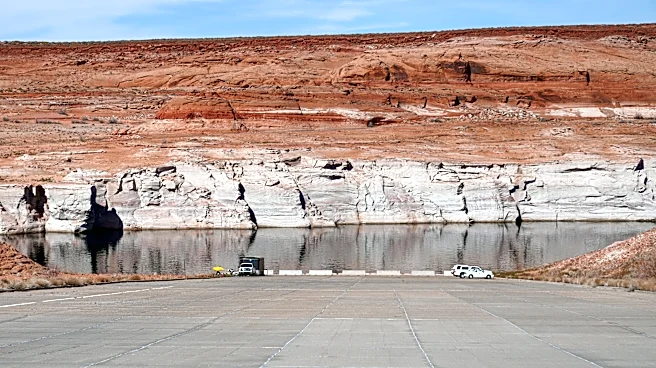
Arizona is bracing for cuts of at least 760,000 acre-feet a year from its 2.8 million-acre-foot Colorado River allocation. That level of reduction reflects the widely reported likelihood that the U.S. Department of the Interior will soon formally accept an offer from Arizona, California and Nevada to collectively reduce their use by 1.25 million acre-feet a year for the next two years.
In August, the board directed $7 million toward studies EPCOR is conducting on two proposed investments in California that the Canadian company says could yield 200,000 acre-feet for Arizona. One of those projects would help build an underground storage basin in Southern California for holding California State Water Project deliveries in years when an excess is available in that system. The other would clean Tijuana River sewage for reuse, returning purified wastewater to Mexico instead of spilling to the ocean as currently happens near San Diego.
Arizona would fund these upgrades in trade for part of California’s or Mexico’s Colorado River allocations.
Then in September, Water Infrastructure Finance Authority directed $4.9 million to another study by EPCOR, in partnership with the Spanish construction firm Sacyr, to look at a seawater desalination plant on the northwest side of the Gulf of California, in Mexico. It could eventually produce up to 500,000 acre-feet of water per year, again leading to a trade part of Mexico’s Colorado River share.
State lawmakers have given Water Infrastructure Finance Authority some $386 million to pursue long-term water projects. Building any of them is likely to cost much more.
Brandon Loomis covers environmental and climate issues for The Arizona Republic and azcentral.com. Reach him at brandon.loomis@arizonarepublic.com.
Environmental coverage on azcentral.com and in The Arizona Republic is supported by a grant from the Nina Mason Pulliam Charitable Trust.
Follow The Republic environmental reporting team at environment.azcentral.com and @azcenvironment on Facebook and Instagram.
This article originally appeared on Arizona Republic: Arizona to study water desalination, reuse projects in Mexico