



It’s a part of the ballot that stumps many a voter in Maricopa County.
They are confronted with a sea of largely unrecognizable names with no party affiliation to suggest their political leanings — not that those leanings should be apparent for the judicial branch.
Alongside the candidates for governor and secretary of state are dozens of judges up for retention.
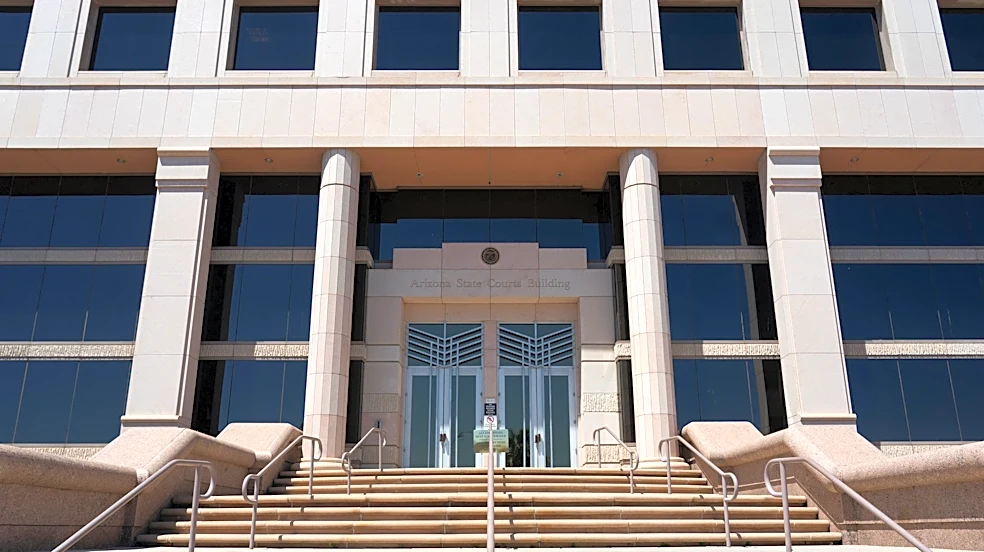
That list on the 2026 ballot in Maricopa County includes one Arizona Supreme Court justice, eight judges on the Arizona Court of Appeals and 48 superior court judges.
The extensive list presents a potential quandary for voters: Research and vote on every judge, vote "yes" or "no" on all — or leave them blank. Whatever way, you can still wear the "I voted" sticker.
There’s no requirement
to vote on every ballot item, and your votes in other races will get counted regardless. Still, a cadre of retired judges urged voters to educate themselves and fill out their ballot in its entirety in a recent Arizona Republic opinion column.
“Informed voters and a fair, independent judiciary are essential to Arizona's future,” the column concluded.
The Arizona Commission on Judicial Performance Review's website is a good starting point for learning more about the judges up for retention and their respective performance reports that determine whether they've met the standards expected of a judge.
The commission found every judge up for retention in 2026 met judicial standards.
But why do some Arizona voters, and those in Maricopa County especially, face a laundry list of judges who are up for retention?
It has something to do with the way judges are elected — and when they aren’t.
Superior court judges are appointed or elected based on county
Back in 1974, Arizona voters passed a constitutional amendment to implement a judicial merit selection system for superior court judges in counties with a population over 250,000.
Under that system, a public, nonpartisan committee for each county’s superior court and one for the appellate courts screens judicial candidates and selects a minimum of three candidates it finds suitable to fill a vacancy — with the governor at the time ultimately choosing whom to appoint.
Maricopa, Pima, Pinal and Coconino counties select trial judges under the merit system as of 2026. Although Coconino County’s population is under 250,000, counties can opt in to the merit system through an initiative process.
All appointed judges face retention elections after two years on the bench. After that, Court of Appeals judges and Supreme Court justices face retention elections every six years. Trial court judges go to the voters every four years.
Trial judges in the remaining counties are elected through partisan primaries and non-partisan general elections.
The Arizona Commission on Judicial Performance Review evaluates every judge and justice who is up for retention and makes a determination about whether a judge has met the professional standard. Legal knowledge, communication skills and judicial temperament are some of the factors the commission considers.
The commission will identify judges that did or did not meet the standards on its website as well as mailed voter guides, though voters ultimately decide whether a judge will remain on the bench.
Merit system looks for good judges — not good campaigners
Part of the reasoning behind having a governor appoint a judge from a list curated by a nonpartisan commission is that judges don’t have the same role as politicians.
“Judges are meant to make their decisions based only on the law and not on politics,” said Ann Ching, a law professor at Arizona State University. “Not on personal ideologies, not on thinking about whether a decision is going to help them get re-elected in the future or anything like that.”
The merit system also opens the door for legal professionals who might be well qualified to be a judge but are deterred by the thought of campaigning and running for election.
“In order to attract attention or perhaps to get voters on your side, you need to make yourself known,” Ching said. “You might need to say things about your position or ideologies on things like, let’s say, criminal law — something many people can relate to — but not every judge even ends up on the criminal law bench.”
Keith Swisher, a University of Arizona law professor, noted that the strengths of winning an election don’t necessarily translate to skilled adjudication.
“Networking, raising money, knowing the right people — none of that makes you a necessarily a fair and impartial judge,” Swisher said.
While being friendly or personable can be an asset in the courtroom, they aren’t the only important qualities for someone seeking the bench.
“What we want in a judge is someone who’s thoughtful, who knows the law, who listens to both sides and their arguments and then rules according to the law and the facts,” Swisher said.
That said, Swisher acknowledged that the merit system wasn’t immune to politics.
“Do politics play a role in who’s getting put on the appointments commission and who the governor decides to pick? Yes, of course. But is it less than what it would be in just a pure partisan election environment? Yes.”
Voters have an opportunity to shape Arizona's judiciary
While impartiality and legal acumen are important qualities in a judge, other qualities exist that are just as important even if they’re less obvious, Ching said.
“People might not realize that judges have to be really effective managers,” Ching said. “They have to be able to manage their staff but also to manage themselves and their caseload. One of the things that can make people most dissatisfied with the justice system is when things take too long.”
Ching acknowledged that the sheer number of judges up for retention in Maricopa County could be daunting to the average voter, but recommended people review the Arizona Commission on Judicial Performance Review’s recommendations as well as the survey results from attorneys, court staff and litigants who interacted with that judge in some capacity — especially ones at the appellate level who set legal precedent statewide.
“Because the Court of Appeals and the Arizona Supreme Court have this important lawmaking role, then I think Arizonans should realize that you can be affected by those decisions even if you never appear in those courts.”
Reach the reporter Perry Vandell at perry.vandell@arizonarepublic.com or 480-341-9433.
This article originally appeared on Arizona Republic: Why so many Arizona judges are on the ballot and how to research them