






SELIGMAN — Eighteen pet carriers lay on the floor of the cabin, but if it weren’t for the wet-mulch musk, you wouldn’t have known they harbored something special. Nestled deep among the wads of shredded paper and other bric-a-brac, the occupants made not a squeak, concealed to anyone who looked through the carrier’s door.
Inside lay what conservationists call the most endangered mammal in America.
Up to a million wild black-footed ferrets once bounded in the grasslands from Canada to Mexico, between Arizona and Kansas. But disease, habitat loss and food decline devastated their populations until they were presumed to be extinct in the 1970s.
After a rancher’s dog discovered a ferret colony in Wyoming, scientists rallied to save the species nearly
undone by humans’ ravenous expansion.
Captive breeding and ferret reintroduction programs in 30 locations nationwide have helped bring ferret numbers back from the brink. Over 35 years, the number of ferrets in the wild is estimated to be about 300.
“We're slowly building up our population again, so fingers crossed,” said Jennifer Cordova, a field coordinator at Arizona Game and Fish Department.
That September evening, 18 individuals were to be added to that tally. They had just flown to Seligman from the National Black-footed Ferret Conservation Center in Colorado. And they carried an outsize duty on their tiny, furry shoulders: to help repopulate the arid grasslands in northern Arizona.
Black-footed ferrets are in trouble
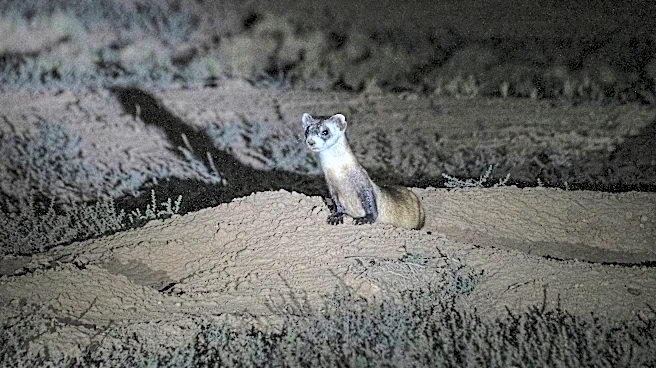
The first thing you would notice about the black-footed ferret is how irresistibly cute they are. Their black feet give them the appearance of wearing stockings, and their domino-mask facial markings do nothing to harden their looks.
But peer into their mouths and you might have second thoughts about petting them. Black-footed ferrets boast the longest canine-to-skull ratio in the animal kingdom, even beating a lion and its fangs. Scientists call these deceptively adorable critters, “little vampires.” Fawn at your peril.
Even the way they hunt is morbid. The black-footed ferret hunts prairie dogs exclusively, which are active during the day. But ferrets are nocturnal creatures, so as night falls, they duck into prairie dog burrows to sneak up on their prey in their sleep.

But the ferret’s dependence on the prairie dog is a vulnerability. The story of the America’s only native ferret is also the story of the prairie dog.
“When prairie dogs do poorly, ferrets do poorly,” said Travis Livieri, the executive director of the nonprofit, Prairie Wildlife Research. He calls the threats to these creatures the three Ps: “people, plague and precipitation.”
Prairie dogs are keystone species in the grasslands they occupy. They nourish all the predators in prairie ecosystems, from raptors to coyotes to rattlesnakes. Their grass-trimming habits leave healthier forbs in their wake, and the burrows they dig become homes to other animals, including burrowing owls and ferrets.
One species is much less appreciative of the presence of prairie dogs: humans. European settlement brought agricultural expansion to the American West. These farmers plowed over prairie dog habitat and viewed the rodents as competition with cattle for forage.
Massive, government-sanctioned poisoning campaigns all but eradicated the prairie dogs, reducing their numbers to 5% of their pre-settlement figures. Though the rate of killing has lessened today, with some states restricting the shooting of prairie dogs, they’re still widely considered pests among ranchers.
Drought adds another squeeze, as it limits the abundance of grasses for prairie dogs to feed on.
But scientists are most concerned about the threat of disease. In the 1900s, the same bacterium behind the bubonic plague among humans made it to U.S. shores and struck wildlife. The microbe behind the sylvatic plague hops from mammal to mammal through fleas, but when it lands on a prairie dog, it can wipe out entire colonies within days.
After the plague arrived in South Dakota in 2005, the acreage occupied by prairie dogs near Badlands National Park shrunk by three quarters within a decade, despite concomitant efforts to rein in the disease.
Like the prairie dogs, black-footed ferrets often perish from the sylvatic plague once they contract it.

In the 2000s, Arizona wildlife seemed to enjoy a respite from the disease. During that time, black-footed ferrets flourished, and their numbers peaked at 123 in 2012. The same year, scientists swabbed a roadkill badger and discovered it was infected with plague.
What followed was a sharp decline in ferret numbers, and they have yet to rebound. This year, surveys only found six individuals in the wild despite years of releases of captive-bred ferrets.
AZGFD’s Cordova has worked on ferret restoration in Seligman for 20 years, and she remembers the heyday of Arizona, with its self-sustaining populations in the wild. Until that reality returns, stabilizing ferret populations is a moral responsibility she can’t shake.
“If humans helped cause their demise, then we have the obligation to help restore them,” she said.
At a time when so many other threatened species are in dire need of human intervention, it’s hard to make an ecological case for throwing limited resources behind the black-footed ferret. And, scientists say, saving the black-footed ferret alone won’t significantly benefit its neighbors on the food web. Focusing efforts on prairie-dog recovery instead might make a bigger ecological impact, given its role as a keystone species.
Yet the black-footed ferret remains the face of conservation of the prairies. For one, it’s less controversial than the rodent it preys on. It also has one unifying superpower: its cuteness.
“Ferrets are what we call a flagship species,” Livieri said. “We're lucky that we have a really cute animal to work with.”
Into the wild the ferrets are released
As twilight neared, teams of staff, interns and volunteers loaded ferret-filled carriers onto pickup trucks and headed toward different corners of Aubrey Valley and the Double O Ranch.
“Ok babies, here we go!” cooed one volunteer into a box.
Cordova and her colleague, project specialist Heather Heimann, planned to release four individuals onto a checkerboard of state and private land southwest of Seligman. Mounds and holes pockmarked the fields on both sides of the dirt road they rumbled along, signs of active prairie dog activity.

Having only known captivity for most of their short lives, the first three ferrets were reluctant to leave their carriers when the door swung open. Heimann had to nudge the hissing creatures out with thick gloves — “the welding gloves work, so that's good,” she reported — and deliver them to the doorstep of a burrow. Then it was more waiting, until the free ferret plucked the courage to slink into its new home.
One male lingered for several minutes outside its carrier, trying to bite anyone who approached. “Sir, I’m going to ask you to vacate the premises,” Heimann told him.
After the ferrets disappeared underground, the researchers set up motion-sensing cameras at the burrow entrance to monitor how they take to their new homes in the next few weeks. In late October, they plan to return with sniffer dogs to survey the population of black-footed ferrets here, which will hopefully include a mix of captive-bred mammals and others born in the wild.
All captive-bred ferrets descend from 18 wild individuals that were taken into custody from Wyoming. Which ferret adult mates with whom is a tightly managed process to maximize genetic diversity from the limited gene pool. Otherwise, genetic defects might start to crop up among the progeny and threaten their survivability.

The Phoenix Zoo is one of six ferret breeding centers in the country. This September, the facility welcomed 34 kits from seven litters, marking the most productive season in its 25-year history of taking up the project.
Conservationists are always on the lookout for ways to bring fresh genetic material into the mix. Ferret cells of the original 18 are stored in a freezer in the San Diego Zoo for this purpose, and they have come in handy.
In 2009, healthy kits were born from the 20-year-old sperm of a ferret long deceased.
More than a decade later, scientists cloned a female ferret named Willa from the founding clutch as a form of genetic resurrection. One of the clones, Antonia, has done what her counterpart has failed to do — produce a surviving lineage of ferrets. Researchers are still checking the health of her offspring before they allow their genes to percolate in the current breeding population.
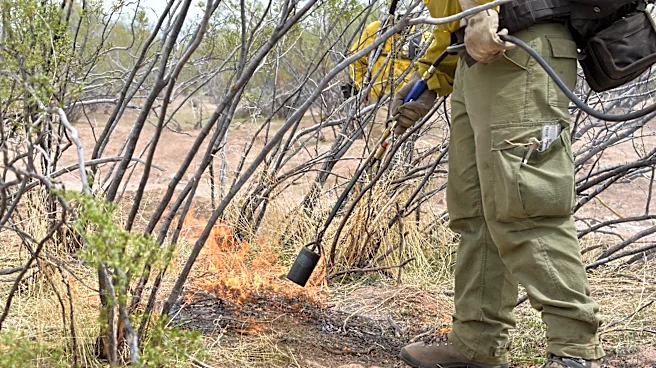
Despite years of low ferret figures in the wild, biologists think that there’s hope for a population recovery, with the advent of new techniques to stave off the plague. Before releasing the ferrets, scientists dust prairie dog burrows with insecticide and scatter food pellets laced with fipronil, the same chemical used in flea control among pets. This kibble is a hit among prairie dogs for their peanut butter flavor.
The released ferrets are also equipped with defenses. During captivity, the animals get their vaccine shots for the plague and canine distemper, which grants them lifelong immunity.
'It's all up to fate now'
By the last ferret’s turn, the night had settled firmly over the prairie, and even the crescent moon had turned in behind the hills.
Unlike the other three kits, ferret four was more curious than nervous. When his carrier door opened, he lifted his head, pointed his nose toward the air, then took a tentative step into his new world. He was the only ferret of the four that descended into a burrow of his own volition, no coaxing needed.
As the night deepened, both land and sky came alive. The sky rioted with stars, at one point flashing with the entrails of a meteor. Animals started tracking across the plain, their eyes glinting in the flashlights Cordova and Heimann swept back and forth. On previous survey nights that lasted until sunrise, the researchers have seen mule deer, bobcats, badgers and foxes prowling in the cover of the dark.

If ferret four’s extraordinary pluck wasn’t already apparent, it was even more so when he refused to stay put. Heimann had barely finished setting up the camera when he emerged from its burrow then bounced across the terrain, exploring a string of other holes then some more of the surface. The only visible sign of it was its green eyeshine, two beacons burning with their own copper fire.
A new yellow eyeshine gleamed back to the scientists. Its bobbing gait and languid pace were unmistakable: a coyote, a common predator of the black-footed ferret. It was headed in the direction of ferret four’s last sighting.
It was a cruel reminder of hierarchy of life, the multitude of dangers to this young ferret on day one. And the coyote isn’t a top threat to the species in this unforgiving world.
Heimann and Cordova lingered to check on the newly liberated ferret for as long as they could.
“Ok buddy, stay down!” Cordova bellowed into the dark. Then, something akin to a prayer — “it’s all up to fate now.”
Shi En Kim covers environmental issues for The Arizona Republic and azcentral. Send tips or questions to shien.kim@arizonarepublic.com.
Environmental coverage on azcentral.com and in The Arizona Republic is supported by a grant from the Nina Mason Pulliam Charitable Trust.
Follow The Republic environmental reporting team at environment.azcentral.com and @azcenvironment on Facebook and Instagram.
This article originally appeared on Arizona Republic: 'All up to fate': Arizona sends 18 black-footed ferrets into the wild