




Arizona voters are grappling with pocketbook issues as Labor Day kicks off a sprint to Election Day.
Water and data centers have become curveballs in Arizona's general-election season this year, especially as the issues intersect with voters' fears about the cost of water, power and economic development.
The Grand Canyon State doesn’t have a U.S. Senate election for the first time since 2014, meaning the political atmosphere leading up to Nov. 3 might feel quieter than usual.
Besides marking the end of summer, Labor Day traditionally kicks off the general-election season and Arizonans can still expect a hectic, monthlong burst of energy heading into the start of early voting Oct. 7, with amped-up media coverage, candidate debates, door-knocking,
and millions of dollars' worth of political advertisements on roadsides, television and online.
“Buckle up,” Democratic consultant Matt Grodsky said.
Election campaigns this year have been dominated by President Donald Trump, whose personality and splashy second-term agenda have topped political headlines for months. After winning a decisive victory on the issue of immigration in 2024, the president’s approval ratings have sunk amid concern over his sweeping tariffs and the war in Iran, which has increased gasoline prices.
Democrats hope that anti-Trump sentiment can help them hold onto Arizona’s top statewide offices, and chip away at Republicans' majority in the state House and Senate, as cost-of-living issues continue to weigh on residents.
Many of the most visible issues — such as gas prices — are national or international in nature, said conservative political consultant Doug Cole, making it hard to blame the state's Democratic leaders.
“That yoke, on those issues, is around the Republicans’ necks,” Cole said.
Republicans, on the other hand, are emphasizing the package of Trump-led federal tax cuts signed into law earlier this year, many of which were adopted at the state level. Some GOP candidates are trying to associate their opponents with Democratic socialist candidates nationwide who have tried to pull the party toward the left.
The GOP has also benefited from a growing voter registration advantage in Arizona. Democrats can’t rely on the party faithful to win elections: Even more than in years past, they’ll have to sway record numbers of the state's independent voters.
“That’s the ballgame, for top-of-the-ticket and down-ballot races,” Grodsky said.
Anxieties simmer over water and data centers
This year, some top issues have scrambled traditional political fault lines.
A newly announced federal plan to cut Arizona's supply of Colorado River water has jolted politicians and the business community, raising questions about the state's long-term economic planning.
Water historically has been a bipartisan issue. It could become more politicized, especially with the looming prospect of a special session of the Arizona Legislature to ratify the Colorado River agreement before a Jan. 2027 deadline. But those politics, too, are not straightforward, with competing priorities in different geographies across the state: agriculture, urban water users, real estate developers, and big industrial water users, to name a few.
Democratic Gov. Katie Hobbs has put out television ads promoting her work on water issues as she's locked in a bitter reelection race against Republican challenger U.S. Rep. Andy Biggs.
Biggs has countered that Hobbs isn't up to the task of water management, calling her "recklessly incompetent" in a July 31 radio interview, and argued government bureaucracy has contributed to the problem.
“People are paying more attention to the climate and natural resources now than they have in my entire life,” said Stacy Pearson, a Democratic consultant.
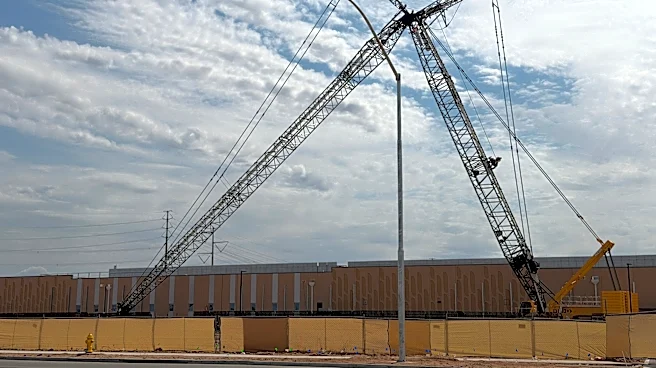
This year has seen explosive concern over data centers, the power-hungry developments that have sprung up across Arizona to feed the country’s growing appetite for artificial intelligence.
In the span of a year, the state and local governments went from giving out data center subsidies to clawing them back amid public outcry. The situation produced unlikely political coalitions.
“You have this meeting of the far progressive left, and the very far, very libertarian right, agreeing on one subject: That data centers can be harmful to neighborhoods and the environment,” Cole said.
“People don’t really know what a data center does, but they know they don’t like it, and that big ugly building isn’t paying taxes,” Pearson said.
Big races will test GOP enthusiasm, key issues
Those themes will come to a head in some of Arizona’s top races.
As Hobbs fends off a challenge from Biggs, Arizona’s other Democratic statewide incumbents — Secretary of State Adrian Fontes and Attorney General Kris Mayes — are going up against Republican rivals Alex Kolodin and Warren Petersen.
Two U.S. House races will help determine control of Congress starting in 2027.
In the Tucson area, incumbent Republican Rep. Juan Ciscomani is fending off a challenge from Democrat JoAnna Mendoza. In northeastern Maricopa County, Republican Jay Feely and Democrat Amish Shah are squaring off for the seat vacated by long-serving Rep. David Schweikert, R-Arizona, who instead unsuccessfully ran for this year's GOP nomination for governor.
Democrats are once again gunning to flip the historically GOP-held Arizona Legislature, though that would require a massive surge of support at a time when the party’s enrollment numbers have dwindled.
Donors' enthusiasm is low across the board, especially on the Democratic side, Grodsky said.
Pearson predicted a reckoning for Republicans, who have controlled the Legislature for decades.
Voters "want to be aspirational" and pick candidates based on a positive vision for the future, Cole said.
"But I'm getting a feeling that this election is not going to be an 'aspiration' election," he said. "I think we're getting a lot of ... 'Who's in power right now is not what I want.'"
This article originally appeared on Arizona Republic: Data centers and water loom over Arizona's Nov. 3 election sprint