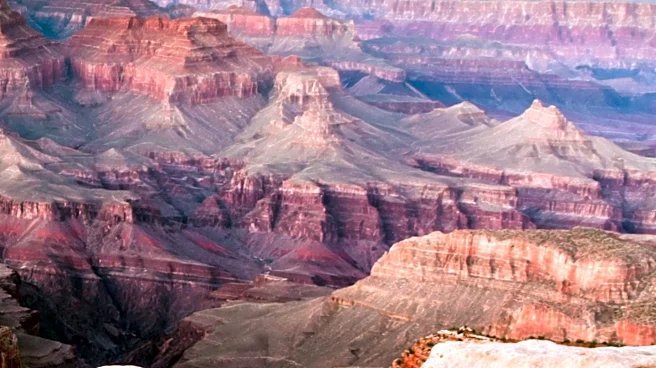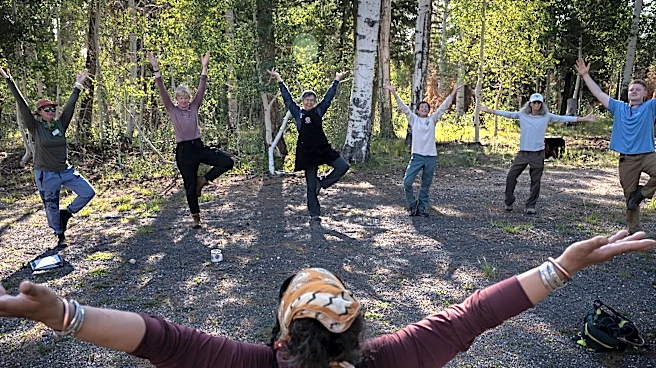






GRAND CANYON — On a bright blue morning in early August, in a gravel parking lot far from the best viewpoints on the Grand Canyon North Rim, a group of people formed a circle for what looked like a mindfulness exercise.
After a poetry reading, the group did yoga. As the instructor, DK Dyson, demonstrated the tree pose, she asked, “What kind of tree are you?”
Someone shouted out the mighty oak. A mango tree, said another. Others chuckled at the predictability of the response of a National Park Service staff member present: “Ponderosa!”
But this wasn’t a wellness retreat. The people in the circle were here for a more somber cause. A year earlier, the Dragon Bravo Fire swept through the ponderosa forests on the North Rim and burned down the iconic
Grand Canyon Lodge.
Now, these volunteers were here to help restore parts of the national park through tree planting, native seed collection and invasive plant removal.
Coming from all over the country, many participants were already frequent and long-time tourists at the Grand Canyon. In the post-fire days, they relished the chance to check on their old haunts and turn grief into action.
This, several of them said, was their time to “give back.”
Volunteering offers a different kind of experience
On July 4 of last year, lightning struck in the Kaibab National Forest and ignited the Dragon Bravo fire. By the time the flames had died down, the fire had ravaged nearly 150,000 acres, wiping out park infrastructure that included water pipelines, a sewage treatment plant and 114 buildings.
Post-fire assessments revealed that the flames burned in mosaic fashion in mostly low-to-moderate severity. Even then, much of the park suffered soil damage, and ponderosa pines were struggling to regenerate. Where these botanical natives failed to establish, invasive plants were moving in.
The Grand Canyon Trust typically organizes two volunteer trips every year to the Grand Canyon to assist the National Park Service in routine maintenance. After the fire, the trust ramped up the number of service projects, recognizing the need for extra hands to stabilize fire-damaged landscapes.
Erosion control was in order in the burn scars upstream of Roaring Springs, the entire park’s only source of drinking water. And miles of dilapidated fencing were endangering migrating wildlife, so they needed to be removed. The August volunteer expedition would be geared toward vegetation restoration in the wake of the burn.
One of the activities was planting year-old ponderosa seedlings on Fuller Canyon down the road from Imperial Point. The Outlet Fire in 2000, Fuller Fire in 2016 and last year’s Dragon Bravo had left the slopes barren of ponderosa. In its stead, fresh aspen had sprung up all around, crowding the spaces where conifers used to thrive before the triple whammy of fires.
Volunteers Jean Brown and Laura Lyn, both from Flagstaff, worked together to plant the first of 4,000 ponderosa seedlings in Fuller Canyon. Weaving between the aspen on the incline with the grace of mountain goats, they scraped away grass and dug a hole for a greenhouse-cultivated ponderosa seedling. Beneath their feet, patches of soil were cinder grey and ashy, clinging to their gloves and boots like the worst kind of glitter.
As Brown and Lyn scaled higher, they were careful not to step on the five-inch-high seedlings that they and other teams planted, towered over by opportunistic grasses and aspen. After each unpotting, the pair ended their routine by sprinkling the ponderosa seedling with healthy soil collected elsewhere to nourish it with symbiotic fungi.
Climb, dig, plant, repeat.
Many of the volunteers had joined similar trips in the past, or felt compelled to volunteer out of their love for the outdoors. Several said they hoped for a different experience in the Grand Canyon, not just to sightsee as typical tourists.
“It's better not as a tourist, because you feel like you're closer to the land,” Lyn said. “And you get to make some really good friends at the same time.”
Some volunteers dropped in from opposite ends of the country. Twin brothers Jim and John West made a road trip out of their visit, arriving from Detroit and Washington, D.C.
“The Grand Canyon has always been my favorite place in the world,” said John, the younger brother from D.C. He’s especially fond of the North Rim for its lack of crowds compared to the south side. Volunteering was another excuse to be in the place that he loves. When the sign-ups came, “I jumped at the opportunity,” he said.
Volunteers have always been a crucial component of environmental stewardship in the national parks. For as long as the National Parks system has been in existence, it has leaned on the public to donate time and effort on tasks such as campground maintenance, fee collection, field science support and assistance in interpretative programs, said Elaine Leslie, a former national park superintendent and an executive council member on The Coalition to Protect America's National Parks.
Now, federal agencies are in greater need of helpers. According to a Pew Research report, federal land management agencies lost 10% of their staff in the West in 2025 due to firings and resignations. In Arizona, the National Park Service shed 15% of its workers. Congress still hasn't allocated disaster relief funding for the long-term recovery and infrastructure rebuilding of the Grand Canyon.
After these cuts, volunteers play an even more crucial role in shoring up the health of parks and other wild spaces on federal land.
“A lot of agencies are underfunded and understaffed. That's been a problem for many, many years, and is much worse now under the Trump administration,” said Lena Bain, the trust’s volunteer manager, who organized the trip. "For a lot of projects that (public land agencies) identify, they let us know that it's not going to get done if we don't bring volunteers to do it.”
"If you're a person who loves your parks and you have some time and some desire to get out there and help," Leslie added, "this is a really good time to do that."
Grand Canyon Lodge holds special memories
After a day’s work, the volunteers stopped by the former Grand Canyon Lodge, the last building at the end of State Route 67 at the edge of the canyon rim. After the fire, all that was left was its stone base. Some of the nearby cabins were intact but singed.
Lyn stood for a long time gazing at the skeleton of the lodge about 60 feet away behind a chain-link fence. She was last here in October 2024 and stayed in one of the cabins. As she retraced her steps toward her old cabin, she marveled at how some structures survived, while others went the way of the lodge — a reminder that wildfire is still a fickle, uncontrollable thing that outdoor enthusiasts in the Grand Canyon need to live with.
As integral as fire is to the health of the West’s forested landscape, still she only felt pangs of regret for the destruction of the lodge.
“It was just a very special place for so many people … you could come here and just find your own sense of spirituality,” Lyn said of the lodge. She remembers the lodge as an international hub where different languages rang. “It was really neat watching other people find the joy in seeing (the Grand Canyon) who had never seen it before.”
In May, the North Rim reopened to tourists and campers. The cabins are still closed, and no amenities are offered in the park.
Volunteer Rebecca Stoneman Washee visited the North Rim with her daughter 10 days before Dragon Bravo hit. On a whim, they splurged on a two-night stay in one of the cabins, nearly balking at the luxury of it compared with the campgrounds a mile away. But she’s now glad for the memories, for being one of the last visitors to experience the lodge while it still stood.
“People were standing out there on the edge, on the sidewalk watching the sunset,” she recalled, tearing up. "You didn't know anybody, but yet you were all bound by that beauty.”
Though the volunteer trip wasn’t exactly a wellness vacation, assisting with park restoration in ways big and small after the fire offered these nature lovers and Grand Canyon fans its own kind of healing.
“It's helping me remember how much I loved it,” Lyn said. “It's so important for people to see places like this and hopefully value them, so that, even if they don't live here, they put their energy into preserving them.”
Shi En Kim covers environmental issues for The Arizona Republic and azcentral. Send tips or questions to shien.kim@arizonarepublic.com.
Environmental coverage on azcentral.com and in The Arizona Republic is supported by a grant from the Nina Mason Pulliam Charitable Trust.
Follow The Republic environmental reporting team at environment.azcentral.com and @azcenvironment on Facebook and Instagram.
This article originally appeared on Arizona Republic: At the Grand Canyon, volunteers plant seedlings in fire-charred forest