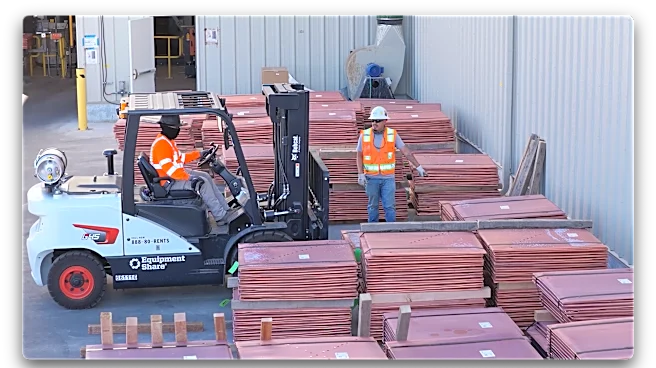

Arizona’s copper industry is gearing up for a new wave of mining as rising demand and prices spur plans for new mines and increased production at existing operations.
Copper has long been prized for its
high conductivity and relatively low cost. As demand grows from various industries, copper is increasingly referred to as a "critical mineral." S&P Global estimates that worldwide demand could increase 50% by 2040, underscored by surging copper prices.
"I think there's a sense of urgency," said Steve Trussell, executive director of the Arizona Rock Products Association and Arizona Mining Association.
Renewable energy, a global move toward electrification, and the tech industry all rely on copper, which could be a boon for Arizona's mining industry. However, increasing costs, limited smelting and refining capacity and falling ore grades pose difficulties for a metal under pressure.
And, some groups are concerned about what a renewed interest in copper could mean for the environment.
Copper, then and now
Copper was a historic economic driver for areas like Bisbee, Globe and Jerome. Arizona has remained one of the country's most productive copper states, producing in 2024 roughly 70% of the nation's supply. The metal earned its spot among the state’s five Cs: copper, cattle, cotton, citrus and climate.
Those five industries have ebbed and flowed over the years. But an electric new era has reinvigorated the copper industry.
In early October, U.S. Environmental Protection Agency Administrator Lee Zeldin traveled to rural Arizona to celebrate the opening of a new copper mine — the first major operation to open in the country since 2008.
Florence Copper is billed as the copper mine of the future, using in situ recovery rather than conventional pit mining. Instead of digging up and processing ore, operators pump a solution underground to suspend, extract and plate copper molecules.

Arizona State Mine Inspector Walter “Les” Presmyk said Florence Copper is among a handful of new mines planned around the state, and is emblematic of a changing technological and economic landscape. Several existing mines are planning to significantly increase their output amid unusually high demand, Presmyk added.
Although domestic production of the metal has slowed over the past decade, from roughly 1.4 million metric tons in 2015 to an estimated 1 million metric tons in 2025, the price recently skyrocketed above $6 per pound. Demand for the metal is already changing Arizona's mining outlook.
“Being able to talk about five brand new large mines coming online in the next few years is unprecedented in my lifetime,” Presmyk, who spent much of his 50-year career in the copper industry, said.
Florence Mayor Keith Eaton said the project has been critical to bring development to the rural town, where the two major employers are the prison system and the county seat. He’s hoping supporting industries will follow, and said the project has already brought a younger workforce to Florence.
“We are not situated on a major railroad. We’re not situated on a major highway interchange. We’re 14 minutes from the I-10, we’re 14 minutes from the 60,” Eaton said. “So we know that, revenue-wise, that we are not going to be a major manufacturer of anything.”
Stuart McDonald, president and CEO of Canada-based Trekor Metals, described the project as a “low-impact, low-cost” alternative to conventional pit mining. The company estimates the project will use almost 80% less water than regular mining practices.
McDonald said in situ recovery has typically been used at “brownfields”, taking a second pass at areas that have been mined before.
The ore body outside Florence is fractured, with the texture of thick gravel. That allows the solution to travel through the gaps and extract the copper molecules completely underground.
The extracted copper is ready to head to manufacturers without additional processing. That means no need to transport copper for costly and energy-intensive smelting, which separates the pure metal from the ore using high heat.
At one point, the majority of the state’s copper was processed using smelting, Presmyk said. But the number of operating smelters in the country has declined over the years, leaving just two, including one in Arizona. That's left some producers reliant on foreign processing.
S&P's 2026 copper survey pointed to smelting and refining gaps as a major risk to the copper industry, along with declining copper concentrations in ore and increasing costs.
Electrowinning, part of the process used at Florence Copper, can bypass some of those concerns.
“Technology is also advancing as well,” McDonald said. “And we’re able to do things at our site in Florence, with in situ mining, that probably weren’t possible 20 or 30 years ago.”
A changing industry
Presmyk remembers when copper was cheap in the early 1980s. While the price of copper skyrocketed earlier this year, it is still competitively priced compared to the precious metals, and more conductive than cheaper aluminum.
“All of a sudden, six dollar or six-and-a-half dollar a pound copper looks pretty cheap compared to, what, $60 or $80 an ounce silver and $5,000 an ounce gold,” Presmyk said.
Copper is an essential material for any industries that rely on electricity, including data centers, solar and wind energy, and computer chip manufacturing.
Most of these uses aren’t new, Presmyk said. But the amount of copper needed to meet demand is “significantly higher."
Higher prices incentivize companies to put more effort into mining and processing materials with lower percentages of copper, Presmyk said.
“Two years ago it was waste – now it’s ore,” Presmyk said.
Environmental, cultural impacts
Roger Featherstone, president and former director of the Arizona Mining Reform Coalition, said high prices and friendly state and federal regulations are the “perfect storm” for an explosion of copper mining claims.
“The pressure is pretty intense right now,” Featherstone said. “These guys are getting while the getting’s good.”
Featherstone, who is worried about water use and contamination at Arizona’s mines, is skeptical that the demand for new copper operations is warranted. He thinks the country should focus on mining, recycling old material and using new technologies to separate copper from mine tailings.
In 2024, more than a third of the United States' copper supply came from recovered scrap.
For Featherstone, it’s a question of the best use of Arizona’s land and water.
The longtime environmental advocate isn’t sure how many mine proposals in the state will come to fruition, due to the boom and bust cycle of the industry, limited domestic smelting capacity and now-marginal copper deposits. But he’s concerned about the damage left behind from mining exploration done to assess viability.
“Realistically, most of these exploration efforts are not likely to succeed,” Featherstone said. “It’s just how much damage they do before they see the writing on the wall.”
Wendsler Nosie Sr., a San Carlos Apache member, is concerned about an influx of new copper mining claims, in particular a controversial proposal to mine the Oak Flat site within the Tonto National Forest. The sacred site was transferred to a British-Australian mining company earlier this year for development of what may become one of the largest copper mines in the country.
Nosie said the San Carlos Apache have long been fighting for access to the site for ceremonies and medicine collection, part of an “ugly history,” he said.
“Since time immemorial, our people had been exercising our religion, and knowing that we were exiled out of these areas for simply the same thing: at that time, silver, and now, copper,” Nosie said.
Apache Stronghold has been challenging the project, claiming it infringes on the tribe’s freedom of religion. In 2025, the U.S. Supreme Court declined to hear the case, although dissenting Justice Neil Gorsuch wrote that he felt the decision was a “grave mistake.” Nosie feels the project and its support from the federal government have opened the door for similar developments.
He also questions whether the benefits from technologies like artificial intelligence are worth the potential costs.
“We’re wanting more and more when there’s already enough,” Nosie said.
Alaina Mencinger covers energy, tech and utilities for The Arizona Republic. Reach her at Alaina.Mencinger@usatodayco.com.
This article originally appeared on Arizona Republic: The artificial intelligence boom needs copper. Arizona has it