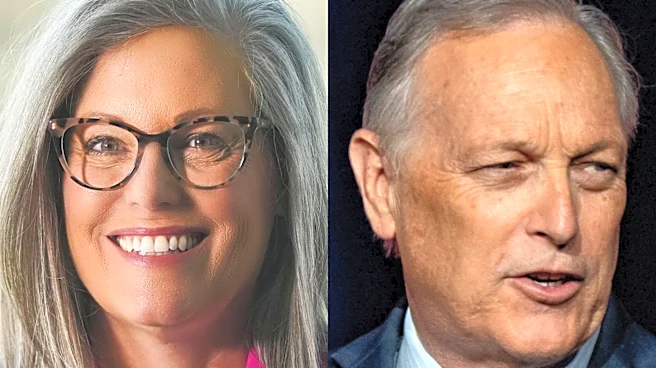



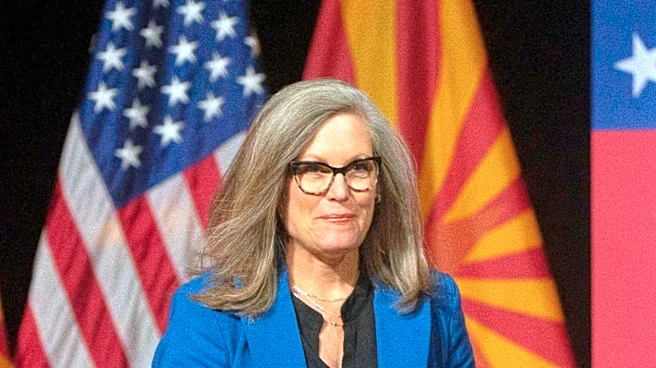
Democratic Gov. Katie Hobbs' decision to not debate her Republican opponents this year and before her first election breaks a tradition that goes back to 1954.
Hobbs' campaign manager, Nicole DeMont, announced on July 30 the governor will decline debate invitations with the Republican nominee, Congressman Andy Biggs, "because face-to-face engagement with Arizonans is more effective than a stage designed for short soundbites and political theater."
Hobbs also skipped a debate with former gubernatorial candidate Kari Lake in 2022.
That decision that caused a stir when top Arizona State University officials decided to grant her an interview on Arizona PBS, a station whose broadcast license is held by the Arizona Board of Regents for ASU. The decision broke
from years of precedent, as well as rules with the Arizona Citizens Clean Election Commission, which co-hosted the debates, that stipulated Lake should get a one-on-one interview if Hobbs ditched the event.
Debates between candidates competing for top positions like governor or U.S. senator has been declining over recent years. A 2022 Brookings Institute study found competitive U.S. Senate races featured significantly fewer debates in 2020 compared to 2010. Several news articles from 2022 document fewer debates that year, including governor races in Arizona, Michigan and Pennsylvania.
Yet the sight of Republican and Democratic candidates for governor on the same stage, trading barbs and policy ideas in a public forum, continued unbroken from 1954 to 2018, research by The Arizona Republic shows.
When former Republican Gov. Jack Williams skipped a debate with Democratic candidate Raul Castro in 1970, his campaign blamed the problem on Castro, who reportedly made no formal response to an invitation in mid-October that year. But a televised debate came a couple weeks later in Scottsdale, newspaper articles show.
Prior to 1970, governor terms were two years. A debate between the two top gubernatorial candidates before the general election took place in every two-year cycle from 1968 to 1954, when Republican Gov. Ernest Pyle debated Democratic opponent Ernest McFarland.
The 1952 race featured a bitter match between Pyle and Democratic opponent Joe Halidman, who told newspapers he had "no intention" of sharing a stage with Pyle. Both men disparaged each other in separate forums.
Stacy Pearson, a Democratic political consultant with Lumen Strategies, said "times have changed" and a rehearsed one-hour debate format is "completely unnecessary." Social media and the many ways people can consume news give voters plenty of information about candidates. Besides, she added, Biggs denies Hobbs won her 2022 election fairly.
"Let them communicate directly with voters," she said. "Not have a zinger-off."
Republican political consultant Barrett Marson said Hobbs made the right choice considering her speaking skills.
"Between her inability to put together a coherent sentence and his continued election denialism, this was an inevitable decision," he said.
Reach the reporter at rstern@arizonarepublic.com or 480-276-3237. Follow him on X @raystern.
This article originally appeared on Arizona Republic: Hobbs skips debates again, extending break from Arizona tradition