





Arizona’s largest utilities are spreading hundreds of thousands of dollars across Republican and Democratic campaigns, seeking influence with whoever controls the state Capitol after the November election.
But the utilities' political action committees may not wield as much financial influence as they once did, said consultant Barrett Marson, chief executive officer of Marson Media.
"At one time, APS and Pinnacle West were spending millions in elections," Marson said. "You've seen a dramatic pullback."
In 2015 and 2016, APS' parent company, Pinnacle West, poured millions into a political action committee backing three candidates for the Arizona Corporation Commission. A few years later, the commission adopted a code of ethics that restricts the donations
that commissioners can accept after controversy over members of the regulatory board accepting donations from the very utilities they regulated.
But that hasn't stopped political action committees associated with some of Arizona's largest utilities from donating to candidates running for the state Legislature or in federal races. Marson said that as major economic players, utilities are still interested in policies that may affect them and may support candidates they feel will lend an "open ear," regardless of party.
"You want a seat at the table if there's going to be new regulations coming from the Legislature, or Congress, or the Corporation Commission for that matter," Marson said.
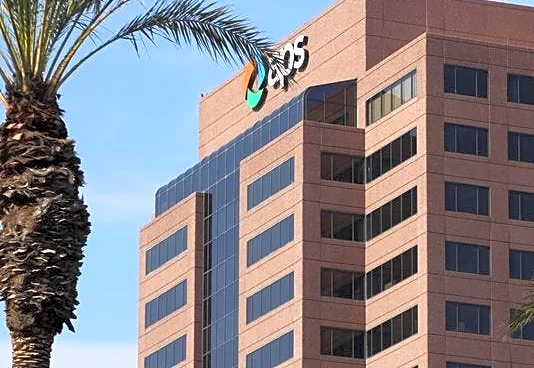
Arizona Public Service
State campaign finance reports show the political action committee affiliated with APS’ parent company has raised and spent more than $900,000 in the 2026 election cycle, donating to races in Arizona and beyond.
The Pinnacle West Capital Corp. Political Action Committee supported top Democratic incumbents Gov. Katie Hobbs and Secretary of State Adrian Fontes with $11,000 each. But the PAC donated $3,500 to Republican state attorney general candidate Warren Petersen, rather than Democratic incumbent Attorney General Kris Mayes.
On the federal level, the PAC donated $10,000 each to U.S. Reps. Greg Stanton, D-Arizona, and Juan Ciscomani, R-Arizona, as well as U.S. Sen. Ruben Gallego, D-Arizona.
APS spokesperson Ann Porter wrote in an email to The Arizona Republic that an employee panel decides where to donate and gives to candidates who “support APS’ mission of providing safe, reliable and affordable energy to Arizona.” Porter added that APS does not comment on specific candidates or contributions.
“Our approach to political participation is transparent and bipartisan, and information about political participation is transparent and bipartisan, and information about political participation and contributions is publicly disclosed,” Porter wrote.
Salt River Project
Like APS, SRP’s political action committee donated to the top of the ballot incumbent Democrats, giving $11,000 to Hobbs, $7,000 to Fontes and $2,000 to Mayes.
On the federal side, SRP donated $10,000 to incumbent Democratic Rep. Stanton and $10,000 each to Ciscomani and fellow Republican U.S. Reps. Eli Crane and Abe Hamadeh. The PAC also donated $2,000 to both Republican Jay Feely and Democrat Amish Shah, who are fighting for outgoing Republican U.S. Rep. David Schweikert’s seat. Schweikert decided not to run for reelection in order to make a bid for the Republican nomination for governor, which he lost.
SRP spokesperson Jennifer Schuricht wrote in an email to The Arizona Republic that the PAC is funded by employee donations. Employees raised $615,922.55 in the cycle. Additional costs to run the committee are covered by the Salt River Valley Water Users’ Association budget.
Schuricht wrote that the SRP Public Affairs team receives contribution requests, which are brought before an 11-member advisory committee made up of employees. They vote every month on which requests to fund. The meetings are not open to the public.
Schuricht wrote that the committee provides opportunities for employees to meet elected officials and engage in political and regulatory processes amid an "increasingly complex policy environment."
"The SRP PIC strengthens SRP's ability to advocate effectively for the customers and communities it serves," Schuricht wrote. "It complements SRP's public affairs efforts to help policymakers understand the complex water and power issues facing the region."
Southwest Gas
Southwest Gas’ political action committee donated more than $100,000 in Arizona races this election cycle, according to state campaign finance records. The gas utility serves roughly 2 million customers in Arizona, Nevada and California.
The highest donations for individual candidates included $5,000 each for Senate President Pro Tempore T.J. Shope, House Majority Whip Julie Willoughby, and Democratic state Reps. Consuelo Hernandez and Alma Hernandez. House Speaker Steve Montenegro and Republican state Sen. Carine Werner received $4,500 each.
The PAC mainly donated to candidates running for the state Legislature but also contributed $2,500 to Petersen, the state Senate president who is vying to unseat Mayes as attorney general.
In an email to The Arizona Republic, Southwest Gas spokesperson Amy Washburn wrote that employees make voluntary donations to the company’s political action committee.
"Our process considers candidates’ positions on issues affecting our business and customers, their roles in the policymaking process, and their alignment with our commitment to safe, reliable, and affordable energy service and the long-term growth and well-being of the communities we serve," Washburn wrote.
Tucson Electric Power Co.
Southern Arizona energy provider Tucson Electric Power Co. has donated more than $4 million to its political action committee, TEP for Tucson. Rather than supporting candidates, the PAC has rallied around Proposition 421, spending millions on television advertisements, voter surveys, mailers and yard signs.
The proposition, if adopted, would renew a 25-year franchise agreement between Tucson and TEP, allowing the utility to build, maintain and operate powerlines and other energy infrastructure on city rights-of-way while avoiding the city's standard permitting process.
The current franchise agreement, adopted in 2000, is expiring. Voters in 2023 rejected a proposed franchise agreement. The new proposal hopes to sweeten the deal by offering an "Energy Collaboration Agreement." The utility would invest an initial $2 million in initiatives, including bill assistance and energy efficiency projects. The investment would increase 2% each year.
The committee was formed in May and is paid for with the utility's "corporate resources," wrote spokesperson Joseph Barrios in an email to The Arizona Republic, and does not take donations from other sources. He added that the funding of the committee will not raise customer rates.
"TEP supports proposition 421 because approval would extend the same common-sense rules that govern TEP's use of public streets and other rights-of-way, supporting reliable service, prompt outage restoration and cost-effective maintenance of our energy grid within the City of Tucson," Barrios wrote. "Without a current franchise in place, restoring power and maintaining infrastructure could become more complicated, slower, and more expensive under the City's standard permitting process."
Alaina Mencinger covers energy, tech and utilities for The Arizona Republic. Reach her at Alaina.Mencinger@usatodayco.com.
This article originally appeared on Arizona Republic: Utilities fund both parties with control of Arizona Capitol in balance