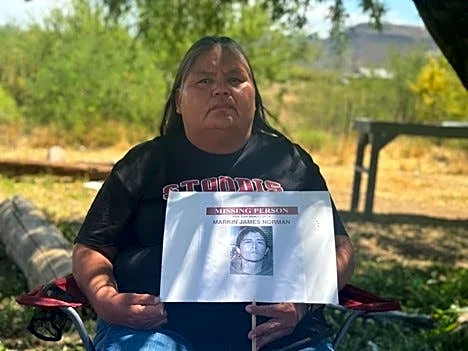

Any missing or unidentified person leaves a hole in a family and a community. Every family deserves to know what happened to their loved one. Every person deserves to be found, every death treated with
dignity and every family offered answers.
Yet the number of missing and unidentified people is growing around the world, including in Arizona. In late 2024, the International Committee of the Red Cross reported 284,400 missing persons worldwide, a 68 percent increase since 2019. The numbers are thought to be even higher in 2026, yet they still reflect only those who are registered.
Accurately counting the missing is difficult. So is locating and identifying those found too late.
Those who work on the Arizona-Mexico border know these realities well. Despite sustained efforts to search for and recover the remains of undocumented border crossers who perish in our deserts, uncertainty often prevails. Reports of disappearance may pass through multiple agencies whose coordination is uneven. Behind every case number, however, is a family waiting for news, a community carrying grief and a human being whose life deserves recognition.
This is where humanitarian forensic action becomes vital. The forensic sciences are essential to finding, identifying and returning the remains of the missing and deceased. But forensic work must be shaped by the needs of families and communities, not only by institutional priorities. Humanitarian forensics joins scientific investigation with ethical, cultural, legal and community-centered approaches. It begins from a core principle of international humanitarian law: families have the right to know the fate and whereabouts of their loved ones.
Arizona State University is meeting this moment. This fall, the New College of Interdisciplinary Arts and Sciences is launching the Humanitarian Forensics Hub to advance methods for finding missing persons, identifying the unidentified, and returning loved ones to their families and home communities. As faculty leaders of this initiative, and as researchers, teachers, practitioners and advocates, we believe Arizona can help lead a more humane approach.
The need is urgent. Arizona has one of the highest numbers and rates of disappearance in the country. Numbers can vary daily, but the National Missing and Unidentified Persons System (NamUS) estimated on Aug. 30, 2026, the International Day of the Disappeared, that Arizona had 1,133 active missing person cases and about 1,845 unidentified person cases.
On October 16-17, participants from at least 19 countries and more than 50 international institutions will gather at ASU's West Valley campus and online for "Humanitarian Forensics: Advocating for the Living, the Dead and the Missing in Arizona and Beyond."
The conference will bring together scholars, forensic practitioners, students, advocates, artists, healers, organizations and families to ask what forensic practice can become when science is joined with care, collaboration and accountability. Panels will address migration-related deaths in southern Arizona, missing and murdered Indigenous people, social stigma in responses to pandemics, spiritual dimensions of death investigation, and more.
These conversations push forensic science beyond a specialized professional world and into the heart of human rights. Why are some communities more vulnerable to death and disappearance than others? How are policies and everyday practices implicated? How can we prevent more deaths? And why do we tolerate so many unresolved losses? What can we do differently and better?
We see several opportunities to strengthen existing practices and better align them with humanitarian forensic principles. Representatives from medical examiners (ME) offices from Arizona and beyond will join us at this fall’s conference to engage with community partners around the painful problem of border crosser deaths. These connections can build upon and strengthen the efforts of those who pioneered the application of humanitarian and human rights forensics in the US-Mexico borderlands and beyond. Facilitating better coordination and communication among MEs' offices, families and communities will benefit all who share stakes in this difficult work. The conference will also be a space to learn from humanitarian contexts globally as we deepen and expand the connections among science, community, culture, ethics and accountability.
But there are more ways a humanitarian approach can apply in everyday forensic practice. This includes ongoing efforts to help prevent heat-related deaths associated with high summer temperatures and expanding resources and partnerships for identification, including via DNA analyses, to help resolve the large number of unidentified individuals in Arizona. Additionally, we should explore practices that help ensure that unidentified and unclaimed decedents remain available, perhaps via traceable, temporary burials rather than cremation. Not only does cremation destroy any possibility for future identification, but many families oppose it for religious and cultural reasons. Expanding access to postmortem CT imaging may reduce the need for a full autopsy, which is also culturally or religiously unacceptable for some. Lastly, efforts should place collaboration with individuals from vulnerable populations at the forefront to help prevent them from becoming missing, such as Indigenous women and children.
Arizona can and should be a leader in addressing these ongoing problems. We believe that our state and its institutions must recommit to the missing, the dead and the living families who continue to search for them. The Humanitarian Forensics Hub at ASU commits to helping build a forensic practice worthy of their dignity.
Tricia Redeker Hepner is a professor and senior associate director in Arizona State University's School of Social and Behavioral Sciences and affiliated faculty in the School of Interdisciplinary Forensics. Sara Fatula is an instructor in the School of Interdisciplinary Forensics. Sherry Fox is an assistant teaching professor in the School of Interdisciplinary Forensics. Gabriella Soto is an associate teaching professor in Barrett, The Honors College and affiliated faculty in the School of Interdisciplinary Forensics, the School of Transborder Studies and the Latinx Oral History Lab. All are affiliated with ASU's Humanitarian Forensics Hub and are co-organizers of the Oct. 16-17 Humanitarian Forensics conference at ASU's West Valley campus in Glendale.
This article originally appeared on Arizona Republic: Arizona can lead on identifying the missing with dignity | Opinion