



My passion for travel began with a road trip.
And I still look back on every vacation I've taken that entirely or mostly involved driving with the greatest fondness. It started with childhood memories of Pennsylvania Dutch Country travels and extended years later to a Pacific Northwest odyssey, a Colorado trip that included a drive to Mount Rushmore and a last-minute 2022 drive from Florida to Texas to take my sister to see Alice In Chains singer/guitarist Jerry Cantrell in concert after COVID-19 canceled his Florida shows.
The road trip is a perfect embodiment of America's spirit as the land of the free. It represents the freedom to travel at your own pace and set your own itinerary. Unlike train and air travel, road trippers can set their own schedules.
Such liberation allows for the best road trip moments. Unplanned detours where hidden gems are found. The restaurant stops to finally taste some big deal regional delicacy. The stops for gas at convenience stores that feel like destinations themselves. The adventures twisting and turning through desolate areas in search of spectacular places.
No highway is more representative of the Great American Road Trip than Route 66, which turns 100 on Nov. 11. The artery connecting Chicago to Los Angeles holds an evergreen place in the nation's heritage as a microcosm of Americana and nostalgia, full of kitschy diners and quirky landmarks.
Those raised in the time of the song "(Get Your Kicks On) Route 66" and the book "The Grapes of Wrath" (which lent 66 the nickname of the Mother Road) may drive the route to recapture memories of what American life was like when they were young. Those raised in the time of the film "Cars" may drive the route to imagine a simpler era that predates social media and smartphones.
And the allure of that mix of history, nostalgia and fantasy continues to draw adventurers from around the country and the world.
Route 66 remains a major tourist draw after 100 years
"I just like seeing America and traveling the roads," said Dilis Remedios, a Miami resident traveling the entirety of Route 66 on a 24-day trip. "When I travel Route 66, I'm imagining history — imagining a wagon, a horse, people coming to the little towns."
Many international visitors, especially enthusiasts of classic cars and motorcycles, flock to these iconic stops. There's even a European Route 66 festival held in the Czech Republic.
At some destinations, operators leave out guest books for visitors to sign, including foreign travelers from hundreds of countries. Inside Hackberry General Store, the blink-and-you'll-miss-it shop famed for its ramshackle aesthetic and collection of vintage cars and gas pumps, some visitors leave behind inscribed dollar bills. I remembered seeing a Brazilian real stand out among the infinitely repeating George Washington faces.
"You'll see how many people from nearly every single country come here," said Amy Franklin, who's owned Hackberry General Store since 2016 and worked there since 2006. "Croatia, Bosnia, all the European countries, New Zealand, Australia, South America."
Franklin said she maintains guest logs dating as far back as when she bought the store. "The previous owner had papers going back to 1998," she said.
Foreign travelers are drawn to Route 66 because it's one of America's strongest cultural symbols, said Marian Pavel, a former journalist in Slovakia who developed a mobile app called Route 66 Navigation, a turn-by-turn navigation app with offline guidance on 900 points of interest on Route 66.
"It reflects both the mythology and the reality of the country: huge distances, regional differences, optimism, entrepreneurship, decline and renewal, and communities that continue to reinvent themselves while preserving their history," he told The Arizona Republic in an email.
Pavel is a prolific Route 66 traveler, adventuring along the route more than 20 times. He's planning to return in time for the centennial celebrations.
"For many international travelers, it is a symbol of freedom, discovery, classic American culture, small towns, roadside architecture, diners, motels, neon, cars, music, and the idea of crossing a continent at your own pace."
What keeps him fascinated by Route 66 are the people who make the route and its destinations what they are. He said that talking with business owners, historians, preservationists and fellow travelers make for the most memorable experiences — which I also found to be true on my own trip.
To better understand why, 100 years later, the Route 66 road trip remains so romanticized nationwide and worldwide, and to fully appreciate its key landmarks, I embarked on a Route 66 road trip myself.
Driving Arizona's Route 66 in one shot is different than visiting piecemeal
I drove the 385.2 miles of Arizona’s existing stretch of historic Route 66 from east to west, starting in Lupton near the New Mexico border and ending in Topock near the California border. My journey stretched five days, with half of the first and last days spent getting there and back from Phoenix.
In past travels, I'd seen some places on the route, like Petrified Forest and Standin' on the Corner Park, plus the historic downtown areas of Flagstaff and Williams. I'd stayed in Seligman after a Grand Canyon visit, but unfortunately my timing didn't allow for a meal at Delgadillo's Snow Cap (though I did get breakfast at one of Yelp's top Route 66 restaurants, Westside Lilo's). And while the piecemeal approach to seeing 66 allowed me to hit a few highlights, it wasn't until traveling all of Arizona's section of the route that I was able to fully immerse myself in its nostalgia-rich culture. It allowed me to make stops I hadn't made before, and to see the ones I had from a different perspective.

The kitch is real, because the people who pedal it are
One thing that struck me about many of the key landmarks on Arizona's stretch of the Mother Road was that they remain in the hands of the families that built them, a sharp contrast to the corporate modern world.
It was a thread that animated many of my stops. I got to share a few words with Clifton Lewis, whose late father, Chester, owned the Wigwam Motel in Holbrook, and Cindy Jaquez, whose grandfather was one of the earliest owners of the Jack Rabbit Trading Post near Joseph City. When I dined at the Snow Cap in Seligman, Juan Delgadillo's daughter, Cecilia, took my order (and sprayed me with fake mustard, a common joke played on restaurant guests).

"Many places around here have gone through many hands," Lewis, 88, told The Republic from the Wigwam Motel's office, filled with Route 66 artifacts and a portion of his father's massive collection of petrified wood. "It's a family legacy. It's important to us. We put in a lot of effort and money to keep it as nice as we have."
The rewards of a road trip lie in the joy of discovery, and while many things have changed since Route 66's yesteryear heyday, the draw is still there.
Route 66 isn't what it used to be. And that's OK
The Navajo Nation community of Lupton, the first Arizona stop west of New Mexico or the last one east of California, once had an abundance of hotels, restaurants and gas stations. It even had a nightclub that was popular with residents of nearby Gallup, New Mexico on Sundays, when it was illegal to sell alcohol in Gallup. (Today, Gallup allows alcohol sales in bars between 10 a.m. and midnight Sundays, but prohibits packaged alcohol sales on Sundays.)
Today, Lupton's downtown consists of a row of six trading posts and curio shops.
While many Route 66 towns are far removed from the Mother Road's pre-interstate days, their retro feel and the satisfaction of finding landmarks off the beaten path are what draw many travelers.
Darryl Baldowski traveled Route 66 from Kingman to Williams with his wife, Janice. The Belvedere, South Carolina couple had visited parts of 66 in New Mexico and Texas, but liked how much of Arizona's route was contiguous.
They also enjoyed the stops along the way, including the 1950s-inspired Mr. D'z Route 66 Diner in Kingman and the Snow Cap in Seligman.

"We're here for fun, we're not in a hurry," Baldowski said. "Who wants to be on the fast track everywhere? The journey to the destination is the trip. You miss everything in between if you get on the interstate."
His comments reaffirmed for me how valuable it is not to rush through the journey and to take your time experiencing what a place has to offer. Stepping off the interstate can reveal so much more about a place that you can't find by just passing through it on your way to the city.
For instance, if I traveled Seligman to Kingman via Interstate 40 instead of staying on Route 66, I would have missed the chance to take an elevator 200 feet underground into the Grand Canyon Caverns — my first time exploring a cave.
And staying on 66 on the way to California will take you to the Old West mining town of Oatman and its roaming burros. You'll even see wild burros on the drive there, from the west, it crosses a curvy, eight-mile stretch known as the Sidewinder, where the hairpin turns, narrow lanes and lack of guardrails make the journey to get there as adventurous as the destination.
Some of the greatest Route 66 discoveries are also the most delicious
On road trips, it might seem tempting to find the nearest McDonald's or Starbucks when hunger or thirst ensues. But on the road less traveled, motorists are rewarded for their patience with destination eateries that pack unique personalities. And often, great food.
In Flagstaff, I enjoyed the fried chicken and sausage po' boy sandwich at Brandy's Proper Cafe (formerly Proper Meats + Provisions) and the wood-fired Neapolitan-style pizza at Fat Olives so much that I made return visits when I took family and friends to Flagstaff.
It's possible to eat fancy on a Route 66 trip — and I admit that I did, dining on beef tenderloin tacos at the Turquoise Room in Winslow while stopping to appreciate the history and art at the La Posada Hotel. Flagstaff even has a Michelin recommended restaurant, Atria. (Though I didn't eat there, it was out of my budget.)
But generally speaking, Route 66 road trippers aren't looking for fancy. They look for vintage diners and drive-ins that represent the unique character, history and old school Americana that defines the Mother Road.
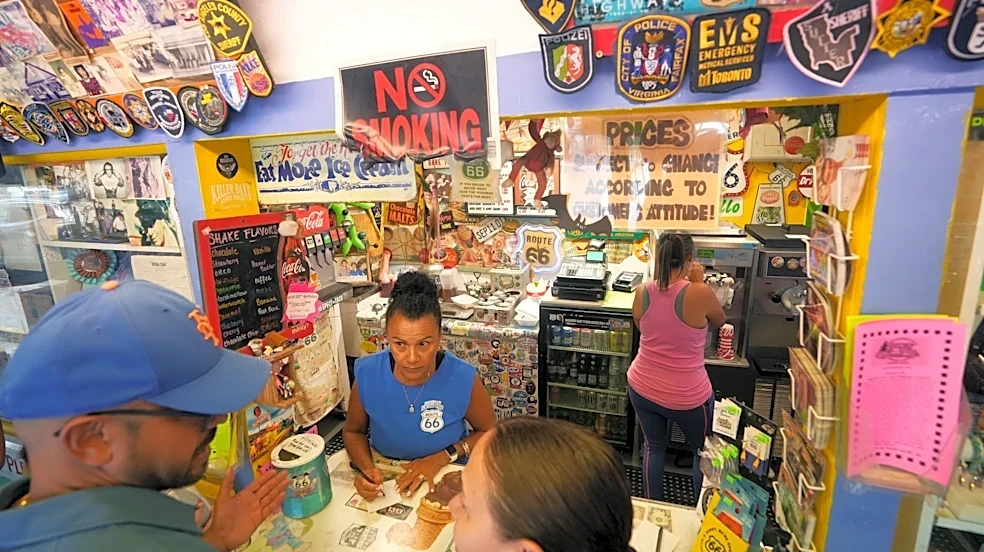
They look for Delgadillo's Snow Cap Drive-In, which became an icon of Route 66 because of its kitschy, colorful aesthetic, built from scrap lumber by late owner Juan Delgadillo. Parked outside the restaurant is a decorated white 1930s Chevrolet with offerings like "Dead Chicken" and painted ice cream cones displayed throughout. American flags, Route 66 flags and flowers hang from the car and a Christmas tree with lights strung on the branches is attached to the bumper.
The restaurant's menu and aesthetic were influenced by Delgadillo's sense of humor. The signs at the front entrance read “Sorry, we're open.” Their menu includes items like "Cheeseburger with Cheese." I ate the Oink Burger, a burger topped with bacon. And yes, I asked for cheese on my cheeseburger.
The team at the Snow Cap makes pulling pranks on customers part of the draw. When you arrive, you'll find two doorknobs at the building's entrance: one that opens the door and one that doesn't. The knob that doesn't work has the word “Pull” above it. (It fooled me.) When you go up to order, the cashier will spray you with a fake stream of mustard from a gag mustard bottle. Cecilia Delgadillo, Juan's daughter, did the honors when I went up to order.

While the Snow Cap certainly had the most character of all the places I ate on Route 66, there were plenty of other food stops along the way that offered history and a vintage flair.
My first Route 66 meal on this trip was a Navajo fry bread taco from a stand at Chee's Indian Store, off Exit 351 of Interstate 40 near Lupton. Chee's began in 1948 as a stand on Route 66 where the Chee family (whose name is the Navajo word for red) sold woven rugs and jewelry. The family expanded to its current location in 1970.
Traveling on Route 66 gave me a chance to get burgers from vintage-style diners, like Goldie's Route 66 Cafe in Williams and a more recent addition to the route's dining scene, Rutherford's 66 Family Diner in Kingman.
Meals and snacks, from cactus candy to "Dead Chicken," punctuate a road trip, but for many Route 66 travelers, history is the main draw.
Historic sites and natural wonders remain hallmarks of a Route 66 road trip
Arizona’s Route 66 and many of its key stops appear to function like living history museums, showing what road trips were like in the years before interstate highways.
Rusty cars and trucks and vintage gas pumps can be seen at many of the key landmarks along the route, like the Wigwam Motel, the Snow Cap in an area behind the restaurant dubbed "Juan's Garden," and at Hackberry General Store. These places hold up as must-visit destinations on the route because of the evergreen interest in classic automobiles and the history of road trip travel.
And some history within Route 66 in Arizona goes back to prehistoric times.
Grand Canyon Caverns near Peach Springs is the largest system of dry caves in the United States, created about 65,000 years ago from limestone that was once the bottom of an inland sea dividing North America.
While there, I marveled at rare forms of selenite crystals, icicle-shaped stalactites, an underground restaurant, a mummified bobcat and a prehistoric sloth.
On my tour of the caverns, I also saw an area that was designed as a bomb shelter packed with meals ready to eat and bottled water; my guide also pointed me to a rock formation shaped like a dog — the caverns' "guard dog" named Rocky.
Meteor Crater, between Flagstaff and Winslow, preserves an impact crater from a meteorite that collided with Earth nearly 50,000 years ago. When it hit, it released 175 million tons of sandstone and limestone and threw it outside the crater, according to Meteor Crater's website.
The impact, which had an explosive force greater than 20 million tons of TNT, was strong enough to melt or vaporize much of the meteorite that struck the crater. While visiting Meteor Crater, I not only saw the crater site, but also the largest known surviving fragment of the meteorite that was recovered.
But perhaps the most famous moment in space history that happened on Route 66 was Clyde Tombaugh's discovery of Pluto in 1930 at Lowell Observatory in Flagstaff.
Kevin Schindler, Lowell's historian, noted parallels between the paths of Route 66 and Pluto — and how both have their devoted fans.
"They had a similar path in life, Route 66 was established in 1926, Pluto was discovered in 1930, then Route 66 was decommissioned and Pluto was reclassified (as a dwarf planet)," he said. "But they're more popular than ever, I think."
Lowell holds an annual I Heart Pluto Festival every February to celebrate Pluto's discovery. And in 2024, Gov. Katie Hobbs signed legislation designating Pluto as Arizona's state planet.
Like any road trip, you must expect the unexpected
Sometimes, the freedom to go at your own pace can hit snags. When embarking on any road trip, including Route 66, prepare yourself in case things don't go according to plan.
Unplanned issues force adjustments to the itinerary, something I had to do a few times — including twice at the same place.
A late start to the day combined with a longer than expected detour at one of my stops led me to reschedule plans to see Meteor Crater, upon realizing that the last guided tour had already left while I was on the way there. So I decided to just keep driving to Flagstaff, where I planned to experience night sky viewing at Lowell.
I wasn't thinking when I booked my stay in Flagstaff. It was a Tuesday — the day Lowell Observatory is closed. I shrugged this off and spent some time exploring Flagstaff's historic downtown and the Mike's Pike region that followed Route 66's original alignment. I decided to extend my time a bit, see Meteor Crater the next day and see the stars the next evening.
Again, I was foiled, this time by Mother Nature.
Stormy and cloudy weather hit the Flagstaff area and Lowell's front desk staff told me there likely wouldn't be a night sky program that day because of the inclement conditions. These things happen. I plan to go back when clearer skies are in the forecast. And I still got to experience the grandeur of the astrograph used to discover Pluto.
I also met Lowell's historian, Kevin Schindler, who took me and some of Lowell's staff to see the Cinder Lake crater field, near Sunset Crater Volcano National Monument. Cinder Lake, along with Meteor Crater, are important landmarks in America's space history because they were used as training grounds for the astronauts in the Apollo missions who walked on the moon.
The difference between Cinder Lake and Meteor Crater is that Cinder Lake is an artificial crater field, designed purposely to replicate conditions on the moon's surface for astronaut training, Schindler said.
Beyond Apollo, these sites are also important in the future of American spaceflight because the astronauts in the Artemis missions that will return humans to the moon are training there as well, he said.
This side trip to the Cinder Lake crater field wasn't part of my original Route 66 itinerary. It came up after talking to Schindler on the phone before I left on the trip. This opportunity to see the crater field on a guided tour and walk where Neil Armstrong and Buzz Aldrin trained before their giant leaps for mankind was one I couldn't pass up, and it was the silver lining in my change of plans.
Does Route 66 still have its magic?
100 years since the road’s debut, Route 66 continues to embody the road trip experience as the Main Street of America.
Jesse Lovell, a cashier at a shop in the mining town of Oatman, famous for its roaming burros, said the 250-year history of the United States is young compared to other countries. Preserving Route 66 is important because it preserves pieces of American history.
"We don't have as much history, so we need to cling to that," Lovell said.
Near the end of my journey, I stopped at the Arizona Route 66 Museum in Kingman to browse its exhibits. While there, I asked the museum's operations director Nikki Terlesky and Kingman's tourism services manager Josh Noble why Arizona plays an important part in Route 66 history and why it's so significant that there's a museum dedicated to Arizona's Route 66 heritage.
They gave many answers: Arizona was the first of the eight states that cross Route 66 to rally for its historic designation, Williams was the last city on the route to be bypassed by the interstate, it's close to two of Arizona's three (soon to be four?) national parks, and the landmarks and things to do on Arizona's stretch of the route are diverse.
Terlesky added that the Route 66 centennial is contributing to "another heyday" for the road.
Tourism is up throughout Route 66 towns nationwide because of people planning trips around the centennial year. And some international media coverage won't take place until the centennial is observed in November, which will likely inspire even more Route 66 tourism in 2027 and beyond.
If given the chance to ride Route 66 in Arizona again — or to take an extended trip including the seven other states in the route — I would do it in an instant.
I believe that the ideals that inspired and embody Route 66, the ones that drew people like me to cruise the Mother Road, will inspire vacationers through the next 100 years.
"If history has taught us anything, I think we will continue to see lots of people interested in visiting and experiencing the Great American Road Trip," Terlesky said. "I don't think that will ever go out of style."
Looking for the best things to do in Arizona? Sign up for our newsletter.
Michael Salerno is an award-winning journalist who’s covered travel and tourism since 2014. His work as The Arizona Republic’s consumer travel reporter aims to help readers navigate the stresses of traveling and get the best value for their money on their vacations. He can be reached at Michael.Salerno@usatodayco.com.
Support local journalism. Subscribe to azcentral.com today.
This article originally appeared on Arizona Republic: Is Arizona Route 66 still worth visiting? I hit the road to find out