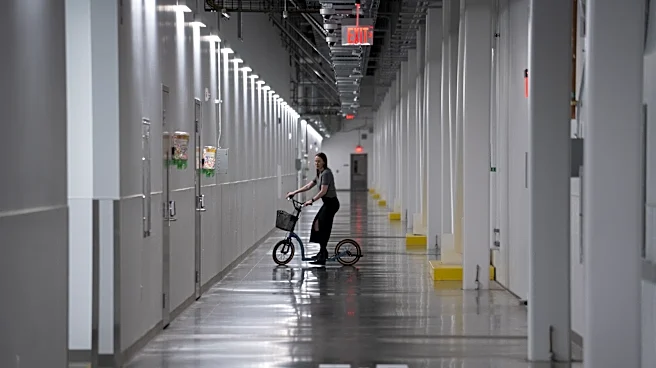






Peoria leaders agreed that the city should update its old zoning rules on data centers as the demand for the facilities increases.
Currently, Peoria has a layered approach to regulating data centers, including a more than 20-year-old code that allows them in all industrial zoning districts without restrictions or Council approval and rules for large water users.
That will change, as the Council has directed city staff to pursue a zoning code amendment that would give it more flexibility in approving data center applications. This would be in the form of a special use permit.
Councilmember Matt Bullock, who owns a data protection and cybersecurity company and often deals with data centers, said there are different types of data centers that require
varying considerations.
By requiring a special use permit, he said, the Council would be able to better differentiate between the different data centers by addressing their varying considerations on a case-by-case basis.
"There's so many more considerations than if somebody wants to build a 10,000-square-foot miniature data center for just their office," said Bullock.
Data centers have received immense pushback across the region and the nation.
Arizona Attorney General Kris Mayes recently called for a statewide pause on new data center developments due to water and energy concerns, while Gov. Katie Hobbs called for the elimination of tax incentives and a new fee on data centers for their water use. Both are Democrats running for reelection in November. The Legislature approved a three-year moratorium on tax incentives for data centers, which Hobbs signed off on.
In Peoria, data centers are allowed "by right" on all industrial zoning districts, but the city still has "strong" policies, programs and regulations addressing the utility infrastructure demands of large water and wastewater users, including data centers, said Lorie Dever, deputy planning director.
Plus, the majority of industrial land in Peoria is already built out so there is little opportunity for a widespread development of data centers, Dever said.
In the Peoria Innovation Core, the city's economic hub underway in its northern region, data centers are limited to a specific industrial zone, would require Council approval through a special use permit and would be required to follow operational limitations, Dever said.
The Legacy Point development near 75th and Northern avenues allows data centers "by right" and there is an application currently under review by the city, Dever said.
Peoria Planning Director Chris Jacques said the city's role was to decide the most appropriate locations for data centers and establish reasonable rules to limit their impact on nearby properties.
Other Arizona cities have regulated data centers to address noise from equipment and generators, water and power needs, building scale, proximity to residential areas and traffic and emergency access, Jacques said.
There wasn't a one-size-fits-all approach, he said.
Dever reminded city officials that if they move forward with a code amendment, the Council does not have the legal authority to prohibit a land use regardless of how disliked or offensive the use of the land may be. Regulations must be objective based on its impacts to a community, such as minimum setbacks and operational restrictions, she said.
Instead of continuing to allow these facilities "by right" alone the city could instead require a conditional use permit, which could subject future data centers to conditions that must be approved by the city's planning and zoning commission.
The city could also require a rezone or a special use permit, which would both be decided by the City Council but vary in city leadership's flexibility. City leaders opted for the latter, which would give applicants a set of baseline development standards to follow and the Council could also add site-specific rules when warranted.
City staff also recommended further regulating data centers to:
- Eliminate their use in business and commerce parks.
- Establish a minimum 500-foot setback and minimum 50-foot landscaping buffer to reduce visual impacts.
- Require a power demand study, in addition to a water and sewer study that the city already requires.
- Require a third-party noise study at the time of application.
- Require that a facility's mechanical and electrical equipment be hidden from public view.
City staff also suggested that any code change not be applied retroactively to active data center applications as that would be unfair, Dever said.
Staff would also want to update how "data center" is defined in the city's zoning code to reflect modern technology and how these facilities operate now, compared to how they did more than 20 years ago.
Right now, Peoria's zoning code defines a data center as a facility that houses "one or more large computer systems and related equipment, concerned with building, maintaining or processing data and providing other data processing services." The code goes on to say that these facilities are also known as a "telecom hotel or carrier hotel."
Bullock and Mayor Jason Beck shared that a 500-foot buffer might not be enough depending on the type of data center, as that would be too close to homes. Jacques said staff would explore other setback requirements.
Zoning code amendments are forwarded to the city's planning group for a recommendation. After that, the City Council will have the final say.
Republic reporters Alaina Mencinger and Stacey Barchenger contributed.
Elena Santa Cruz covers the West Valley cities of Glendale, Surprise and Peoria. Reach her at elena.santacruz@arizonarepublic.com or follow her on X @ecsantacruz3.
Like this story? Get more West Valley news straight into your email inbox by signing up for our free weekly West Valley Newsletter, which comes out on Tuesdays.
This article originally appeared on Arizona Republic: Metro Phoenix city to tighten data center rules after 20 years