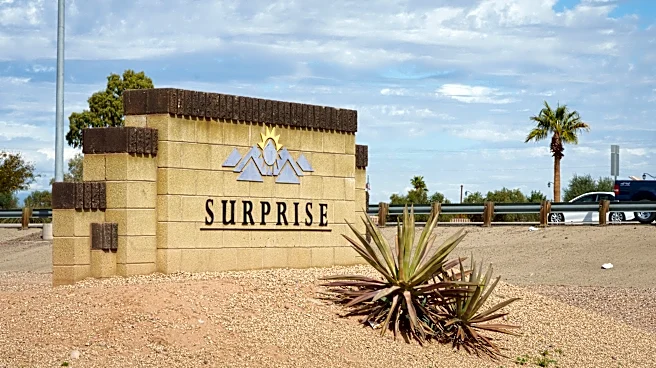




Surprise leaders agreed on a local law allowing battery energy storage facilities to be as close as 250 feet from homes.
The decision follows more than a year of city staff research and public meetings where city leaders weighed whether the distance should be as much as 1,500 feet, since the explosion of a facility seven years ago injured several first responders.
After an hour of debate and discussion on Sept. 1, the City Council unanimously settled on a setback range of 100 to 500 feet from battery storage facility properties to existing homes.
There would also be an additional 150-foot buffer between the actual battery storage facility and its property line, meaning any future facility would be at least 250 to 650 feet away from homes. The systems
will also have to be surrounded by an 8- to 12-foot wall.
Under the new rules, future battery storage facilities must first go through a rezone process and ultimately be approved by city leadership.
Battery energy storage systems capture and store excess power generated during the day, then send it back to the grid after the sun goes down and people continue to use power. They also stabilize the power grid when passing clouds reduce solar panel output.
Officials have been cautious about reducing the setback distance. In 2019, an Arizona Public Service battery storage facility in the city exploded and injured several first responders. That facility is no longer in operation, and company spokesperson Ann Porter said APS learned a lot about battery storage following that incident. Surprise and other metro Phoenix cities enacted local laws months after the explosion to try to prevent a similar event in the future.
Now, the new regulations aim to apply extra zoning rules and development standards for the facilities as the city continues to grow and energy demand increases. A major part of the conversation was how close facilities should be to homes. A lawyer for APS said the company preferred having these facilities close to power substations.
Different setback rules exist throughout the Valley. Buckeye requires a minimum of 150 feet from residential properties, Mesa requires 1,000 feet and Maricopa County requires 100 feet from property lines.
Goodyear recently adopted new regulations requiring facilities to be at least 330 feet from residential areas. That could be reduced to 150 feet through a special use permit if a safety analysis is provided, detailing how toxic smoke, gas, or fire could travel if there's an unexpected event.
The initial 1,500-foot number in Surprise stemmed from emergency response guidelines for a general hazardous event. Surprise's planning group agreed twice to slash that to 100 feet, while the City Council wanted to see if 1,000- and 500-foot setbacks could also be considered.
"This battery energy system is for the future," Lisa Everett, who serves on the city's planning commission, told the Council. "I know we are looking back at yesterday, what happened in the past, but you are comparing apples and oranges. What is happening today is completely different."
Representatives and advocates for clean energy and battery storage systems also called on city leadership to support the 100-foot setback, arguing that any increase would limit the number of storage facilities that could be implemented in the city. Many said 100 feet was the national standard.
Councilmember Johnny Melton agreed, saying the 2019 incident "completely changed" the industry and fires at these facilities were now rare. He said he didn't want Surprise to set an example of a high setback because that may restrict where these facilities could go. The facilities are important for grid stability, he said.
"Arizona is growing fast," Melton said. "Our economy is evolving. And APS and SRP are under intense pressure to try to find a way to chase the curve."
Benjamin Graff, a lawyer representing APS, suggested the City Council consider adopting a range. Graff said the industry needed to earn Surprise's trust by proving officials learned from the 2019 explosion and that utility providers can keep first responders and neighborhoods safe.
Elena Santa Cruz covers the West Valley cities of Glendale, Surprise and Peoria. Reach her at elena.santacruz@arizonarepublic.com or follow her on X @ecsantacruz3.
Like this story? Get more West Valley news straight into your email inbox by signing up for our free weekly West Valley Newsletter, which comes out on Tuesdays.
This article originally appeared on Arizona Republic: Surprise sets new battery storage facility buffers near neighborhoods