


Jodi Arias, who in 2013 was convicted of first-degree murder for the fatal stabbing and shooting of her former boyfriend, Travis Alexander, still wants to make an argument that she deserves a new trial.
Her deadline to make that filing, initially set for April 2021, has received continual extensions over the years.
At an Aug. 28 hearing, it was extended one more time — until Jan. 29, 2027.
The deadline was prolonged despite the sister of the victim telling the judge that the family wanted some finality to the case after so many years.
“We’re supposed to have some closure, but it keeps going on and on and on,” said Samantha Alexander, who joined the hearing in Maricopa County Superior Court by telephone.
She said the continuing proceedings have caused
disruption in the lives of her relatives.
“We are just dumbfounded by all these delays,” she said.
She got emotional as she told the judge how she is traumatized every time prosecutors alert her to another hearing, reminding her of the case.
“If I run into a person named Jodi on the street,” she said, “It causes PTSD.”
The judge told the family he had kept their concerns in mind when he made his ruling.
Still, Arias will get five more months to allow her team to investigate the case and present an argument that she should get a new trial.
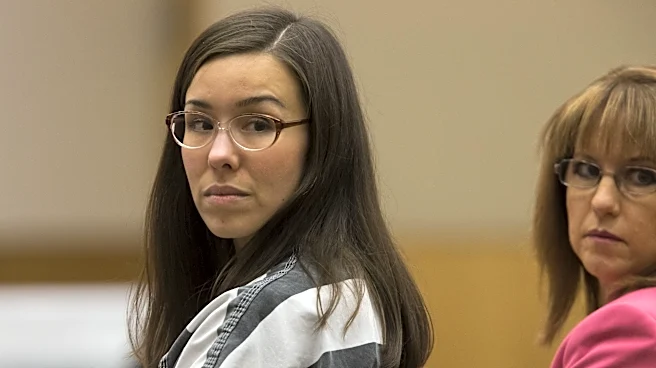
Arias, housed in the Perryville state prison complex in Goodyear, gave her name and date of birth when prompted by the judge. She otherwise remained silent during the hearing.
The blood-and sex-soaked case of Arias garnered extensive media attention when it went to trial.
Arias faced the death penalty in the case, in part due to the gruesome nature of the crime. Authorities said Alexander was stabbed multiple times and that his neck was cut so severely he was nearly decapitated. He was then shot in the head.
Two jury panels could not agree on whether she should get the death penalty. A judge subsequently sentenced Arias to life in prison without the possibility of parole.
In February 2021, Arias filed a notice that she was seeking a new trial, a legal process known as post-conviction relief.
That was the same month her appellate process had concluded. The Arizona Court of Appeals upheld her convictionin April 2020. The Arizona Supreme Court declined to take up her case.
Arias had faced a deadline of Sept. 2 to file her petition.
But she filed a motion to extend the deadline yet again. In that petition, she cited “health issues affecting multiple members of the defense team.”
In court, an attorney for Arias, Christopher Stavris, told the judge that six members of the defense team had varying health issues. He mentioned cancer, surgeries and one person with a heart attack.
“I’m starting to think I need to get something filed soon before I get sick,” he told the court.
Stavris also said he had not received all the documents and evidence he needed to make his argument. He mentioned a hard drive belonging to Arias that was with the Mesa Police Department that he was fighting to receive.
Prosecutors wanted judge to stick to deadline for Jodi Arias
The Maricopa County Attorney’s Office, which had not objected to previous requests, had asked the judge to not give Arias any more time.
Prosecutors said in a court filing that the Sept. 2 date, coming more than five years after her initial request to file a petition, was a “realistic deadline.”
In court, a deputy county attorney, Phillip Garrow, asked that the court set some status hearings to make sure the process was proceeding on time.
“My concern is making sure this is moving forward,” he told the judge. “The delay speaks for itself.”
It is not clear what issues Arias may raise in her request for a new trial.
Since August 2024, most of her filings with the court have been sealed from public view.
Even minute entries that detail the goings-on at court hearings were sealed. It was not clear from the few documents available to the public whether the hearings themselves were also closed to members of the public.
In a June 2026 filing, Arias and her attorneys said they could provide the judge more information about the status of their investigation in a “sealed, ex-parte, hearing.”
Stavris, near the close of the Aug. 28 hearing, asked that it also be sealed. A Republic reporter raised a protest of the sealing. Judge Aryeh Schwartz granted the motion to seal the proceeding.
What Jodi Arias can, can't argue about need for new trial
Arias, under the rules of court procedures, is limited in what issues she can raise.
According to state law, post-conviction relief cannot parrot issues raised on an appeal.
Arias’s petition for post-conviction relief must argue that she discovered new facts that would have likely changed the verdict or sentence.
Available filings show that Arias and her team have looked further into the conduct of Juan Martinez, the prosecutor for the Maricopa County Attorney’s Office who led the case.
Arias had already cited Martinez’s conduct in her appeal. She said he badgered defense witnesses, including Arias herself. And that he sought publicity, posing for photographs with avid watchers of the trial on the courthouse steps.
Martinez agreed to disbarment in July 2020, ending an investigation into his conduct by the State Bar of Arizona. Among the allegations the Bar investigated was that he fed inside information about the Arias case to a person writing a blog about the case, and lied to investigators about his sexual affair with the blogger.
An October 2025 court filing said Arias had requested and received records from a company that represented Martinez as he sought to market a book about the case.
The filing said Arias was investigating when Steve Troha, who worked as an agent for Folio Literary Management, first had contact with Martinez.
Troha, the filing said, was able to help land Martinez’s book, “Conviction: The Untold Story of Putting Jodi Arias Behind Bars,” with its eventual publisher, Harper Collins. Troha was a literary agent.
Arias’s team was also able to get the records of Martinez’s disciplinary case before the State Bar, according to a status report filed with the court in July 2023. Those records previously were under seal, the filing said.
That report also mentioned the voluminous case file. It includes 24,000 pages of transcripts for the 125-day trial, along with 950 exhibits and 2,090 “instruments” as part of the court record. The report said there were more than 100 banker boxes filled with materials.
Stavris was appointed as Arias’s attorney for the post-conviction relief portion of her case in February 2021, as she started the process.
He was to be paid under contract prices set by Maricopa County. That contract says Stavris would apply for compensation of $110 an hour and a flat fee of $2,675 when the petition itself was filed.
The county office that handles attorneys under contract did not return an e-mail from The Republic asking how much Stavris had earned during this more than five-year process.
This article originally appeared on Arizona Republic: Jodi Arias gets more time to seek new trial in murder case | Exclusive