
Arizona school districts could be required to spend at least 60% of their operating budgets on classroom instruction under Proposition 320.
Most districts in Maricopa, Pima and Pinal counties, which would
all be impacted by the new measure, don't meet the necessary threshold. If passed, the districts could risk losing millions of dollars in state funding.
Under Proposition 320, school districts would need to increase their spending on direct instruction by half a percentage point each year until they reach 60% beginning in the 2027-28 school year. For every year school districts are not in compliance, they could lose a quarter of their Arizona Classroom Site Fund. The fund is responsible for an average of roughly $12,000 of an Arizona teacher’s salary, according to the Auditor General.
The measure would apply to all Arizona school districts with more than 7,500 students or those located in counties with over half a million people. It would not apply to public charter school districts or private schools.
The ballot initiative would also permit the Arizona Auditor General to define which expenses count towards the 60% threshold. Administrators and public officials are turning to the Auditor General's instructional spending percentage to predict school district's standing.
Only two school districts in Arizona's three largest counties reached an instructional spending percentage of at least 60%: Arlington Elementary School District in Arlington at 62.8% and Red Rock Elementary School in Pinal County District at 60.5%. Other districts, like Sentinel Elementary School District in Dateland and Baboquivari Unified School District in Pima County, would need to roughly double their share from their current rates of 33.5% and 32.2%, respectively.
According to Adrian De Alba, Phoenix Union High School District’s chief financial officer, the Auditor General only counts certified teachers, teacher assistants, substitutes and instructional materials towards instructional spending. It does not include special education support, math and literacy coaches and professional development for teachers.
Phoenix district plans for potential reorganization
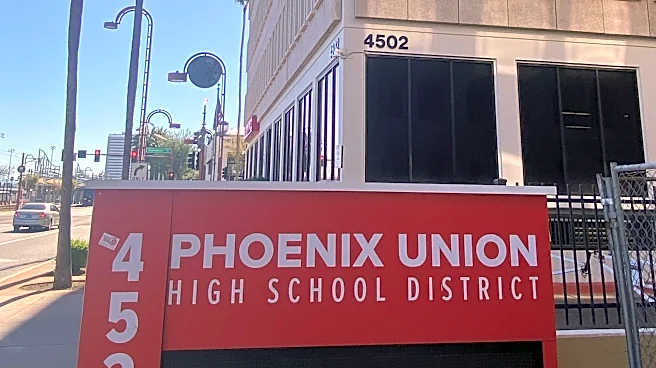
Phoenix Union only spends 47.3% of its funds on direct instruction, meaning the district would have well over two decades to comply with the law.
During a district governing board meeting on Sept. 3, Jimmy Arwood, director of governmental relations for the Arizona School Boards Association, highlighted some of the tough choices that could be ahead for Phoenix Union. He said school board members would have to consider reductions in student transportation — such as consolidated bus routes, earlier pickup times, or the elimination of transportation altogether — or staffing of counselors, custodians and school resource officers.
Rep. Matt Gress, a Phoenix Republican who played a key role in getting the measure on the ballot, said he doesn’t believe every district needs its own transportation department. He pointed to a 2025 study from the Common Sense Institute that found Arizona schools have spent over half a billion dollars in transportation costs despite a 45% reduction in eligible bus riders.
“When half of the ridership disappears, you should be able to see a reduction in those costs,” he said.
Transportation only accounts for 4.6% of the district's budget, according to district documents, and Arwood said the district would need additional cuts to remove 13% of non-instructional spending.
“There are going to have to be positions cut. There's no other way that you get to that 60% without doing that,” Arwood said.
Gress said the measure would directly benefit teachers and allow school districts to focus on core subjects.
“We're going to see higher teacher wages and we're going to see more resources for the classroom — more reading interventionists to address our literacy challenges,” he said.
Literacy coaches are not counted toward the Auditor General's current calculation instructional spending percentage. Instead, they are considered support staff. Gress said literacy coaches would need to shift their roles to be more involved inside classrooms and fit with the measure's definition.
Proposition 320 would be protected under the Voter Protection Act, Arwood said, which will prohibit the Legislature from making tweaks to the language if it’s passed. There is also no guarantee that teachers' pay will increase.
“The voters are basically saying to the Auditor General, we trust you to decide exactly what you want to define these things as,” he said.
Phoenix Union board members raise concerns
According to the Edunomics Workforce Data Tool, Phoenix Union saw a 11% decrease in its number of teachers between the 2018-19 and 2024-25 school years. During that same period, administrative positions increased by 48% and student enrollment fell 6%.
“I understand that they want to deflect from their admin spending, but the data is pretty clear that schools have been focused on doing a lot more than classroom instruction, and it's our opportunity with Prop. 320 to rectify that,” Gress said.
At the Sept. meeting, Phoenix Union board members raised concerns about how the measure could impact classrooms.
Board member Signa Oliver said the measure would go against prior guidance to increase school resource officers on campus.
After the fatal stabbing at Phoenix Union's Maryvale High School, Superintendent of Public Instruction Tom Horne and Maricopa County Superintendent Shelli Boggs issued statements on the importance of keeping schools safe.
Board member Deborah Cross said Proposition 320 could lead to a higher workload for teachers, raising the possibility teachers would have to take on janitorial duties to make up for cuts to school staff.
“This is one of the last straws for them to use to kill a public school system,” she said.
Rep. Aaron Marquez, who is also a Phoenix Union governing board member, told The Arizona Republic the district has many needs because it is one of Arizona's largest districts. If passed, the measure would devastate school districts across the state by reducing services that students and families depend on.
“I ran for the Legislature because I want to increase teacher pay. The reality is, to get there,” he said, “Arizona needs action from the state legislature to put more funding into our public school districts. And Prop. 320 is making us do more with less with undefined definitions.”
Coverage of education solutions on azcentral.com and in The Arizona Republic is partially supported by a grant from the Arizona Local News Foundation’s Arizona Community Collaborative Fund.
This article originally appeared on Arizona Republic: Most school districts Proposition 320 would impact are under spending threshold