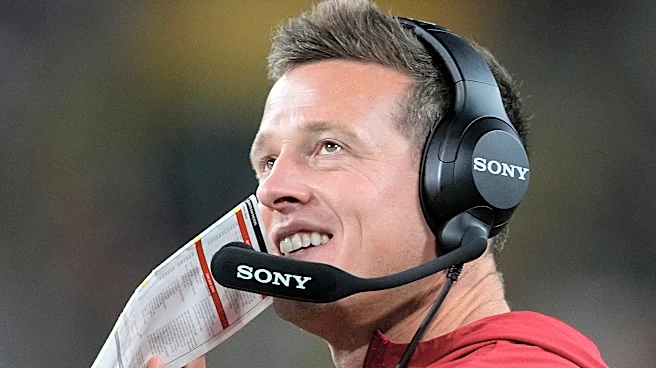




For the 2026 Arizona Cardinals, there may be no more important storyline than Mike LaFleur’s development as a head coach.
Increasingly, there are two pathways for bad organizations to become good: Draft a star quarterback or find an elite play-calling head coach. The former is closed off to the Cardinals until next April. The latter? It’s in their hands over the next four months.
The blueprint is well-established. In 2025, Ben Johnson and Liam Coen both accomplished the head coach-driven turnaround. In 2024, Sean Payton pulled the Broncos out of the wilderness. Even the Rams — as hard as it is to remember now — were putrid for a decade before Sean McVay arrived.
There is, of course, far more to being a head coach than playcalling. But since the
emergence of McVay and Kyle Shanahan, this has been the league’s default setting. Of the 10 head coaches hired this winter, eight will call plays.
And in the preseason, LaFleur showed plenty of reason to believe he could be quite good at it.
As LaFleur cautioned in a recent press conference, preseason does not always translate into real games. Coaches don’t game plan in preseason, so there’s no way to assess whether they’re able to target a defense’s weaknesses. They don’t sequence plays to lull the defense into an exploitable look. They don’t reveal their most complex play designs. It’s all very basic.
But even still, we could see the core tenets of LaFleur’s system in action, especially in the 11 snaps the first-team offense saw against the Las Vegas Raiders.
— Theo Mackie film (@theomackie_film) September 2, 2026
Take this play, which works for a variety of reasons.
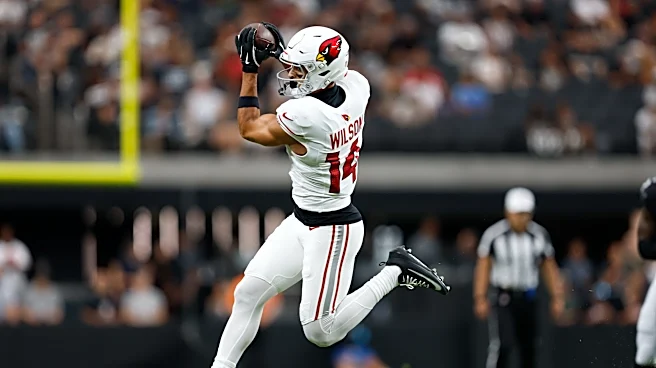
By leaking Michael Wilson into the flat on the backside of an outside zone play action, the Cardinals are forcing the Raiders to cover every blade of grass, from sideline to sideline. That’s the core philosophy that McVay and Kyle Shanahan used to take over the league a decade ago.
But the details are notable too. Because the Cardinals are in 12 personnel (one running back, two tight ends), the Raiders match with base personnel and a single-high safety look. There’s only one deep safety, so the cornerback (No. 5) is forced to carry tight end Teagan Quitoriano’s corner route because he has no help over the top. With Trey McBride on the field, that effect would only be amplified.
As a result, the Raiders have no one in Wilson's vicinity when the ball is delivered.
Plus, you can bet that the Cardinals have a run play built to look identical to this. Split zone runs, with a wide receiver blocking an edge defender on the backside — as Wilson feigns here — are a regular feature of McVay’s offense. After all, it’s a system designed to make the run and pass look identical.
— Theo Mackie film (@theomackie_film) September 2, 2026
Another key element of marrying the run and pass is involving the wide receivers as blockers — something LaFleur has preached all summer.
Neither of these two plays ultimately hit behind the wide receivers’ blocks, but they both show the idea in action.
On the first, both Kendrick Bourne and Jalen Brooks insert through the formation to create favorable blocking angles. That requires buy-in from the wide receivers, who have to want to get dirty in the run game.
On the second, Bourne is used as a motion man to get the defense flowing the wrong way on a counter run to the backside. That only works if the defense is fearful of Bourne being used as a lead blocker on the front side. In this system, he will be.
Again, the play design forces the defense to think. That’s a win for the offense.
— Theo Mackie film (@theomackie_film) September 2, 2026
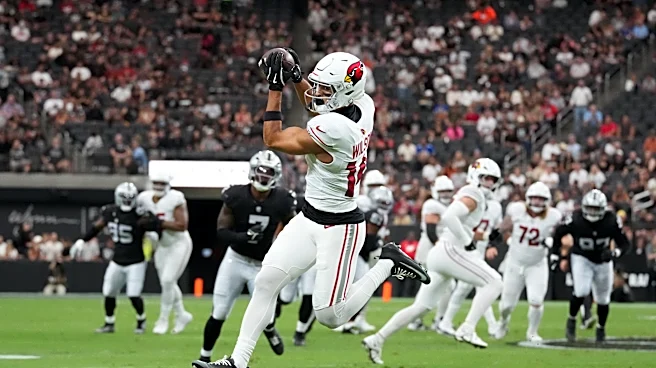
And here, on the Cardinals’ touchdown, is the marriage of the run and pass. This time, it’s Michael Wilson inserting into the D gap, selling the threat of the run and sucking multiple defenders toward the middle of the play.
But there’s more to it than that. Notice two elements of Wilson’s route. He takes an inside release, initially breaking as if he’s running a crossing route. And at the top of his route, he pauses to briefly engage in a block.
All of that is to create time, so Wilson can cut back toward the sideline at the perfect moment: When Jacoby Brissett is setting his feet, while Marvin Harrison Jr. is directly behind Wilson. That puts the safety (No. 20) in conflict. He has to choose between covering Wilson or Harrison. Either way, the Cardinals will have one of their top receivers in one-on-one coverage.
The result is a touchdown, created by LaFleur’s emphasis on the details of playcalling. The Cardinals hope it will be the first of many.
This article originally appeared on Arizona Republic: What we learned about Mike LaFleur's offense during preseason