



Andrew Lloyd Webber's iconic Broadway smash hit "Phantom of the Opera" returns to the ASU Gammage stage to celebrate 40 years of music, love and dramatic chandeliers.
Yes, "Phantom of the Opera" has officially arrived at ASU Gammage. No matter if you've seen the show a hundred times or for the first time, it always leaves you awestruck and humming the entire drive home.
And, really, no show is ever the same as the last. The principal actors can change, the blocking can change, even the sets can change, adding in new layers to each iteration of "Phantom."
According to Jovon Shuck, "Phantom's" stage manager, this particular run of the show pays a lot of homage to its original design.
"The director of our show has been with the show for a long time
and is sort of the show's unofficial historian," said Shuck. During rehearsals, he would break out his iPad to reference notes and sketches from the original production in the '80s or '90s or even when the show was first being put together.
"I think it's important that we are still connected in a straight line back to that production and be able to tell that story with those intentions in 2026 and bring it to an audience fresh," said Shuck.
Supporting Arizona crews at Gammage
And part of what makes these productions so special is that local crews are hired to help put them on.
"In each city we hire roughly 100 local people to help us move the show in and out and then an awful lot of those people stay every night and help us run the show," said Shuck. "They dress the performers, they make repairs to costumes, they're helping with wigs, they're helping move all the scenery."
That means when you go to ASU Gammage, you're not only supporting the touring cast and crew but also local talent.
An over-the-top set with lots to take in
What makes "Phantom" so special — aside from the iconic music — is how over the top it is from top to bottom.
Audiences will be treated to pure opulence in both the set design and costuming, with big set pieces that are detailed, gilded and glide seamlessly, transitioning one scene to another, while the costumes are dripping with real jewels and layered and textured, making them look immaculate no matter if you're in the first row or the last row.
According to Shuck, taking the production back to its roots involved a lot of drapery, a lot of embroidery and "lots of Victorian extravaganza."
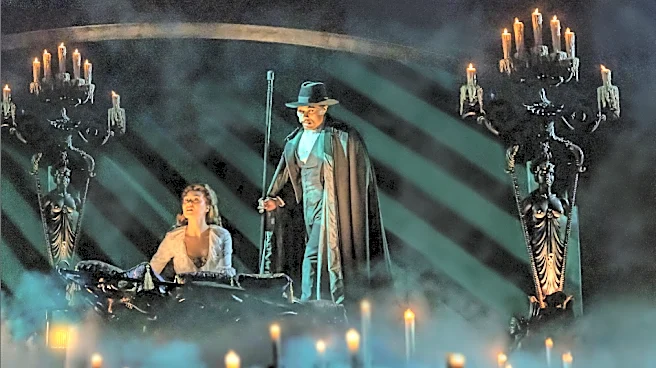
One of the ways Shuck and the team add drama to the set is by covering it in a thick layer of fog, which is perfect for when Christine and the Phantom make their way through the tunnels under the opera house via boat and suddenly dozens of tea lights begin emerging from below the stage.
"There's 30 of them, and we perform every night on a raised deck, about 10 inches, 12 inches above the floor, and those candles are articulated in the floor so they start parallel to the floor and crank up 90 degrees through little flaps in the floor. It's a really neat effect because they appear sort of out of nowhere," said Shuck.
Another grand moment includes a giant staircase that takes center stage during the musical number "Masquerade," where the entire company is on the stairs performing the number.
"Sometimes the stairs get applause," Shuck laughed. "Which it's not often that the set gets applause."
That's right, "Phantom" has stairs worth applauding.
The special chandelier that transfixes the audience
But maybe the biggest, and most important set piece, is the beautiful chandelier that hangs above the audience. At first, it's covered in a drop cloth to protect it from dust before the cloth is dramatically ripped away and the orchestra swells with the iconic "Phantom of the Opera Overture" and it begins to rise higher into the ceiling.
Throughout the first act, the chandelier sparks and lights up before it comes crashing down at intermission. And it takes a lot of prep work to ensure it can safely fall every night.
"We have an advanced carpenter who goes and does what we call a site survey, and that takes the most time because not every show hangs a one-ton moving piece of scenery over the audience," said Shuck.
And the chandelier is so special, it even has a name. According to Shuck, her name is Gillian in honor of the show's original choreographer Gillian Lynne. She not only weighs a whopping 1 ton, but she also sports more than 20,000 beads and is equipped with lighting effects, sound effects, fireworks, pyrotechnic effects, smoke and haze.
So, while "Phantom of the Opera" is a tale as old as time at this point, it's safe to say that there's a reason that for 40 years audiences have been continuing to flock to performances of Lloyd Webber's iconic musical.
How to see 'Phantom of the Opera' at ASU Gammage
When: Sept. 16-Oct. 4, 2026.
Where: ASU Gammage, 1200 S. Forest Ave., Tempe.
Admission: $91.50-$374.68.
Details: 480-965-3434, asugammage.com.
Meredith G. White covers entertainment, art and culture for The Arizona Republic and azcentral.com. She writes the latest news about video games, television and best things to do in metro Phoenix.
This article originally appeared on Arizona Republic: Why 'Phantom of the Opera' at ASU Gammage is still a must-see