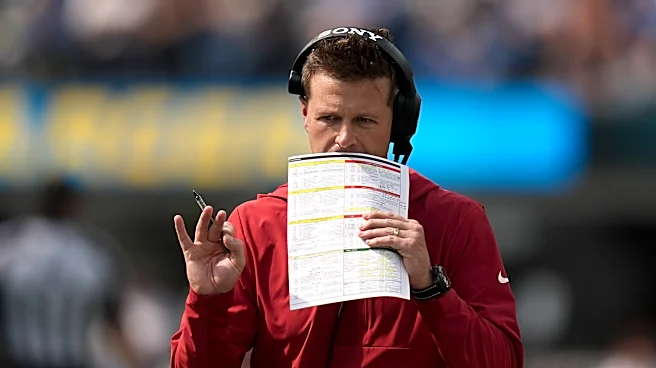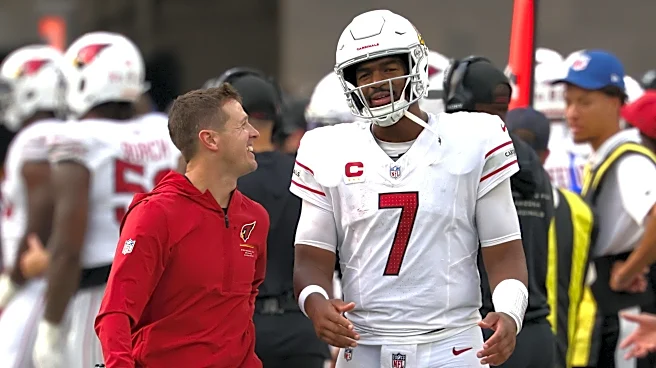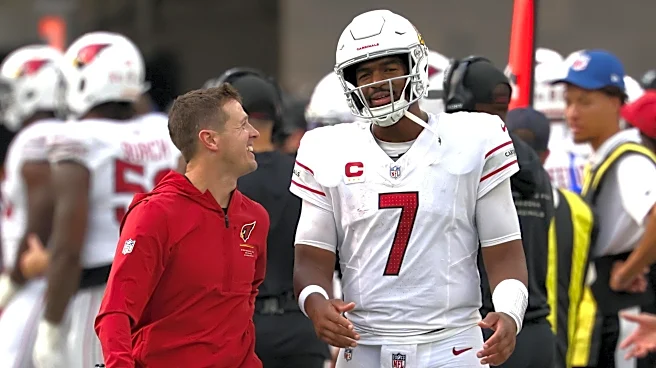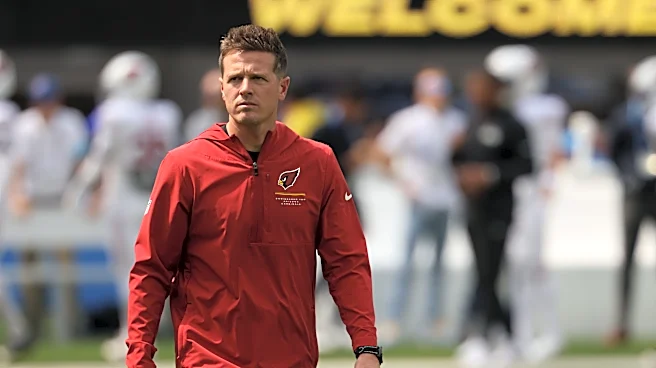


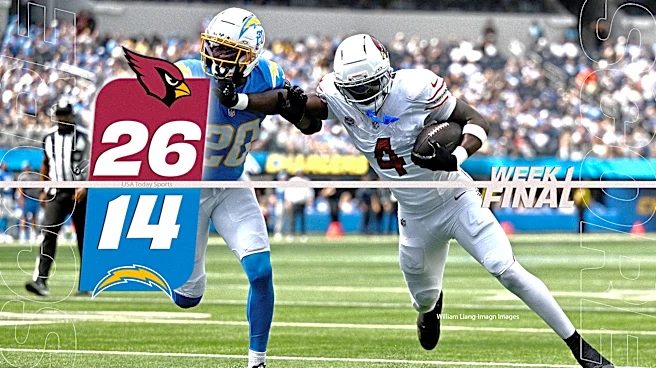
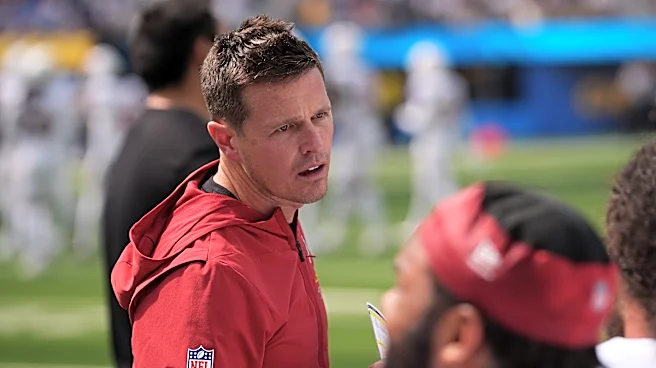
When Mike LaFleur guided the Arizona Cardinals past the Los Angeles Chargers in Week 1, he accomplished something no NFL head coach had done in more than three decades.
Depending on the sportsbook, the Cardinals were listed as anywhere between 8.5 and 10.5-point underdogs. The most recent coach, per ESPN, to win his debut when facing that large of a spread was Bill Cowher with the 1992 Pittsburgh Steelers. Not bad company.
LaFleur did it by following in the footsteps of his coaching tree. Over the past decade, Sean McVay’s former offensive coordinators — Matt LaFleur, Kevin O’Connell and Liam Coen — have emerged as some of the sport’s best playcallers by finding creative ways to confuse opposing defenses and put their players in advantageous positions.
When he was hired, the question was whether LaFleur could emulate their success, even though he produced inconsistent results in his lone previous stop as a playcaller, with the 2021 and 2022 New York Jets.
The early returns, against the Chargers, were encouraging. Here’s what the film showed.
Manipulating the defense with scheme
Back in training camp, LaFleur sat down with The Arizona Republic to explain one of the biggest lessons he learned from Kyle Shanahan, his first mentor in the NFL.
“Kyle focused more about defensive play than he did offensive play,” LaFleur said. “What are defenses trying to do? What are the rules of their front structures? What are the rules of their coverages? How can we get them off their rules in their coverage? … Cause there's different ways that you can get that done. Formationally, where the back aligns, all those kind of things.”
Now, fast forward to Week 1. Immediately, LaFleur showed what that can look like.
On the very first play of the game, the Cardinals lined up under center and had Jacoby Brissett drop back without play action. Once upon a time, this was the default, but beginning in the late 2000s, shotgun-heavy offenses took over the NFL. Last season, the Cardinals attempted just four pass attempts from under center without play action.
Elsewhere, though, under-center straight dropbacks had a minor resurgence. The 49ers attempted 52 such passes, the most of any team in four years.
When asked about the benefits of those looks in his press conference on Monday, Sept. 14, LaFleur offered a knowing smile, declined to answer and said, “We’ll talk in February.”
So, we don’t know exactly what the Cardinals saw from the Chargers defense here. But typically, the benefit of an under-center straight dropback is that it allows the quarterback to keep his eyes on a defense’s post-snap rotations, while still giving an elevated pre-snap threat of the run.
Just look at these two plays from the Cardinals’ win.
— Theo Mackie film (@theomackie_film) September 16, 2026
On the first play of the game, the Cardinals are under center with two eligible receivers close to the core of the formation. That look introduces a run threat, and the Chargers respond with a single high safety in cover-3. Whether or not the Cardinals expected that exact coverage, their play call perfectly attacked its weaknesses, with a pair of seam routes. Both came open, and Brissett hit Trey McBride for 27 yards to open the game.
A drive later, the Cardinals again line up in a 2x2 set, with two eligible receivers to each side of the field. But this time, Brissett is in shotgun, with all four receivers spread out wide. The Cardinals’ pre-snap look is telegraphing a pass.
Predictably, the Chargers respond with a more cautious, two-high safety coverage. So the Cardinals have a play designed to attack that, with McBride running an over route to exploit the space between the two safeties.
Both times, LaFleur was able to scheme up an advantage for his offense.
Later in the game, he used 21 personnel (two running backs, one tight end) looks to do so again.
— Theo Mackie film (@theomackie_film) September 16, 2026
On the first two plays out of this formation, the Cardinals motion Jeremiyah Love left, with Michael Wilson and McBride blocking as if they’re setting up a screen to Love. Both times, they then hand it off to Tyler Allgeier. Whether or not this is a run-pass option, it looks that way to the Chargers.
So, facing second-and-14 on the final play of the clip, LaFleur goes back to that same formation, with the same motion.
Before the ball is even snapped, you can see the impact that has on the Chargers. The box safety, Derwin James, is signaling to the rest of the defense to adjust coverage and rotate toward the perimeter. He’s seemingly expecting that same screen to Love.
But that’s ideal for the Cardinals. On second-and-long, they likely know a blitz could be coming. And by clearing space over the middle of the field with their formation, they’re able to run a pair of dig routes, attacking the space behind the blitz. The result is an easy completion to create third-and-manageable.
And again, it happened because the Cardinals were a step ahead of the defense.
All game, LaFleur’s formations and motions helped generate these types of advantages. Because the Cardinals largely struggled with their run blocking, it was most evident in the passing game. But on the ground, they also created favorable angles — they just couldn’t always capitalize.
“Being able to go out there,” LaFleur said, “and put different personnels in and make those defenses at least discuss it, talk about it, that takes time, so that they’re not just zeroed in on one or two things.”
And then there was the third-and-4 in the third quarter, when the Cardinals caught the Chargers off guard with a quick snap.
— Theo Mackie film (@theomackie_film) September 16, 2026
For an offensive playcaller, this is a thing of beauty.
“One of the few things on offense that is our advantage: We know when we’re snapping the football,” LaFleur said last week. “The defense should not know.”
Here, his offense provided the perfect example.
Mitigating pressure with scheme
The Cardinals also created an advantage for themselves by consistently having answers for the Chargers’ pressure packages.
In his press conferences since the game, LaFleur has repeatedly bemoaned one red zone play when the Chargers schemed up a free rusher, but that was the exception. On 14 blitzes, the Cardinals allowed just three quick pressures — and completed passes against two of them. Last year, they allowed quick pressure on 30.5% of blitzes. And on those 50 quick pressures, they completed just 18 passes.
In other words, this version of the Cardinals allowed less pressure and had more answers when they were pressured.
— Theo Mackie film (@theomackie_film) September 16, 2026
The first play here is an example of the Cardinals finding solutions in protection. Because they slide the offensive line left, the potential unblocked pressure is off the right side. And with Marvin Harrison Jr. running an intermediate dig as the lone route to that side, there’s no quick option to throw over the blitz.
So they build their protection plan accordingly, with both McBride and Love staying home to block the safety, rather than leaving anyone unblocked. That gives Brissett plenty of time to scan and find Kendrick Bourne for a nice gain.
The next two plays are different. On these, the Chargers do generate pressure, but the Cardinals’ route concepts give Brissett solutions.
On the second play, the potential unblocked pressure is off the left side, with the offensive line sliding right. But if the Chargers bring two extra rushers off that side — as they do — then the Cardinals know they’ll likely see man coverage. And against man with a single high safety, Harrison’s go route is a shot they’ll take every time.
The final play, meanwhile, is a naked bootleg, designed for the possibility of an unblocked defender off the edge. With McBride initially selling the run by taking two steps inside, the linebacker gets sucked into the play. He recovers well, but the run/pass conflict puts him in a near-impossible position.
As with the deep ball to Harrison, it still requires an excellent throw from Brissett. But both times, the solution was built into the play design.
“It’s all-encompassing,” LaFleur said. “It’s the play, it’s the guys doing their job, it’s the quarterback getting it out and it’s the offensive line straining.”
That recipe is how you end up completing 7 of 12 passes for 77 yards and a touchdown against blitzes, as Brissett did. And it’s how a head coach walks away from his debut with an upset win.
This article originally appeared on Arizona Republic: How creative schemes have the Arizona Cardinals surprising opponents