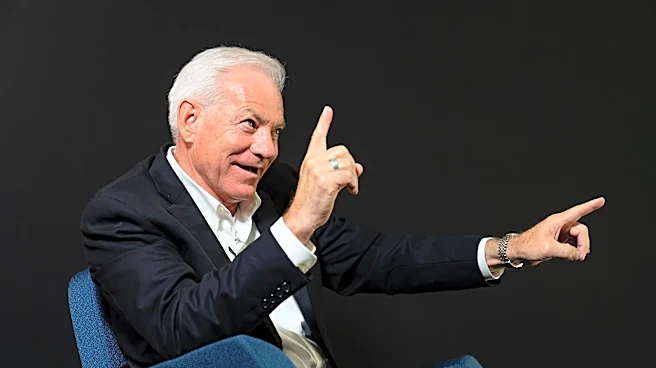






Outgoing Arizona Rep. David Schweikert does not know his next professional step after he leaves Congress in January, but he is not ruling out another run for office.
Wherever he lands, he will advocate for the Republican Party to "become conservative again," he said. And he'll keep talking about "math" — the dire need to address the nation's debt and what he has repeatedly warned could be an economic crisis if no action is taken.
"I'm always going to evangelize for what I believe is right," he said.
The eight-term Arizona congressman discussed his departure from the U.S. House of Representatives and what comes next in an interview with The Arizona Republic. He acknowledged miscalculations in the gubernatorial campaign that ended his time in Washington,
D.C., and admitted to a tinge of heartburn as he prepares to leave Congress.
It was not over his distant second-place finish in Arizona's Republican gubernatorial primary and not because the lifelong conservative leaves vacant one of the nation's most competitive seats in a year when Democrats could take control of the U.S. House.
The heartburn, he said, is that he didn't find the right words to convince the public or his congressional colleagues to tackle the nation's debt. He wondered whether he stayed too long, deluding himself into thinking action was on the horizon.
"I've loved what I've done," he said. "And at the same time, my heart is absolutely just crushed.
"Debt. Deficits. Not telling the truth about demographics. The fact that every day we wait, fixing it is harder," he said. "And somehow I'm a pariah for wanting to fix the things that are tough."
'A tough shot'
Schweikert has flirted with running for a different office before and took the plunge with his September 2025 announcement he would run for governor. Entering the race 14 months before the general election was too late, Schweikert said.
"We knew it was a tough shot, getting in late without the president's endorsement," he said.
Two well-known Arizona Republicans, Karrin Taylor Robson and Rep. Andy Biggs, were already seeking the GOP nomination to challenge incumbent Democrat Katie Hobbs in November. Taylor Robson and Biggs occupied two major lanes of GOP politics: fiscal conservatives and the populist wing loyal to President Donald Trump, respectively. And both carried Trump's endorsement.
"He was the third wheel," said Kyle Kondik, managing editor of Sabato's Crystal Ball newsletter at the University of Virginia Center for Politics. "It ended up being kind of a quixotic exercise, because he got in and just really never got any traction."
Taylor Robson, a wealthy land-use consultant, signaled she would again dip into her own purse to fund her campaign with an early $2 million advertising spend. It was a down payment and a message to clear the field that did not deter Schweikert. Taylor Robson ended her campaign in February.
Schweikert's relatively late debut left many Arizona political insiders and observers scratching their heads.
Addressing criticism that he was too much like the better-funded Taylor Robson — that they both would appeal to Republicans who didn't fully embrace Trump — Schweikert said he offered voters a proven conservative voting record. Taylor Robson, in contrast, had not held elected office before.
Schweikert blamed a disappearance of donors for his dismal fundraising numbers.
He raised $1.2 million for his campaign, state reports show, but over $700,000 was self-funding or transfers from his other campaign accounts. He entered the run-up to the primary with just $86,000 on hand. That sum was less than the salary he'd earn as governor and far from enough to turn his campaign's skirmishes against his GOP opponents into meaningful attacks using advertisements or mail pieces.
"I wish I had had more realistic understanding of how much of the donor class had tuned out," he said. "They were just frustrated, so even people who had been with me for a decade basically said, 'David, we've closed up our checkbook to all politics.'"
It was a "miscalculation" to believe voters would respond to his argument that he was more electable than Biggs or Taylor Robson in a matchup against Hobbs in November, he said.
"We had a sense of reality in the final months," he said. "If the resources weren't coming ... we probably weren't going to make it unless there was a sudden reformation of understanding the party wanted conservatism instead of populism."
That transformation eluded the GOP ahead of July, as it has in past election years. Republicans have lost the Arizona Governor's Office, top statewide offices, and both of the state's U.S. Senate seats to Democrats after nominating Trump-aligned Republicans. Schweikert has instead walked the GOP tightrope between MAGA and moderates.
"I was hoping evangelizing conservatism instead of anger was a path," he said. "I believe it is a path, maybe ... I was trying a little too early."

Could he have won again?
Schweikert didn't flinch at the competitiveness of his congressional district, which he said he could have won again this year had he run for the seat.
"It would have been tough, but when has it not been?" he said.
The wealthy 1st Congressional District, which spans north Phoenix, Scottsdale and northeast Valley suburbs, has become increasingly competitive. Schweikert defeated Democrat Jevin Hodge in 2022 by less than 1 percentage point, and bested Amish Shah by over 3 1/2 points in 2024.
Shah, a physician and former state lawmaker, clinched the Democratic nomination again after a divisive primary and faces Republican and former NFL kicker Jay Feely in November. Democrats this year see a promising convergence of factors in Shah's favor: a midterm election in which the Republican president's approvals are sinking and the voluntary departure of longtime political survivor Schweikert wiped away any incumbency advantage.
Whether Schweikert was in the race or not, the district would likely be a toss-up, Kondik said.
Schweikert said it was not fear of losing his House seat that drove his gubernatorial ambition, but frustration with Congress and his belief that, as governor, he'd have more power to implement tech innovations and solutions. Consensus among a majority of the 435 members of the House seemed increasingly impossible.
"I had almost crossed the point where running for governor or not, I wasn't going to run for Congress again, because you're not allowed to strangle the people you work with," Schweikert said.
'A little out of sync'
Schweikert is a portrait of the Republican Party of 16 years ago, before its populist makeover.
"In some ways, I'm a little out of sync with where a lot of my party is," he said.
In 2010, halfway through Democratic President Barack Obama's first term, Schweikert was elected to Congress in the tea party wave. Republicans flipped control of the U.S. House from Democrats as economic anxiety from the Great Recession and Obama's push for the Affordable Care Act fueled demand for fiscal conservatism.
His fixation was reining in the national debt — currently at a record $40 trillion, double what it was a decade ago. No number of weekly speeches from the House floor warning of economic collapse seemed to convince members of Congress to act. He felt repeatedly betrayed by false promises, including a final time that convinced him to run for governor, he said.
After passing Trump's signature One Big Beautiful Bill in 2025, Schweikert came back to Arizona for the summer recess thinking the first item on the agenda when he returned to Washington would be addressing the debt and the nation's fiscal stability. Talking points about curbing waste and fraud wouldn't be enough, Schweikert said, so he shopped around ideas for spending cuts that would not affect entitlement programs and program modernization instead.
But Republican leaders who control the House and the White House did not keep a promise for a second reconciliation bill, Schweikert said. He felt like he fell for it again.
"I'm trying to save the future and the people I work with don't care," he said.
What they did care about, he said, were political victories and vanity stoked by feeding people what they want to hear. He has seen signs of change that give him hope, he said, pointing to the popularity of long-form podcasts and, sometimes, YouTube videos of his own floor speeches.
"My belief has grown, until the public demands it, the political class will just feed them what they think is just, you know, a sugar appetite of happy talk and rage," he said.
"I think maybe the voters are ready to be treated more like the thinking human beings they are," he added.
What's next?
Schweikert's term ends in January. Before then, he will support Biggs for governor and Feely as his successor.
"I'm voting for my Republican ticket," he said. "It is what I am, and I've done it my whole life."
Afterward, he plans to spend more time with his family, including his two young children, who he often cites when demanding members of Congress address the nation's "fiscal insanity." He mentioned the seemingly quixotic prospect of a debt commission that might materialize and suggested he could be a "semi-outsider" on that panel.
"God knows I have charts," he joked.
Whatever he decides, one of the longest-serving members of Arizona's congressional delegation is leaving the door open for a future political bid.
"I may run for office again one day, but it would be something in Arizona, because my disdain for Washington is hard to describe," he said.
Reach reporter Stacey Barchenger at stacey.barchenger@arizonarepublic.com or 480-416-5669.
This article originally appeared on Arizona Republic: What's next for Arizona Rep. David Schweikert?