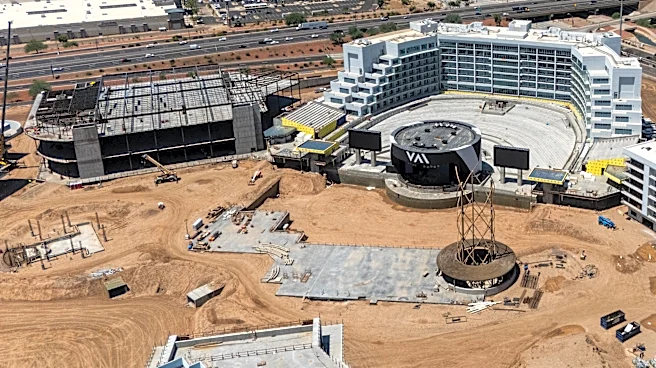






An unfinished orange roller coaster looms along Loop 101, south of State Farm Stadium.
Instead of thrilling riders, it puzzles those driving by, who have seen the same view for years.
Around the roller coaster, a massive construction zone five years in the making spans dozens of acres, dotted with buildings in various stages of construction surrounding a center amphitheater.
The ambitious project, called VAI Resort, would be the largest hotel in the state, once it opens. It occupies prime real estate in the city's entertainment district. Some city leaders hope it puts Glendale on the map for Las Vegas-style hospitality in Arizona.
Plans have been approved for about 1,100 hotel rooms across four towers, an 11,000-seat amphitheater, a 50,000-square-foot
“party island,” a “sky bar” that offers food and drinks atop a 130-foot tower, and an amusement park, called Mattel Adventure Park, with rides and attractions for kids and families.
The project is likely to expand because the developer closed on more land in late 2025, near the initial construction site at Loop 101 and Cardinals Way.
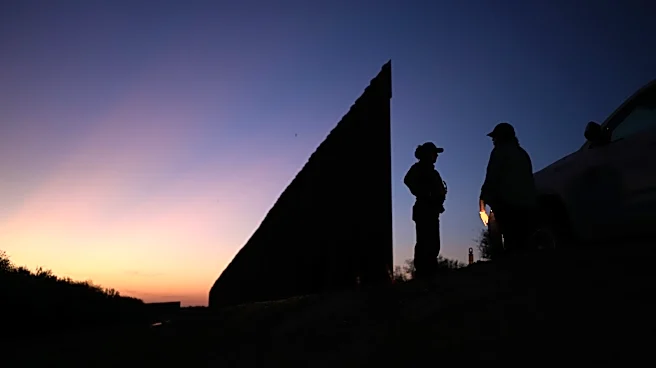
The resort's rookie commercial developers, who have made billions of dollars from border wall construction, have provided limited information. And the prolonged construction, changes in plans and the seemingly incremental progress have left some people frustrated.

“I’m rather weary at this point,” said Glendale City Councilmember Lupe Conchas, adding that VAI has become a running joke on social media.
The resort was originally proposed to open before Glendale hosted the Super Bowl in 2023, but under different ownership. The project broke ground in June 2021. In April 2022, it was sold to VAI Global Development, which immediately expanded its plans and pushed back the construction timeline.
The sale also changed the target demographic for the resort. When it was first proposed, the project’s centerpiece was the water feature, then called a “lagoon.” It was proposed to have white sand beaches and feature water sports and activities like scuba diving and windsurfing. The focus on sports and swimming seemed to target families with children.
VAI still features a large pool, which is planned to include a white sand beach. But the resort’s role as a concert venue has eclipsed the focus on outdoor recreation. Its owners have promoted it as the best way to see a concert, with hotel rooms acting as suites and an amphitheater in the center of the grounds. Two of the hotel towers are named after musical themes: Rhythm and Cadence. A “party island” designed to replicate the vibes of international party hotspots like Mykonos and Tulum indicates it is targeting a grown-up audience.
Mattel Adventure Park, which was announced when the project was under its first ownership, is still part of the project. It is slated to cater to children, with rides themed after iconic toys Hot Wheels, Barbie and Thomas & Friends. VAI is now the owner and operator of the Mattel Adventure Park, a change from when the park was planned to be a tenant at VAI.
While Conchas and some of his constituents are skeptical, others said they are unfazed by the slow progress and are optimistic for the resort’s future.
“I’m encouraged by what has taken place,” Dianna Guzman, the Glendale councilmember whose district includes VAI, said. “I see the progress they’ve made; I’m not worried it’s not going to be completed.”
Patrick Banger, who took over as Glendale city manager in January 2026, said he has visited the construction site a handful of times to get a feel for the project.
“These are people who have experience in a different style of hospitality,” he said of some of the people VAI has hired. “It’s unlike anything we have in our city or in our region. I have not seen a resort of that density or magnitude outside of Las Vegas.”
The level of complexity in the project, like creating tunnels that musical acts can use to reach the stage without being spotted by the crowd, are “at a level I have not seen in my career,” Banger said.
Banger said it is not surprising to him, given the scale of the construction, that VAI has taken years to build.
“I’d love it if it was done tomorrow,” he said.
Who are the VAI Resort developers?
The project is owned and developed by VAI Global Development and is the company’s first commercial development project. It is closely connected to Fisher Industries, a civil construction company led by Tommy Fisher, the father of VAI CEO Grant Fisher. Several of VAI Global Development's listed leadership team members, including Grant Fisher, also work for Fisher Industries.
Fisher Industries had been contracted to work on construction of the resort under its first ownership but bought the project in 2022. Tommy and Grant Fisher formed VAI Global Development that year.
The Fishers have previously said that VAI is privately funded.
Leaders from VAI repeatedly declined an in-person meeting or phone call with The Arizona Republic for this story. Rian Kirkman, senior vice president of marketing for VAI, did provide some information by email.

Before starting VAI, the Fishers solely focused on civil construction projects, including freeway and bridge construction and dams.
Fisher Industries is one of the largest contractors making upgrades to and constructing the border wall between the United States and Mexico. According to federal spending data, Fisher Sand and Gravel, one of the arms of Fisher Industries, has been awarded about $14.66 billion worth of contracts since 2023 to construct border wall sections in Arizona, New Mexico, Texas and California. The company’s largest contracts are in Arizona and Texas, worth $5.1 billion and $4.6 billion, respectively.
The lion’s share of those contracts came in the 2026 fiscal year, which ended in June. Fisher received eight contracts that year, according to federal data.
U.S. Customs and Border Protection declined to give a status update on Fisher’s progress on its border wall contracts but provided a list of contracts that the company was currently working on. That list totals 10 projects, all of which are listed as “awarded” on a CBP website dedicated to updates on the status of the wall.
Conchas said he believes the Fishers have concentrated on border wall contracts at the expense of finishing VAI.
“I guess a developer can focus on two things at once, but so far that hasn’t happened,” he said.
Kirkman declined to comment about Fisher Industries' work on the border wall.
What's being built at VAI? How is it progressing?
Five years into construction, most components are still far from finished, according to data provided by Glendale in July 2026.
A development agreement approved between VAI and the city in late 2024 lists the “completion of construction date” as March 31, 2027, but that date certainly will be moved based on the project’s status. Glendale officials said VAI leaders have told them they would announce an opening date when they were 12 months away.
“They've been patient with the development,” Kirkman said of the city. “And while we are all excited for the resort to open, we believe this approach will result in a better guest experience in the long term.”
Glenn NP Nowak, an associate professor of architecture at the University of Nevada, Las Vegas, said resort development strategies and timelines vary widely from project to project.
“Perhaps the ‘typical’ thing about large-scale construction is that it tends to be atypical,” Nowak said in an email. “They are all unique. Even the very large resorts we have in Las Vegas, one right after another, while there are similarities, each property is different.”
The only VAI building on the site that is complete is the company office.
The other pieces are in varied stages of construction. Glendale data shows the Rhythm Hotel, the hotel building closest to the Mattel Adventure Park, is the furthest along. That building is 75% complete. Two of the other hotel towers, called the Amphitheater Hotel and the Cadence Hotel, are 67% and 65% complete, respectively. The fourth hotel building, called VAI Villas, is 20% finished.
Kirkman said recent work on the Amphitheater Hotel, which has the video screens that are visible from Loop 101, has concentrated on the hotel lobby, guest rooms and eighth-floor steakhouse and champagne lounge.
“While you might not see that from driving by, some of those interior spaces are looking more and more like a resort and less like a construction site,” he said in an email.
City data shows the centerpiece of the project, the music stage and amphitheater, is 55% complete. VAI Global Development CEO Grant Fisher said in late 2023 that the amphitheater and concert stage design had been retooled dozens of times, contributing to some of the slow progress on that portion.
In a July 2026 email, Kirkman said some of the audio and visual capabilities for the stage have been installed, allowing for testing on the sound and light systems.
“Behind the scenes, we’ve been working with such a creative group of design firms on rendering all of the restaurant, hotel and entertainment spaces,” Kirkman said. “We are close to final and will have a large number of updated renderings to share in the next few months.”
Kirkman said VAI is preparing for a “major announcement” in the fourth quarter of 2026, which he said would be exciting for the resort and for Glendale.
So far, no performing acts or events have been announced at VAI. In 2024, VAI announced celebrity chef Jose Andres would open his first Arizona restaurant at VAI, but Andres did not respond to requests for comment for this story.
The resort has two large pools, about one acre each, according to Glendale documents from 2025. In September 2025, Glendale approved a deal that would allow VAI to buy 50 acre-feet of treated wastewater annually to fill them. It would be enough water to fill about 25 Olympic-sized pools per year.
The deal lasts 25 years with two options for 10-year extensions. The resort could choose to buy that water from Glendale or go to the market and see if it can buy the water for a cheaper price.

The Mattel Adventure Park is 60% complete, but other portions of the project have made less progress, according to city data. The convention center building and the Konos party island are both at 15% completion.
The project team for VAI previously estimated the resort would cost $1.2 billion to develop, but construction costs have increased significantly since that estimate was released.
“We are lucky that ownership's mantra has always been that we want to do it right, not necessarily do it as fast, or as cheaply, as we can,” Kirkman said. “That’s the benefit of private ownership.”
Kim Grace Sabow, president and CEO of the Arizona Lodging and Tourism Association, said the group was confident VAI would be worth the wait.
"The scope and ambition of this project have grown considerably since it was first envisioned, and we believe the result will be something truly transformational not just for Glendale and the West Valley, but for Arizona tourism as a whole," Sabow said in an email.
Once VAI is open, she said, it would help Arizona attract major events and regular tourism.
"Arizona competes every day for leisure travelers and corporate meetings and events, and a destination of this scale gives us another powerful asset to help us win that competition," she said.
Nowak, the architecture professor, said under ideal conditions, a large-scale resort should take two to three years to build.
The Aria Campus development in Las Vegas, formerly called CityCenter, took about five years to develop, he said. That project is one of the largest resort developments in the world, with multiple hotel towers and two shopping malls. The Durango Casino and Resort in Las Vegas, which has about 200 rooms, a casino and other uses. It took about two years to build, but it is significantly smaller than VAI.
The most recent resort to open in Las Vegas, the Fontainebleau, took about 16 years to build, but there was no progress at the development for about 12 of those years.
The scope and timeline of the VAI development could change again. In late 2025, VAI bought 33 acres south of the resort. The land is vacant but has zoning that allows a wide variety of buildings with height up to 15 stories, which would be the tallest buildings in the city aside from State Farm Stadium.
Kirkman said the company was using the land as a laydown area for equipment and materials, but he did not specify what the land would be used for after it was no longer needed for construction equipment.
While some Glendale leaders are optimistic about the project, others remain skeptical.
Guzman said she has toured the construction site a few times and has seen measurable progress. “I was amazed at how far they’ve come,” she said. “It is definitely advancing.”
Conchas offered a much less rosy assessment. "We have put our reputation as a city on the line for this," he said. "It needs to get finished. If not, it would be a huge embarrassment for the city."
Corina Vanek covers development for The Arizona Republic. Reach her at cvanek@arizonarepublic.com. Follow her on X @CorinaVanek.
Like this story? Get more West Valley news straight into your email inbox by signing up for our free weekly West Valley Newsletter, which comes out on Tuesdays.
This article originally appeared on Arizona Republic: Will VAI Resort ever open in Glendale? Why it's still under construction