







Arizona's Heber horses and Salt River wild horses are governed under different laws and management systems, but both controversies raise the same fundamental question: Where is the site-specific science supporting decisions about their future?
For the Heber horses, the Forest Service has sought to classify free-roaming horses in the Apache-Sitgreaves National Forests as unauthorized livestock. That label carries enormous consequences, yet classification is not a substitute for evidence about the horses themselves, their history or their actual ecological impact.
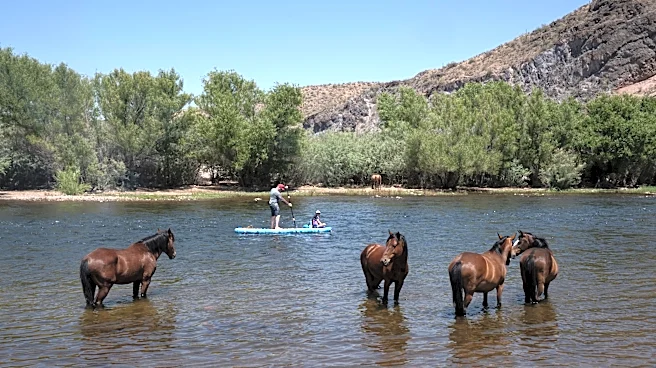
Along the Salt River, the issue is different but equally troubling.
Arizona law protects the Salt River wild horses, yet the herd is being reduced toward a population target that did not
originate with a comprehensive scientific carrying capacity study.
An early target of approximately 100 horses emerged from a confidential straw poll during a collaborative process. That number was later negotiated upward to approximately 120 to 125.
A straw poll can measure the preferences of people in a room. It cannot determine how many horses an ecosystem can sustain.
The Salt River herd has already declined substantially through fertility control and natural attrition. Before additional horses are permanently removed, Arizona should require independent science demonstrating what population the Lower Salt River can actually support.

The same principle should apply in Heber.
Wild horses are routinely blamed for damaged vegetation and degraded habitat, but public lands are affected by many forces, including livestock, drought, wildfire, recreation and development.
The scientific question is not whether horses affect their environment. Of course they do. The question is how much, compared with other influences, and whether that impact justifies removing them.
That requires field research, measurable evidence and transparent methodology.
Generalized studies from other western landscapes cannot automatically answer what is happening along the Salt River or in the Apache-Sitgreaves National Forests.
I have studied wild equids and their ecosystems for decades. These disputes are rarely only about horses. They involve competing values and competing uses of public lands.
That is precisely why government must distinguish objective science from management preference.
If the Forest Service believes the Heber horses are causing unacceptable ecological damage, it should demonstrate that with site-specific evidence.
If Arizona officials believe the Salt River can sustain only 120 or 125 horses, they should show the scientific calculation supporting that number.
The public should not have to accept a label in one forest and a straw poll along another river as substitutes for science.
Before Arizona permanently loses more of these free-roaming horses, there is one question officials should be prepared to answer:
Where is the science?
Craig C. Downer is a wildlife ecologist who has studied and advocated for wild horses and burros for decades.
This article originally appeared on Arizona Republic: Arizona's wild horses deserve science, not assumptions | Opinion