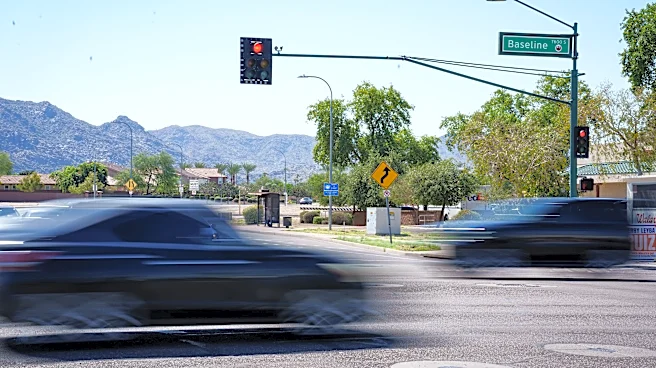








If you’ve ever wondered why you’re stuck at a red light in Phoenix when no other vehicles are around, or why backups at some intersections seem chronic, here's one answer:
The city's traffic management system isn't working properly.
Network failures and dark cameras are a daily problem at the city, creating a less-than-ideal environment for motorists. The network and camera problems mean technicians get fewer automated alerts about timing problems that would cause drivers to hit more red lights than necessary.
On Oct. 5, when The Arizona Republic visited the city's Traffic Management Center, three-quarters of the city's 587 closed-circuit TV cameras mounted on signal lights were sending no images, and only 39% of the city's 1,359 intersections
with signal lights were communicating with the central system.
A map of Phoenix intersections displayed on traffic-management software at the city facility illustrates the lack of connectivity with color-coded dots: Green indicates connected signal lights at an intersection, yellow means the intersection is connected but has communications failures, and reddish-brown shows intersections that aren't yet enabled to hook up to the network.
When The Republic visited the center on Oct. 5, the reddish-brown and yellow dots overwhelmed the green dots on the screen.
Traffic signals' basic functions aren't affected by the problem. Lights cycle between red, yellow and green. Turn arrows send vehicles on their way. But lack of signal-light connectivity means city staff doesn’t receive as much information about how an intersection is functioning, leading to delayed problem-solving. What's more, city workers must drive to intersections to fix problems that other cities or counties handle remotely.
Reasons behind the problems are many, including aging technology that needs to be replaced and a lack of necessary infrastructure in some parts of the city, such as a lack of fiber-optic cables.
The current issues began with a large data crash in the system in early 2024, said Simon Ramos, the city's traffic engineering supervisor and head of the city's Traffic Management Center. Most of the cameras had to be taken offline when work on an upgrade began in early 2025, he said.
"Reconnecting cameras and field devices requires extensive work due to the size and complexity of the network," Ramos said. "Although many cameras were installed before the overhaul, the temporary loss of connectivity is not a result of system failure. It is a planned part of the network-wide upgrade and not a waste of past investment."
Planned or not, the city’s traffic management system has been in disarray for more than a year as the upgrade proceeds slowly.
Meanwhile, Phoenix has some of the worst traffic collision statistics in the country: It's near the top for red-light-running, pedestrian fatalities and total per-person traffic fatalities each year.
The City Council adopted the ambitious Vision Zero program in 2022 and created the Vision Zero Community Advisory Committee with an aim to reduce annual vehicle collisions and deaths to zero by 2050. The program's goals include upgrading signal-light technology.
In an April 20, 2026, presentation to the Vision Zero committee, Ramos said network connectivity was "the most important key element" for the Traffic Management Center.
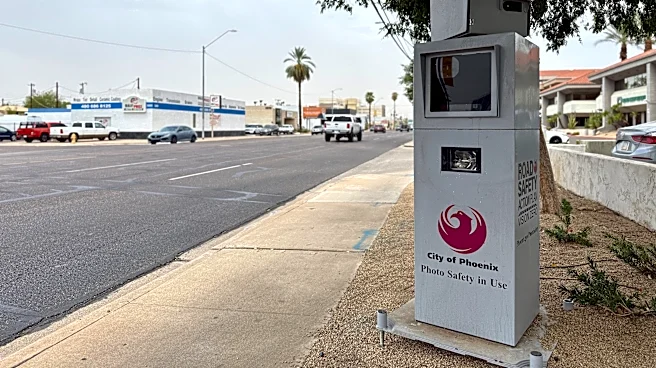
City leaders also decided in July 2025 to renew a photo enforcement program, adding 17 speed or red-light cameras across the city.
Traffic-monitoring cameras don't get as much attention as red-light cameras and Flock cameras, but they can be important to motorists — especially if they're not working.
Traffic safety concerns mount
Two current committee members, traffic engineer Randy Dittberner and political consultant Joe Yuhas, said they had no idea so much of the traffic-management system was offline.
Dittberner, an experienced traffic engineer who works for a private firm, said if someone feels they're waiting at a red light unnecessarily, they may run it. Longer lines of traffic can lead to more rear-end collisions, too, he said.
"Traffic operations and safety are intertwined," he said.
Yuhas said traffic management and cameras must be part of the plan to reach Vision Zero's goal.
"And if we're failing on the technology front, the goal is now going to be even more elusive," he said. "I think clearly these are revelations that need to be brought to the attention of not only our committee, but more importantly, other policymakers."
Both Dittberner and Yuhas attended the April 20 committee meeting featuring Ramos' presentation. But during his talk to the board, Ramos said the city's traffic system was connected to a network. He presented the board with an image of the Traffic Management Center's intersection map, but the photo wasn't current — it was taken before the 2024 data crash, when nearly all the dots appeared green because of connections to the older, rudimentary Wi-Fi system.
Ramos downplayed the problems to The Republic, saying that motorists are somewhat hampered by the partially-working system and that the system "could be improved."
“While this reduces operational efficiency, traffic safety has not been compromised, and staff continue to effectively manage the system during the upgrade period," he said.
Bruce Littleton, a former traffic engineering supervisor who led the city Traffic Management Center until March 2024, said it's the "human" who makes the error when running a red light or making another mistake.
"The system didn't make an error," he said. "Could you have used the system better to lower the frustration or give less opportunity for the driver to make an error? Absolutely."
Phoenix traffic center in flux
Traffic officials in many Arizona cities and counties monitor intersections by way of a wall of video monitors that visually shows real-time conditions on the streets.
Phoenix doesn't have a video wall, although it used to have a more-familiar setup at City Hall until mid-2024. Now, the six members of the city’s Traffic Management Center, whose responsibilities include trying to make sure 1,359 intersections work smoothly, work from cubicles at the city’s Signal Shop facility at 22nd and Jefferson streets.
Signal Shop workers do the physical work of mounting or repairing signal lights.
Ramos said a prime reason for moving the center into the Signal Shop facility was to ensure faster service on problematic signals.
But with the system still in transition, the Traffic Management Center employees use their laptops to pull up live intersection images, usually when they already know there's a potential problem.
Technicians usually find out about a signal-timing issue or intersections that are jammed with unusual traffic back-up because someone called to let them know about it. Then they drive to the intersection to make fixes that, in other, better-equipped municipalities, can be handled remotely.
The basic "pan-tilt-zoom" cameras don't record video, but more of them would literally give city staff better oversight of traffic problems.
The city also has installed 296 detection cameras, which monitor vehicles and pedestrians at an intersection so signal timing can be adjusted accordingly, giving vehicles and people crossing streets a green light when they need it.
Maricopa County, by comparison, owns and manages 188 intersections with 154 connected to its advanced traffic management network as of early October, spokesperson Tom Herrmann said. Its Traffic Management Center employs four technicians, who have a video wall that shows 15 images at once. The county has 97 closed-circuit cameras, nine of which are currently offline.
In Chandler, officials boast they have more than 800 detection cameras and 150 closed-circuit cameras at over 230 intersections, a video wall so technicians can "quickly respond to any traffic hiccups."
"Chandler’s TMC can adjust traffic signal timings remotely and in real‐time, cutting down delays and keeping you moving during peak hours," according to its website.
The goal of Phoenix's upgrade is to do the same thing, albeit on a larger scale.
Upgrade followed system failures
Littleton, who now works as a traffic engineer for Lee County, Florida, told The Republic the city's intersections were fully connected by Wi-Fi when he worked for Phoenix, but they were connected with old equipment.
When the city began adding hundreds of CCTV cameras to monitor traffic, plus other devices that use up bandwidth like detection cameras and NoTraffic AI systems used at dozens of intersections, the old network couldn't handle the load, he said.
"We have always been about 95% connected in Phoenix," Littleton said. "Is the technology working? That's a separate question."
After the 2024 data crash, Ramos said he sought approval for the upgrade in early 2025.
The project will be mostly finished by late 2027, Ramos said, although officials hope to get intersections in the downtown area upgraded earlier. The exact cost of the project wasn't readily available from city officials.
Jeffrey Pourier, a former sales engineer for the Mesa-based Enterprise Network Solutions, told The Republic he led work to design a new, modern network for intersections still using antiquated gear through a contract with the city.
"Keep in mind, like, this network was really broken," Pourier said. "Really, really broken, and my scope for my company wasn't even to deploy anything, it was just to redesign it."
He agreed most cameras aren't functional and criticized the city's efforts, saying he was harried at work and given unrealistic completion goals. Pourier said when he departed last year after two years of work, the city appeared to have two or three years of work remaining to restore connectivity with modern gear.
Phoenix officials plan to build a new Traffic Management Center monitoring room with numerous video monitors at the Signal Shop sometime in 2027.
Reach the reporter at rstern@arizonarepublic.com or 480-276-3237. Follow him on X @raystern
This article originally appeared on Arizona Republic: Broken traffic cameras, connectivity gaps leave Phoenix drivers stuck | Exclusive