




Bring home more than just souvenirs from your next road trip.
Return with a sense of peace and well-being when you seek out roadside chapels, shrines and other small spiritual sites across the state.
No matter what type of adventure you undertake, there’s always time to pause for some peaceful contemplation.
It’s the perfect way to stay firmly connected to the moment.
These sanctuaries allow travelers to ponder the infinite while lifting hearts and healing spirits.
Often, they are just quiet spots to reflect and meditate amid our astonishing natural beauty.
Make it a journey of self-discovery on your next outing when you include one of Arizona’s most spiritual places.
All faiths are welcome.
Chapel of the Holy Cross, Sedona

One of Sedona’s most distinctive works of art isn’t found
in a gallery but instead rises from the ground.
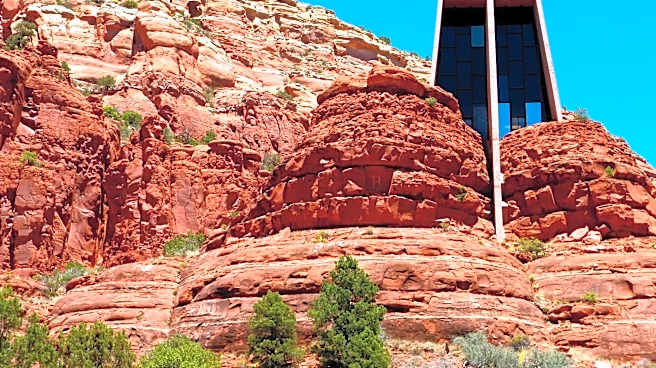
The Chapel of the Holy Cross was completed in 1957, built between two burly pillars of rock. High cliffs of salmon hues form the backdrop.
The interior remains simple and unadorned. A few benches, some tapestries and flickering candles create a meditative oasis, while soft sunlight streams through the floor-to-ceiling window.
Enjoying a few still, peaceful moments during vacation can be priceless.
Details: 780 Chapel Road, Sedona. 928-282-7545, chapeloftheholycross.com.
Amitabha Stupa and Peace Park, Sedona

Sedona draws many on a spiritual journey.
Another popular destination is the Amitabha Stupa and Peace Park.
Set on 14 acres, at the base of Thunder Mountain, the Buddhist site is open for visitors of all faiths where they will find the 36-foot-tall Amitabha Stupa, and a smaller Tara Stupa, dedicated to the female deity.
Visitors will find prayer wheels, prayer flags and a medicine wheel.
Stupas are an ancient form of sacred architecture dating back more than 2,500 years.
Details: In West Sedona, take Andante Drive north to Pueblo Dive and turn left. Proceed 50 yards and park. Take the short walking path to the stupas. 877-788-7229, tara.org/amitabha-stupa.
Shrine of St. Joseph of the Mountains, Yarnell

A renewal of spirit is offered at the Shrine of St. Joseph of the Mountains in Yarnell.
Built in 1939, life-sized sculptures representing the Last Supper, the Garden of Gethsemane and the Crucifixion are spread through the shaded grotto of oak trees and granite boulders. They were created by a self-taught artist and World War I veteran fulfilling a battlefield vow.
Visitors can walk a winding trail over the hilly terrain through the Stations of the Cross or meditate in the park-like setting.
The shrine lost a few buildings in the tragic Yarnell Hill Fire of 2013, but the sculptures of Felix Lucero survived the 3,000-degree inferno.
Visitors wishing to pay their respects to the 19 heroic firefighters who perished can visit the nearby Granite Mountain Hotshots Memorial State Park.
Details: 16887 Shrine Drive, Yarnell. yarnellshrine.org.
Crane Petroglyph Heritage Site, Rimrock

The Crane Petroglyph Site contains the largest collection of petroglyphs in the Verde Valley.
More than 1,000 petroglyphs are carved into the cliff face on what was once the V-Bar-V Ranch.
Stories are told here, mostly distant echoes from the Southern Sinagua people. The carvings are an important example of the Beaver Creek Style.
From the visitor center, it’s an easy walk on a flat trail back to the site, where a docent points out individual figures and clustered carvings, discussing their significance. Most were created between 1150 and 1400.
Details: The site is located a couple of miles down Forest Road 618 (just off Interstate 17) near Beaver Creek. Open Fridays through Mondays. Check the website for hours. 928-203-2900, fs.usda.gov/r03/coconino/recreation/crane-petroglyph-heritage-site.
Sedona Vortex Sites

Even if you are not an adherent of the New Age movement, plan on visiting at least one of Sedona’s vortexes. Because here’s the wonderful secret: Vortexes are located at some of the most devastatingly scenic spots among the red rock formations.
What is a vortex? Sedona’s vortexes (the proper grammatical form "vortices" is rarely used) are thought to be swirling centers of energy that are conducive to spiritual healing, meditation and self-exploration.
Believers identify four primary vortexes. They are found at Boynton Canyon, Bell Rock, Cathedral Rock and Airport Mesa.
Anyone on a journey of self-discovery or just curious can find out more about vortexes from the Sedona Metaphysical Spiritual Association (928-300-7796, sedonaspiritual.com), an affinity group of the Sedona Chamber of Commerce.
Mission San Xavier del Bac, Tucson

Father Eusebio Francisco Kino arrived in 1687 on the frontier of New Spain.
He began work among Indigenous people called Pimas by the Spaniards. In their own language, they were O’odham or “the people.”
Kino traveled from Upper Sonora to southern Arizona establishing missions and introducing cattle and wheat. The Mission San Xavier del Bac was established in 1692.
Today’s mission was built between 1783 and 1797, the oldest European structure in Arizona, and is known for its elegant Spanish colonial architecture and colorful art adorning the interior.
Shimmering in the Arizona sun 10 miles south of Tucson on the Tohono O’odham Reservation, the “White Dove of the Desert” remains an active parish.
For visitors, there is a museum and gift shop on the premises, and free guided tours of the mission grounds are available. Volunteer docents lead the 45-minute tours.
Details: 1950 W. San Xavier Road, Tucson. 520-294-2624, sanxaviermission.org.
Tumacácori National Historical Park
Father Kino established the mission at Tumacácori in 1691.
The Tumacácori Mission Church, which is the structure often thought of as the mission, was begun around 1800.
Construction proceeded in fits and starts for the next two decades and was never completed. Yet it is a profoundly moving experience to enter the sunlit church and stand in this quiet place. Behind the church is the mortuary chapel and cemetery.
The visitor center contains a fascinating museum that puts the staggering amount of history in perspective.
Details: 1891 Interstate 19 Frontage Road, Tumacacori. 520-398-2341, nps.gov/tuma.
El Tiradito Shrine, Tucson

In a quiet alcove in Tucson, people come to mourn loss and love at what’s believed to be the country’s only Catholic shrine dedicated to a sinner.
The primary legend surrounding El Tiradito in Barrio Viejo is a steamy one. It involves a tragic love triangle in the 1870s. A young sheepherder named Juan Oliveras began an affair with the mother of his young bride. When caught in the act, Juan was chased into the dusty street and axed to death by the woman’s husband, his father-in-law.
Due to the nature of his sin, the dead man could not be buried in consecrated ground. He was planted where he fell and the shrine sprang up honoring the memory of El Tiradito, “the little castaway.”
Visitors come to the small grotto to light candles and leave offerings. Often, they will scribble their own hopes and prayers on little pieces of paper and tuck them into the cracks of the weathered adobe wall. Legend has it that if a candle burns through the night, your wish will come true. That’s how El Tiradito also became known as the Wishing Shrine.
Details: 420 S. Main Ave., Tucson.
Our Lady of the Sierras, Hereford

Travelers on State Route 92 south of Sierra Vista will spy this distinctive shrine perched in the foothills of the Huachuca Mountains.
Established in 1998, the site features a small stone chapel, a 31-foot-tall Madonna and a 75-foot-tall Celtic cross beside a small tumbling waterfall. The Stations of the Cross were later added.
The short steep road twists up the shoulder of the hill and rewards visitors with both a peaceful setting and expansive views across the valley.
Details: 10310 S. Twin Oaks Road, Hereford. 520-378-2950, ourladyofthesierras.org.
Find the reporter at rogernaylor.com. Or follow him on Facebook at facebook.com/RogerNaylorinAZ.
This article originally appeared on Arizona Republic: Take a journey to Arizona's spiritual tourism sites, from shrines to vortexes