




If you've been waiting for evidence of widespread voter fraud in Arizona, you’ll have to keep waiting.
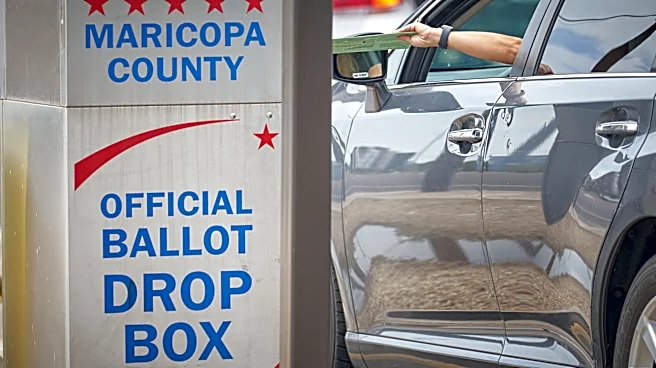
On Monday of this week, Maricopa County Attorney Rachel Mitchell announced the results of her office’s investigation into the alleged noncitizen voters referred to her by Recorder Justin Heap. Mitchell's detectives spent months "knock[ing] on doors," conducting "dozens of interviews," reviewing documents and putting in "many man hours” to track down noncitizen voters.
The results? Mitchell's team found eight noncitizens who had voted in Maricopa County.
Eight.
If you think that number is pathetic, it gets even worse. Of the eight, only three voted in the November 2020 presidential election. Of the eight, five are independents, two are registered
Republicans and one is a registered Democrat. Of the eight, seven were seemingly registered in error. Of the eight, all are in the United States legally, most have been in Arizona for decades and one has been in Arizona for 72 years.
Maricopa County has approximately 2.5 million registered voters. In the county's November 2020 general election, approximately 2.1 million people voted. The newly uncovered noncitizen voters made up 0.0001428% of the county's presidential vote that year.
This finding is entirely consistent with other recent state and county audits.
In August, Yavapai County Recorder Michelle Burchill announced the results of her labor-intensive investigation into the county's approximately 195,000 registered voters. She found four noncitizens who participated in past elections.
Utah recently published an audit of its 2.1 million registered voters. It found 27 "confirmed noncitizens" who had registered. In early September, Georgia uncovered 432 potential noncitizens with a voting history "at some point" since 1996. Georgia has approximately 8.2 million registered voters.
None of these unlawful voters acted as part of a broader scheme to steal an election. None of the incidents involved criminal election officials.
Some, like Representative Abe Hamadeh, responded to County Attorney Mitchell’s findings by saying that even one unlawful voter is too many. But that shows a fairly juvenile understanding of public policy. Public policy isn't the creation of a perfect world. It's a world of tradeoffs.
If we said "even one automobile injury is unacceptable," we would limit cars to five miles per hour. Very few people would have cars.
In voting, if we say, "the only acceptable amount of fraud is zero," then we'd spend billions of taxpayer dollars administering an election process that would require you to undergo a background check, a retinal scan and thumbprint verification. I don't think Americans would like that system.
As it is, we have an election system that makes it easy to participate, doesn't unduly waste taxpayer dollars and still only allows a very, very small amount of fraud. That's not a perfect system. But it's a very good, very workable system.
Now if you're still waiting on evidence of widespread fraud in American elections, my question to you is: How long will you wait before you consider the possibility that it simply doesn't exist?
The FBI is currently led by Kash Patel. The Department of Homeland Security is led by Markwayne Mullin. The Department of Justice is led by Todd Blanche. All of them are enthusiastic supporters of President Trump and all of them are zealous about finding voting fraud. They've all dedicated many thousands of agency investigative hours to finding election fraud.
And yet, since retaking power in January 2025, the Trump administration has charged fewer than 100 people with election fraud. According to reporting from ProPublica, between January 2025 and May 2026, the federal government charged 41 people with "voting illegally or other election-related crimes." As with the voters uncovered by County Attorney Mitchell, not all of the 41 belong to the same political party, and they are spread out over many elections in the past 20 years.
Again, perhaps the reason that skilled, highly trained, smart federal law enforcement officers ― under the direction of Patel, Mullin and Blanche ― can't find evidence of widespread fraud is because… it doesn't exist.
County Attorney Mitchell and her team deserve great credit for thoroughly investigating the issue. Hopefully her office’s efforts will inspire confidence in Arizona's elections.
But as anyone who has worked in law enforcement can tell you, there are far more crimes than law enforcement has time to investigate. The thousands of hours spent by county, state and federal law enforcement chasing election fraud is time they didn't spend investigating violent crimes, serious financial fraud or drug trafficking.
At some point we have to tell our leaders that it's time to close the door on election fraud in 2020 (or earlier). We've looked. We've looked more than is reasonable. It's high time to be honest about what has been found and then make decisions about how to allocate resources moving forward.
Stephen Richer is the CEO of Republic Affairs, a legal fellow at the Cato Institute and a former Maricopa County recorder. You can contact him at Stephen@StephenRicher.com.
This article originally appeared on Arizona Republic: Arizona keeps investigating voter fraud. The results are in | Opinion