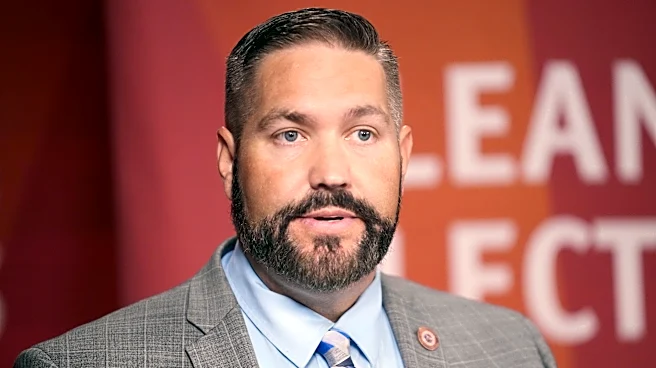





Maricopa County Recorder Justin Heap’s allies are financially supporting a lawyer from Stephen Miller’s firm running for the Arizona Legislature, all while the attorney landed Heap a major victory in his push to gain more power over elections in the battleground state's most populous county.
Heap’s network is boosting Republican James Rogers’ bid for a state House seat in the East Valley. Rogers is senior counsel at America First Legal, the law firm co-founded by President Donald Trump’s adviser Miller.
He also represented Heap in his high-profile election battle with the Maricopa County Board of Supervisors.
The Rogers' campaign finance report shows how a network of Republicans who challenged the 2020 election results and gained power in Arizona
and are seeking more influence at the ballot box this November.
“He's an election-denier, and his whole circle is election-deniers,” said Tyler Montague, a Republican anti-Trump activist from Mesa, where Heap and Rogers both live.
Rogers was instrumental in Heap’s election dispute victory in Maricopa County, and records show that people affiliated with the recorder donated to the Rogers' campaign shortly after each of Rogers’ courtroom triumphs.
Plus, Heap allies bitterly attacked Rogers' Republican opponent during the primary, dredging up unflattering details from her past and mocking her with AI-created memes.
The result was a 13-percentage-point win for Rogers in the July 21 primary election. He’s likely to coast to victory in the safely red legislative district this fall and, with the backing of Turning Point Action, succeed Heap’s father in the Legislature.
Heap's allies gave Rogers cash on key days
As Heap’s pro bono lawyer, Rogers is in the unique position of running for office in an election overseen by his client, while helping him fight to change the rules of the election.
The county recorder and county supervisors share election administration duties in Maricopa County. Heap argued that the board usurped his power when it negotiated a shared-services agreement that pared back his responsibilities just before he took office.
Rogers pulled papers to run for the state House on June 9, 2025. Three days later, Rogers filed Heap’s lawsuit against the board.
The bitter legal feud lasted for more than a year and went through three courtrooms: Maricopa County Superior Court, the Arizona Court of Appeals and finally the Arizona Supreme Court.
Rogers’ involvement in the case itself was controversial: Maricopa County Attorney Rachel Mitchell last year told him to stand down in a letter.
But Heap stuck with Rogers in the courtroom. He also praised him on the campaign trail.
“I have been nothing but humbled and amazed at his prowess and his dedication,” Heap told an “Election Integrity Rally” crowd days before the primary, taking a victory lap after Rogers helped him beat the supervisors in court.
Heap made the speech in front of a sign that depicted Rogers as Fred Rogers from the children’s show “Mister Rogers' Neighborhood,” according to a video. Heap's office did not respond to a request for comment.
Election-deniers contributed to Rogers' campaign coffers
As the case progressed and Rogers notched courtroom victories, Heap’s staff and allies donated to his state representative campaign along the way, records show.
Two days after Judge Scott Blaney ruled in Heap’s favor on April 17, Rogers received $500 in campaign contributions from Merissa Caldwell, records show. She is married to Jeff Caldwell, Heap’s director of special projects.
Merissa Caldwell is a far-right activist in her own right. She shares misinformation about elections and supports the Arizona Republicans who were charged with multiple felony counts after falsely certifying that Trump won the presidential election here in 2020.
She also serves as the head of Election Integrity Network’s Arizona chapter. The national group is overseen by Cleta Mitchell, an important player in Trump’s plot to overturn the 2020 election.
Cleta Mitchell also donated to Rogers’ campaign. She gave him $500 on April 22, a few weeks after Rogers proposed that she serve as mediator in the dispute between Heap and the board on April 6.
The board did not take Rogers up on the offer.
The next month, after a judge ruled again in favor of Heap on May 13, Rogers got $250 from Heap’s chief of staff. Sam Stone contributed on May 14, according to a campaign finance report.
Merissa Caldwell gave Rogers another contribution on June 8, saying she and her husband, a top Heap staffer, would go without some extra cash to help him.
“It's worth it to give up a few date nights with my husband to get James elected!” Merissa Caldwell wrote on X.
Two days earlier, the county had announced outside counsel would investigate why two members of Heap’s staff took voting equipment out of a county facility. Rogers was involved in that issue as part of the Board of Supervisors dispute, but he is not involved anymore, America First Legal spokesperson Dani Repass said in an email.
Rogers’ most significant legal victory came the next month, when the Arizona Supreme Court sided on July 7 with his legal arguments and expanded Heap’s power over elections.
Merissa Caldwell gave Rogers $1,000 that day, records show.
Two days later, on July 9, Rogers received $200 from Republican nominee for Secretary of State Alex Kolodin.
Kolodin also had given Heap legal advice in the Maricopa County dispute, according to the recorder’s office.
“AFL was not aware of these donations until you raised them, and they had no bearing whatsoever on AFL’s legal work for Recorder Heap,” said Repass, the America First Legal spokesperson.
Repass put some daylight between Rogers' campaign and his legal work. America First Legal is a 501c3 nonprofit that does not endorse candidates or engage in electoral politics, she said.
“AFL’s pro bono representation of Recorder Heap was based solely on the legal merits of his position, and nothing else. Mr. Rogers’ campaign is a personal endeavor entirely separate from his work at AFL, and AFL has no involvement in or control over his campaign’s fundraising,” Repass said.
The contributions did not raise major red flags for Brendan Galvin, the director of insights at the campaign finance watchdog group OpenSecrets. Heap’s allies did not appear to be coerced into giving the donations, he noted.
“When you're within that community and one of your own is running for office and you have the ability to support them financially,” Galvin said. “It's not surprising to see that.”
Even beyond Heap’s allies, the legal wins in Maricopa County were some of Rogers’ most lucrative fundraising days of the campaign, records show.
“Just because it's technically OK doesn't make it ethically OK,” said Jennifer Guzman, the programs director for Common Cause Arizona, a left-leaning group. “This is really just a push to have more control over who gets a say in these elections.”
Rogers declined to answer questions about donations from Heap's allies. He has taken on a number of cases in Arizona as a lawyer for America First Legal, where he has worked since 2023.
Rogers played up his election experience in a written statement.
"I am running for the Arizona House because I have the skills, experience, and backbone to help make Arizona permanently red," Rogers said in an email. "As an election integrity lawyer who has litigated these issues and has already drafted bills for the Legislature, I will be the only Representative with the specialized knowledge of election law to craft the reforms we need."
Heap allies slammed Rogers' Republican opponent
The county recorder’s father, Republican state Rep. Ralph Heap, opened the door to a nasty political fight when he gave up his seat to seek a spot on the Arizona Corporation Commission this election cycle.
Rogers won the primary with a boost from Turning Point Action, the political arm of the Phoenix-based conservative network. Ralph Heap is endorsed by Turning Point and embroiled in his own political drama after being accused of campaign finance violations.
Although she founded a Turning Point coalition, Rogers’ Republican opponent Ciara Anderson became the subject of attacks from the group’s leader and Heap allies in the run-up to Primary Day.
The attacks followed an article by the State 48 News accusing Anderson of failing to "clearly disclose to voters" her bad conduct discharge from the Air Force, although Anderson’s campaign literature mentioned it. Christy Kelly, the writer behind the news site, told The Republic she had never been part of Rogers' campaign and her article was published independently of any political group or message.
Anderson did not respond to a request for comment.
People shared AI-generated memes depicting Anderson as “woke” with blue hair and a Pinocchio-style growing nose.
Tyler Bowyer, Turning Point Action chief operating officer, used his platform to attack Anderson online, saying she “couldn’t be more disingenuous or ungrateful.” Reached for this story, Bowyer said he was unavailable for comment until January.
Bowyer is also tied to the election denier movement. He was indicted for his alleged role in Arizona’s 2020 fake electors scheme.
Bowyer pointed out online that Anderson had support from moderate Republicans. He said he was disappointed that Anderson did not do more to oust a Republican city council member in Mesa who supported Vice President Kamala Harris in the 2024 presidential race.
But perhaps no one was more passionately against Anderson than Merissa Caldwell, who bashed Anderson as a “complete lying charlatan” even after she lost.
The Republic's Ray Stern contributed to this report.
Stephanie Murray covers national politics and the Trump administration for The Arizona Republic and azcentral.com. She co-hosts “The Gaggle,” The Republic’s weekly politics podcast. Reach her at stephanie.murray@usatodayco.com, on X and TikTok @stephanie_murr and on Instagram @stephaniemurray.news.
This article originally appeared on Arizona Republic: Arizona recorder's election-denying allies boost legislative campaign