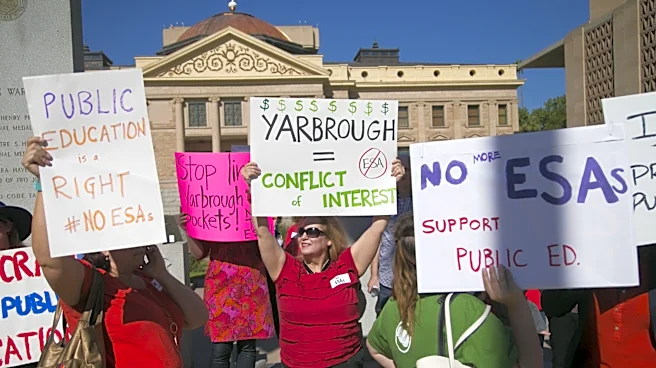


A Maricopa County judge will hear arguments this week on whether sweeping school voucher reforms should be sent for voters to decide this fall.
A ballot measure looking to add an income cap and several other restrictions on Arizona's universal school voucher program garnered more than 421,000 signatures from voters to qualify for the general election ballot.
Pro-voucher advocates quickly challenged thousands in court. The lawsuit, backed by The Goldwater Institute, a conservative think tank, includes two different claims against the group supporting the "Protect Education Act." The first accuses several petition circulators of not being properly registered or of being convicted of a felony without having their civic rights restored.
Second, attorneys
allege thousands of signatures were duplicates or had other issues that disqualified them. Attorney Kory Langhofer told The Arizona Republic that an initial inspection of the signatures found that around 10% were invalid.
The Protect Education Act has substantial leeway in its total signature count, having submitted 421,451 when only 255,949 were required to make the ballot. At the time, public school advocates said the number of signatures collected showed a growing public desire to reel in a school voucher program that now costs the state $1 billion a year.
“Signature collection for this campaign began in mid-March, and the total number gathered in such a short time reflects the tremendous statewide enthusiasm to bring meaningful reforms to the highly flawed and wasteful private school voucher program that our leaders have refused to take action on," campaign spokesperson Olivia Fierro said in July.
The Aug. 7 hearing was expected to introduce more details on the signatures' veracity. Fierro said hundreds of thousands of signatures were verified as of Aug. 6, and advocates were committed to defending them.
"Regarding duplicates, voters sign petitions all the time, and it can be hard to remember which one they signed — especially when a decoy petition was out there trying to confuse people," Fierro wrote, referencing a separate voucher-related measure that would have maintained universal access to the program. "When we turned in 421,451 signatures, we knew we turned in far more than enough to qualify."
What would the 'Protect Education Act' do?
Arizona's universal school voucher program, also known as the Empowerment Scholarship Account program, allows public dollars to go toward private school tuition. But recent reports have shown unchecked spending on items unrelated to education, such as luxury goods and lingerie.
If passed, the Protect Education Act would implement a $150,000 household income cap, excluding children with disabilities. The Arizona Department of Education also would need to publicly share how much ESA funding each school receives.
Background checks would be required for all educators and school staff working at voucher-funded schools, and fingerprint clearance cards would be issued for employees who have unsupervised contact with children.
This is one of the last opportunities for pro-voucher advocates to stop potential reforms from going to voters.
A competing ballot measure was struck down by a Maricopa County Superior Court judge in late July. If passed, it would have threatened to invalidate both current and future voucher reforms. Judge Joseph Kreamer ruled the measure violated Arizona's Constitution by including more than one proposed amendment, making it overly broad.
What to expect this week
The court case against the ballot measure was expected to continue through next week. If the proper number of signatures are verified, advocates for the voucher reforms will have the chance to see the measure on the ballot in November.
Helen Rummel covers state politics and higher education for The Arizona Republic. Reach her at hrummel@azcentral.com. Follow her on X, formerly Twitter: @helenrummel.
This article originally appeared on Arizona Republic: Voucher reform advocates to defend thousands of signatures in court