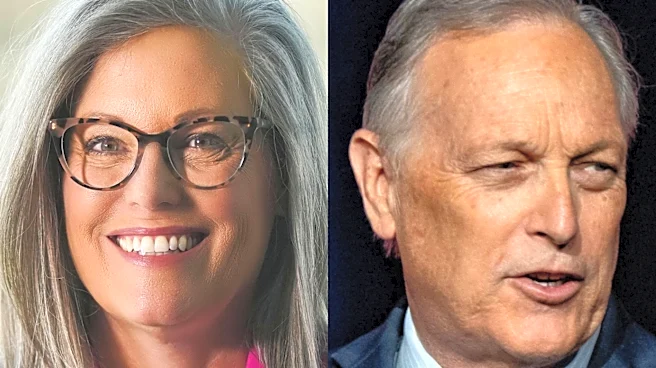



A controversial bill that died in the Arizona Senate 13 years ago has haunted gubernatorial hopeful Andy Biggs as he hopes to unseat incumbent Democrat Katie Hobbs, becoming an inescapable issue in the race.
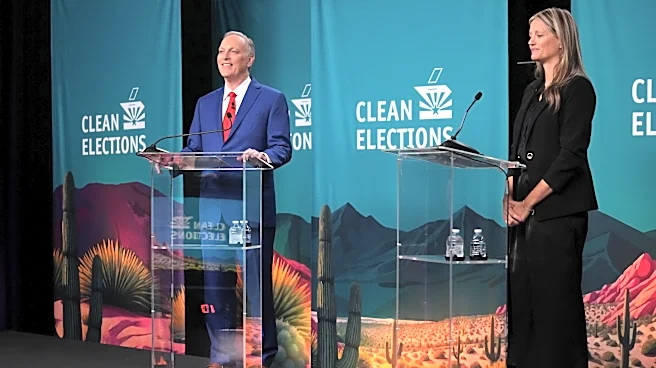
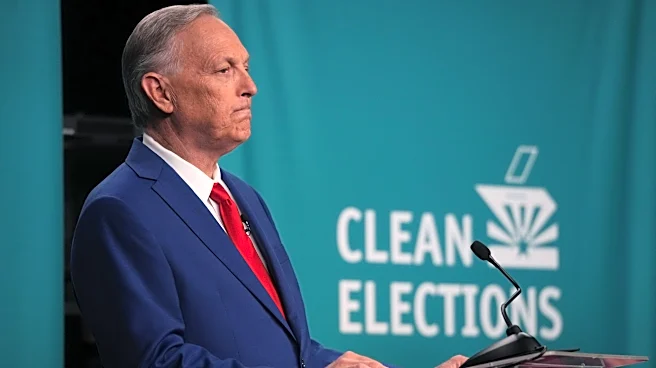
Biggs' comments on the bill, which would have allowed the takeover of a police force friendly to a polygamous sect in Colorado City, have shifted in the months leading to the November election. And he offered a new take in a debate on Oct. 6 — a denial.
"I didn't stop it," he said of the bill, "but I did assign it appropriately."
The bill's sponsors have said it was Biggs who killed the bill, using his powerful position as Senate president at the time. They said Biggs assigned bills to multiple committees to kill them, a practice that is still
used at the Arizona Capitol today.
Biggs denied that sending a bill to several committees was abnormal, and blamed journalists for covering Hobbs' advertisements that feature the bill.
"You guys are trying to buttress her story when it's not true, it's just flat out not true," he said.
"Absolutely it makes me mad," he added. "I'm as mad as anybody who has righteous indignation can be. They've engaged in reputational annihilation."
Hobbs' campaign has launched four ads related to the bill. The latest features Elissa Wall, who was part of the cult and accuses Biggs of not caring about conditions there. The sect was led by Warren Jeffs, who in 2011 was convicted of sexually assaulting 12- and 15-year-old girls he considered brides and is serving a life sentence in Texas. Jeffs was alleged at trial to have taken more than 70 wives.
Other ads tie the bill to Biggs' vote against releasing the investigative files related to Jeffrey Epstein, alleging Biggs "protected pedophiles." Biggs did later vote to release the files.
The bill that raised concern about Biggs' leadership
Arizona lawmakers for years debated what to do about the polygamous sect in the insular Colorado City and neighboring Hildale, Utah, which had drawn attention for decades as a stronghold for the Fundamentalist Church of Jesus Christ of Latter Day Saints.
Then-Attorney General Tom Horne voiced concern that Colorado City law enforcement was working for the church. A corruption complaint was filed with the U.S. Department of Justice in 2012, and in 2016 a federal jury found police in Colorado City and Hildale had discriminated against nonmembers.
In 2012, lawmakers took a crack at allowing the Mohave County sheriff to take over the town's police. Biggs voted in favor of that bill, but the measure died in the House. A revamped and more detailed version of the bill allowing takeover of the police force appeared again in 2013. The 2013 bill passed the Arizona House in a 52-7 vote, and then Biggs assigned it to three committees in the Senate.
The bill's sponsors, Reps. Michelle Ugenti-Rita and Kelly Townsend, in 2016 accused Biggs of killing the bill.
Townsend said Biggs kept her bills bottled up. She and Ugenti-Rita were among four GOP lawmakers who publicly criticized Biggs, a fellow Republican, describing his leadership style as bullying or petty. The lawmakers complained their bills floundered or they were marginalized because of political spats with Biggs.
"Women and children suffered three years longer than they should have because he protected the bad guys," Ugenti-Rita said at the time. "That's what bothers me."
Horne and Ugenti-Rita both declined to comment for this story. Townsend did not respond to messages.
The lawmakers' concerns bubbled up in 2016, when Biggs won his seat in the U.S. House of Representatives representing the 5th Congressional District in the southeast Valley. Now, as he runs to be Arizona governor, they have been amplified again by Hobbs and her allies.
In the years in between, there has been a public reckoning when it comes to systemic abuse of children and leaders who are complicit in it.
Stacy Pearson, a Democratic political consultant in Arizona, pointed to outrage over powerbrokers of both parties tied to Epstein, systemic abuse within the Catholic Church or the yearslong abuse of members of USA Gymnastics by a team doctor as examples of pushing public sentiment in favor of greater accountability.
"We are in a different era of accountability with crimes against children, it is a higher profile problem than Andy Biggs' campaign was prepared to respond to," Pearson said.
"We are past the point of dismissal of that behavior," she said. Voters want accountability, "for a politician to say this is what I did and why I did it," Pearson said. "And Andy Biggs doesn't have a consistent answer about the bill."
What Biggs has said about the bill
In October 2025, Biggs was asked during an interview on AZ Family if he killed the bill.
"I can’t remember the procedure, I do remember the bill," he said.
He said lawmakers were "still trying to get all the information that we possibly could on whether somebody was corrupt because that was the accusation,” and he wasn't sure if they ever heard evidence to justify a state takeover of the police force.
That was after Jeffs was sent to prison, and after Horne, the state attorney general, called for intervention to address the town's police force.
By this summer, when The Washington Post took notice of a growing political issue in the Arizona governor's race, Biggs' campaign said the bill was poorly written, too broad, and opposed by law enforcement. The Fraternal Order of Police did go on the record in opposition in 2013, though that didn't sway lawmakers from overwhelmingly supporting the House version.
Biggs later said he couldn't remember a lot about the bill. And in the recent debate, Biggs claimed he did not stop the bill though law enforcement asked him to do so.
Regardless of the mechanics, Biggs said in an Oct. 7 interview with The Arizona Republic he still has concerns about the bill because it would have impacted police agencies all over the state, and he again expressed opposition to it.
Any appearance that he shifted his defense of the bill was the result of having to go back to something that occurred over a dozen years ago, he said.
"My thought hasn't shifted on this bill," he said. "I had to go refresh recollection, that's what happened. And I still don't have a great recollection of it. I'm going by what I have found looking at public records and talking to people, trying to piece it all together."
Biggs said he routinely sent bills to multiple committees in the Senate for a full vetting, not to stop them.
"It's part of a normal process to assign bills to the proper jurisdiction committees, I don't know why that's so astonishing," Biggs said. Asked about the lawmakers who said Biggs ran the Senate with a punitive hand and intentionally killed their bills, Biggs said they were wrong.
He repeatedly blamed reporters for their coverage of Hobbs' advertisements, complaints that took up a third of a 10-minute interview.
“Andy Biggs keeps changing his story because he knows there's no defending his decision to protect Warren Jeffs' corrupt pedophile cult," Hobbs' spokesperson Michael Beyer told The Republic. "But the most disturbing part is that, even after everything we know about the horrific abuse of women and underage girls in Colorado City, Biggs still stands by his decision."
Biggs has defended his record on protecting children, citing his bill in Washington, D.C., to prohibit actions that coerce children into self-harm or other abusive acts, his time as a prosecutor in Phoenix before he won elected office, and this year's Kayleigh's Law. The bill co-sponsored by Biggs requires courts to issue lifetime orders that sexual offenders not contact their victims, if the victims request such an order.
His campaign has also tried to turn the tables on Hobbs, making the case in social media videos and a September advertisement that Hobbs is failing to protect Arizonans from pedophiles. The campaign cites four bills Hobbs vetoed.
One 2023 bill would have added to the state's public sex offender registry people convicted of more offenses against children, but Hobbs said the law already required the most dangerous offenders to be posted.
Another bill the same year would have required sex offenders to give notice at their child's school of their registration status each year. Hobbs said offenders were already required to notify school districts where they live. A 2024 measure would have prevented some sexual offenders on lifetime probation from seeking to end their probation early, which Hobbs said stripped judges of their discretion in considering cases. Hobbs' office said the governor signed bills similar to those three in later years of her administration.
A fourth bill that Hobbs vetoed in June addressed concerns about revenge porn and would have required everyone depicted in adult content to consent to it being posted online. That included elected officials approving before they are satirized, though it included an exception for news and other types of programming. Hobbs said the bill would have a chilling effect or infringe on the right to free speech, noting other state laws already protect victims without censoring criticism of elected officials.
A winning issue with women voters?
Hobbs allies have sought to make Biggs' equivocation an issue of its own, and political consultants told The Republic that might resonate especially with female voters who can help decide elections in the Grand Canyon State.
Pearson and Republican political consultant Barrett Marson said the issue is helping Hobbs, who holds a narrowing lead in the race that is within the margin of error, according to an internal campaign poll made public Oct. 8. And it leaves Biggs on defense, trying to explain a complicated issue in the speed of a political soundbite, Marson said.
Biggs' explanations ultimately boil down to defending his concerns about the bill, Marson said.
And, he added: "If you're explaining, you're losing."
Reach reporter Stacey Barchenger at stacey.barchenger@arizonarepublic.com or 480-416-5669.
This article originally appeared on Arizona Republic: Andy Biggs’ shifting account of Colorado City bill haunts governor bid