




Lea la versión en español
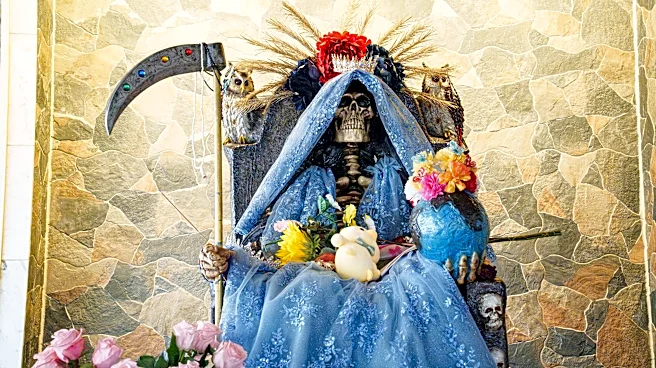
A skeletal figure draped in a blue robe overlooks the room. On either side stand towering statues of Santa Muerte, each more than seven feet tall.
The display greets visitors at Santísima Muerte Phoenix AZ, a worship space at 8424 N. 24th Ave. in Phoenix. Patsy Lopez and her husband, Virginio “Vickie” Garcia, run the site, which Lopez says the community has gradually embraced as a church.
“We’ve been here for seven years,” Lopez said. “People adopted us as a church.”
In front of the statues of La Niña Blanca, or “The White Girl,” another name for Santa Muerte, worshippers leave candles, glasses of water, flowers, bottles of tequila and other offerings.
Every Sunday, about 100 to 150 people gather for a ceremony that begins around 10 a.m. Lopez and Garcia lead the service.
For first-time visitors, the skeletal imagery, cigarettes, tequila and altars may seem far removed from a traditional church setting. Devotees, however, say each object carries symbolic meaning and reflects a personal relationship with Santa Muerte.
Long associated with Mexico, devotion to Santa Muerte has gained followers in Arizona, fueled in part by migration and by believers who say the figure offers protection, comfort and support during uncertain times.
The devotion’s growth is perhaps most visible in plans for what organizers describe as the largest Santa Muerte altar in the United States. The 55-acre project, planned for Arizona, will include cabins, dining areas, shops and a large worship center.
From hardship to leading Arizona’s largest Santa Muerte congregation
Patsy Lopez said her devotion to Santa Muerte began about nine years ago.
At the time, she shared a tire shop with a business partner and friend who kept an image of Santa Muerte and regularly left offerings of water and coffee. Lopez said he introduced her to the devotion and suggested she could turn to the folk saint as she navigated a difficult period in her life.
“I had nothing when I decided to separate from the father of my children,” said Lopez, 37. “I ended up on the street.”
A native of Ciudad Obregón, Sonora, Lopez moved to Phoenix in 2014. With children depending on her, she said she was struggling to make ends meet and looking for a way to support her family.
Remembering her friend’s altar, she made a promise.
“I told her that if she helped me move forward, I would give her a place of honor,” Lopez said. “And anyone who came looking for her, I would teach them about the devotion.”
At first, publicly displaying an image of Santa Muerte hurt her business, Lopez said. For about a year, some customers avoided the shop because they associated the figure with something sinister or demonic.
“It was a very difficult year,” she said.
Over time, that changed. Lopez said more people began visiting the business seeking out the altar, and her financial situation improved. Through the devotion, she also met her husband, Virginio “Vickie” Garcia. Together, they later founded Santísima Muerte Phoenix AZ.
Speaking softly as she recalled those years, Lopez described the turn in her life in simple terms:
“A miracle.”
What is Santa Muerte?

Santa Muerte is a folk religious figure who personifies death and is typically depicted as a female skeleton dressed in a robe and carrying objects such as a scythe.
She is not recognized as a saint by the Catholic Church.
The origins of the devotion are complex. Religious scholar R. Andrew Chesnut has written that European images of death arrived in the Americas during Spanish colonization and encountered Indigenous traditions, including those of the Mexica and Maya, that already included deities associated with death. Over time, popular religious practices emerged that blended those influences.
While the devotion has deeper historical roots, many scholars trace its rise as a public movement to 2001, when Enriqueta Romero placed a life-size image of Santa Muerte outside her home in Tepito, a neighborhood in Mexico City. Researchers also identify that year as the beginning of the altar's monthly rosary services, which continue to draw large crowds.
There is no official count of Santa Muerte followers. Chesnut has estimated that the devotion has between 10 million and 12 million adherents, primarily in Mexico, the United States and Central America.
At Sunday ceremonies in Phoenix, worshippers come from a wide range of backgrounds. Men with tattoo-covered arms pray alongside homemakers, laborers, retirees and young families. Some wear thick chains around their necks. Others carry candles, prayer cards or flowers.
The gathering reflects the diversity of the devotion's followers. People of different ages, occupations and social backgrounds join in songs and prayers as incense drifts through the sanctuary.
Candles, coffee, water and tequila: What does it mean to "care for" Santa Muerte?
One of the biggest differences Lopez sees between Santa Muerte devotion and other religious practices is the relationship devotees build with the figure.
She calls it "taking care of her."
Offerings at her altar can include coffee, water, tequila, apples, coins, seeds and cigarettes. Lopez said each item carries its own significance for worshippers.
“Water clears our paths,” Lopez said. “It helps keep them free of negativity and bad energy.”
According to Lopez, seeds symbolize abundance and the hope that there will always be enough food. Apples are often offered as a gesture of gratitude. Cigarettes and smoke, she said, are used by some devotees in purification rituals.
“Every offering has a meaning,” Lopez said. “Depending on what a person is going through, there's a reason behind it.”
What do the colors of Santa Muerte's robes mean?
Not all Santa Muerte statues are dressed the same way. For many devotees, the color of a statue's robe reflects a specific prayer request, intention or expression of gratitude.
In Lopez's community, blue is associated with legal matters and court cases; red with love and relationships; white with family protection; black with protection from harm, witchcraft or the "evil eye"; yellow with money and business; green with health and employment; and purple with the transformation of negative energies.
“Each robe represents a favor that has been granted,” Lopez said.
The meanings, however, are not universally standardized. Unlike many organized religions, Santa Muerte devotion has no central religious authority that establishes doctrine or practices for all followers. As a result, interpretations and rituals can vary among communities and individual devotees.
Are the services similar to Catholic Masses and rosaries?

Are the services similar to Catholic Masses and rosaries?
Patsy Lopez intentionally uses terms familiar to many Catholics: Mass, rosary, Hail Mary, Our Father and the Apostles’ Creed.
“It’s the traditional rosary, but centered on Santa Muerte,” Lopez said.
According to Lopez, worshippers recite Hail Marys and Our Fathers during gatherings and profess the Creed. Services also include scripture readings and psalms, though reflections are framed through the lens of Santa Muerte devotion. The congregation also holds a weekly rosary.
“We’re not against God,” Lopez said. “We understand that God comes before anything else.”
That view is shared by Lopez and many devotees, but it differs from Catholic doctrine. The Catholic Church does not recognize Santa Muerte as a saint and rejects her veneration.
Church leaders have been outspoken in their criticism. In 2013, Cardinal Gianfranco Ravasi, then president of the Vatican's Pontifical Council for Culture, described the devotion as a “degeneration of religion” and a form of blasphemy.
Migrants fuel the growth of Santa Muerte devotion
The connection between Santa Muerte and migration is a recurring theme at Lopez’s congregation.
She said she has met people who arrived at the shrine after crossing the desert under harsh conditions.
“Many arrive with their feet bleeding,” Lopez said.
Some devotees, she said, began praying to Santa Muerte after seeking protection during a border crossing, while returning to Mexico or while trying to reach the United States safely.
“They found themselves in situations where they came very close to death,” Lopez said. “That’s when they began asking for help.”
The relationship between migration and popular religious devotions has been documented by scholars. William A. Calvo-Quirós, author of Undocumented Saints: The Politics of Migrating Devotions, has examined how Mexican devotional traditions have spread to the United States alongside migrant communities. His research places Santa Muerte within broader discussions of migration, discrimination, economic insecurity and survival.
The figure’s presence has also been documented along the U.S.-Mexico border. Near the Nogales port of entry, for example, researchers have recorded a mural of Santa Muerte painted beneath the border fence.
For Rosalba Lopez Acosta, a Phoenix resident and Santa Muerte devotee, the faith became deeply personal after her sister was detained by immigration authorities earlier this year.
According to Rosalba, her family had little hope that her sister would be released quickly because she was not eligible for bond.
That was when she began praying to Santa Muerte.
“I started asking Santita to please open the jail doors for my sister and let her out,” Rosalba said.
Rosalba said her sister later received unexpected news that she would be released. At first, she feared the release meant she would be deported to Mexico.
“My sister didn’t even pay bond,” Rosalba said. “She said they just called her and told her, ‘You’re leaving later today.’”
Today, Rosalba’s husband and children are also devotees. Each has a small altar at home that they “take care of,” a term followers use to describe maintaining the altar and leaving offerings.
Rosalba discovered Lopez’s congregation through a TikTok video and soon began attending services.
Since then, she said, she has missed only a handful of Sundays.
“I’d rather miss something else than miss Mass,” she said.
Why is Santa Muerte associated with drug trafficking?
Organized crime is among the most common and controversial associations tied to Santa Muerte.
Researcher Laura Roush has written that the devotion's growing visibility beginning in the mid-1990s coincided with the expansion of organized crime in Mexico, helping fuel perceptions that Santa Muerte was part of a broader "narco culture." Her research in Tepito, a Mexico City neighborhood closely associated with the devotion, found a more complex reality, including how followers have responded to widespread assumptions that they are linked to violence or criminal activity.
Images and altars dedicated to Santa Muerte frequently appear in depictions of narco culture. But scholars caution that equating all devotees with drug traffickers presents an incomplete picture of the movement.
Other ethnographic studies have documented devotion to Santa Muerte among incarcerated people, as well as among family members, police officers and correctional staff, suggesting that her followers come from a much broader cross-section of society than commonly portrayed.
Patsy Lopez said she regularly encounters those stereotypes.
“Just as there are good people, there are bad people,” Lopez said. “But that doesn't depend on Santa Muerte.”
Lopez argues that individuals, not religious figures, are responsible for their actions. She also believes sensational media coverage and social media content have helped reinforce the devotion's association with crime and violence.
As Santa Muerte gains followers in Arizona, is it considered satanism?
For Lopez, the answer is no.
She considers herself a believer in God and said her devotion to Santa Muerte has strengthened, rather than weakened, her faith.
“I do feel it is an energy that we still don't fully understand,” she said of Santa Muerte.
Opinions about the figure remain sharply divided. The Catholic Church and many Christian denominations reject the devotion as incompatible with their religious teachings. Devotees, however, argue that following Santa Muerte is neither satanic nor a rejection of belief in God. Instead, they describe it as a spiritual practice centered on protection, guidance and comfort.
Many followers view La Niña Blanca, as Santa Muerte is often known, as a being of light or an angel sent by God to watch over those in need.
The devotion's visibility, however, often brings criticism.
Lopez said she receives thousands of negative comments on social media and is frequently labeled a satanist. She also recalls people standing outside her business holding Bibles in protest.
Still, she said she has learned to live with the criticism.
“There will be people who like it, and there will be people who don't,” Lopez said. “That's normal, and it's understandable.”
Does Santa Muerte "demand payment" for favors?
It's another claim Patsy Lopez says she hears frequently.
“No, that's not true,” she said.
According to Lopez, devotees may make a request and promise an offering or act of devotion in return if that request is fulfilled. But she rejects the idea, common among critics and skeptics, that failing to keep such a promise can cause Santa Muerte to harm or kill a relative.
Instead, Lopez describes the relationship in more personal terms.
“If you stop taking care of it, then it simply moves away from you,” she said.
In her view, failing to fulfill a promise means losing the closeness, guidance or protection that devotees associate with Santa Muerte, rather than facing punishment.
Lopez prefers to refer to fulfilled requests as “favors.” Other devotees, as well as some scholars who study the movement, often use the term “miracles” when describing beliefs surrounding the figure.
Why are more people turning to Santa Muerte? Hundreds gather for her annual celebration

Patsy Lopez said weekly services begin around 10 a.m. on Sundays and typically draw between 100 and 150 people. Special celebrations attract significantly larger crowds.
She recalls that about 500 people attended the congregation's Nov. 2 Santa Muerte celebration two years ago, traveling from across the United States as well as from Chile, Peru, Mexico, Guatemala and El Salvador. Last year, she said, attendance grew to about 700.
Looking out at the crowd from the stage, Lopez said she worried someone might get hurt.
Instead, she remembers an orderly gathering.
“Nobody pushed. Nobody yelled. Nobody got upset,” Lopez said.
Some Phoenix residents even chose to step aside to make room for visitors who had traveled from outside Arizona, she said.
The annual celebration includes rosaries, music, decorations and community activities. Last year, organizers held a Catrina contest. Lopez said planning for the event begins months in advance.
Inside the congregation's Phoenix location, murals cover portions of the walls and large Santa Muerte statues dominate the altar. Lopez said she regularly travels to Mexico City to purchase religious images and items that are difficult to find in Arizona.
Seven years later, what began with a small altar now draws hundreds
Today, the woman who said she once lost nearly everything after separating from her children's father now leads services before an altar filled with statues imported from Mexico.
And the community's ambitions continue to expand.
Lopez and her husband are developing a project known as Manto Sagrado in Heber, Arizona, where they hope to build a 55-acre community and church dedicated to Santa Muerte. The project would include worship space and other amenities, marking what they see as the next chapter of a movement that began years ago with a small altar.
For Lopez, the effort remains tied to the promise she says she made during one of the most difficult periods of her life: creating a place for Santa Muerte and sharing the devotion with those seeking answers.
The congregation has also built a large online following. Santísima Muerte Phoenix AZ has about 56,000 followers on Facebook and roughly 12,000 on TikTok, platforms that have helped introduce the congregation and its events to people across Arizona and beyond.
“Everyone has a story,” Lopez said. “Everyone has a reason why they believe in Santa Muerte.”
Each Sunday, that devotion continues to fill the Phoenix sanctuary.
For followers, Lopez said, the meaning of Santa Muerte is found less in the controversy surrounding the figure than in the prayers, expressions of gratitude and promises devotees bring to the altar. It is that personal connection, she said, that keeps people returning and draws new visitors through the doors.
Contact reporter Nadia Cantú at nadia.cantu@lavozarizona.com or on X at@Nadia_Cantu.
This article originally appeared on Arizona Republic: Who is Santa Muerte? What we found inside Arizona's largest temple