




Voting in Arizona starts Oct. 7, and the ballot is full of contests that will determine which party controls Congress and further illustrate the swing state's political hue.
Once a solidly red state, Arizonans have recently favored Democrats for statewide office over GOP competitors who adhere to election conspiracies that have taken hold in the state. The state's purple tint drew national attention after voters helped elect Democrat Joe Biden president in 2020, and then returned to Republican Donald Trump in 2024, making it one of the nation's newest battlegrounds.
There is no presidential contest this year, and for the first time in over a decade there is no U.S. Senate election on the ballot. While that could mean lower turnout, races in Arizona
have again drawn national attention for their outsized importance.
Two seats in Congress could flip from red to blue this year, hampering Trump's agenda in his final two years in office if they do. And looking ahead to 2028, two of the state's most prominent Democrats — U.S. Sens. Mark Kelly and Ruben Gallego — are considering campaigns for the White House. Even testing the waters for a national bid has raised the political profile of the Grand Canyon State.
But first, Arizona Democrats hope for a banner year in the November midterm, which historically favors the party opposite the president, and as Trump's approval ratings have sunk to historic lows.
Here's what to know about the key races on the Nov. 3 ballot.
Control of Congress runs through Arizona
All nine of the state's members in the U.S. House of Representatives are up for reelection, but just two of those are competitive because of their district makeup. Democrats view one seat left open by a longtime GOP congressman as a prime pickup opportunity, as they hope to pick off an establishment Republican seeking a third term in another competitive district.
The races serve as a referendum on Trump's second term in office and could determine whether Democrats or Republicans control the House in the president's final two years in office. Here are the two competitive races to watch, and another open seat that could get interesting.
1st Congressional District: Democrat Amish Shah, an ER physician and former state lawmaker, and Republican Jay Feely, a former NFL kicker, are competing for an open seat in the state's wealthiest district. The district spans north Phoenix, Scottsdale and the affluent suburbs of Fountain Hills and Paradise Valley.
The seat was left vacant by eight-term Rep. David Schweikert, a fiscally conservative Republican who became a lonely figure in his party as it veered toward populism and culture wars. Schweikert mounted a bid for the Arizona Governor's Office this cycle, but came in a distant second to fellow Rep. Andy Biggs.
5th Congressional District: Biggs has held this seat for a decade and leaves it open as he asks voters to elect him governor instead. Biggs has easily won reelection in the district that covers red-leaning suburbs southeast of Phoenix, and his GOP successor is likely to win in November.
It's viewed as a safe GOP seat, even for a candidate with baggage. Republican nominee and former Pinal County Sheriff Mark Lamb has been dogged by allegations he engaged in sexting, threats and intimidation. Not to mention concerns about his residency: Lamb is building a ranch retreat in Tennessee, 1,500 miles from the district he wants to represent.
6th Congressional District: Republican Juan Ciscomani is defending his seat in southern Arizona against Democrat JoAnna Mendoza. Ciscomani was first elected in 2022 and is hoping for a third term. Both candidates bring compelling backgrounds: Mendoza is a U.S. Marine Corps veteran who grew up working with her parents in the state's cotton fields. Ciscomani is a first-generation American who was born in Mexico and has depicted himself as the embodiment of the American dream.
More than Arizona's other House seats up for grabs this November, the race is widely seen as a referendum on Trump's second-term performance.
Statewide officials: Do Dems stay in power?
The three Democrats who hold the state's highest offices face challenges from a slate of Trump-aligned conservative Republicans who have doubted or even gone to court challenging the outcome of the 2020 presidential election.
In 2022, Arizona voters rejected election conspiracies when they elected Democratic Gov. Katie Hobbs, Attorney General Kris Mayes and Secretary of State Adrian Fontes. The trio now hopes voters will return them to office for a second, four-year term. Their challengers are Biggs for governor, Senate President Warren Petersen for attorney general, and state Rep. Alex Kolodin for secretary of state. Each of those officials elected later this year will play a key role in certifying the 2028 presidential election.
And Arizona's next governor could significantly shift policy.
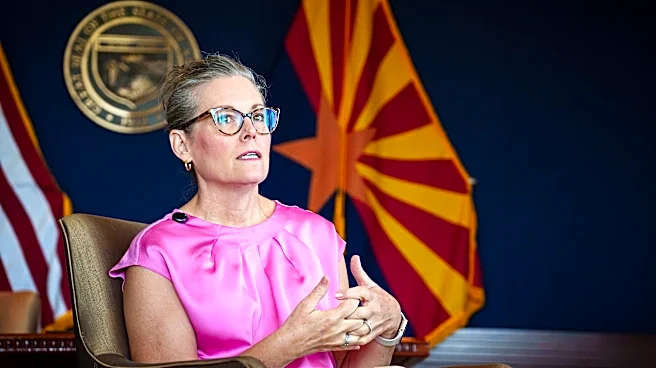
Hobbs' veto pen has kept most MAGA-inspired proposals pushed forward by the Republican-majority Legislature from becoming law over the past four years.
Hobbs has cast herself as a pragmatic centrist who is above the political fray — an effort to appeal to Republican voters willing to cross party lines and independents she'll need to stay in office. Democrats statewide are at a disadvantage: Republican voters outnumber Democratic ones here by 310,000.
Biggs is considered one of Congress' most conservative members, and he's tried to distance himself from efforts to interfere in the presidential race six years ago. If he takes office with a Republican Legislature, Arizona's balance could swing to the right.
The GOP's go-around of Gov. Hobbs
Republicans who control the Arizona Legislature have found a workaround to Hobbs' veto blockade. As in years past, lawmakers have sent questions to the ballot instead, a move that does not require the governor's sign-off but does mean the ballot can stretch to multiple pages.
There are eight questions before voters in November that reflect the right's focus on culture war issues like transgender athletes and diversity, equity and inclusion policies. A high-profile measure that could have placed restrictions on Arizona's voucher program, called Empowerment Scholarship Accounts, was disqualified by courts and will not be on the ballot.
Here are a few of the questions to keep an eye out for.
Proposition 141: Car mileage tax ban
Voters will decide whether the state will ban taxes based on vehicle mileage — a measure that would preempt any distance-based tax on electric vehicle owners who don't pay the state's gasoline tax.
Proposition 144: Election regulations
This sweeping measure proposes several election reforms in Arizona, where identification is already required to register to vote. If passed by voters, one of the measure's changes would require all voters to show government-issued ID before casting a ballot, including the majority of voters who cast ballots by mail.
Proposition 316: Grocery taxes capped
Municipalities could not increase sales taxes on groceries through 2027 if this measure passes. After that, cities cannot create a new grocery tax or raise a current one by more than 2% without voter approval. It also includes a retroactive clause that could impact cities that recently approved tax hikes.
Proposition 319: Photo-radar enforcement restrictions
If approved by voters, this measure would require Arizona's cities to get voter approval to use photo-radar systems to enforce traffic laws.
Will Arizona turn the page on election conspiracies?
Arizona was the epicenter of Trump's claims that Biden's 2020 win was the result of fraud that led to a stolen election. Those false claims continue to fracture the state's GOP and cost the party statewide election victories.
The Arizona Senate conducted an expensive and widely discredited audit of votes cast in Maricopa County, which includes Phoenix and is home to about 60% of the state's voters. The exercise confirmed Biden's win, only the second time since 1948 a Democratic presidential candidate carried the Southwest state.
At a time when trust in elections is under attack, glitches on the ground in Arizona have fueled the fire for critics. But those issues, like printer problems that plagued almost a third of voting locations in 2024 and long lines in several recent elections, have not disenfranchised voters, according to official reviews and audits.
The state's July primary allowed election officials to breathe a sigh of relief, with no administrative problems reported, though critics are sure to take a microscope to any issues that arise in November's vote.
Staff writer Helen Rummel contributed reporting.
Reach reporter Stacey Barchenger at stacey.barchenger@arizonarepublic.com or 480-416-5669.
This article originally appeared on Arizona Republic: Arizona's November ballot could reshape Congress, state politics