





Some of the top officers at the Palm Beach County Sheriff's Office earn substantially more than the leaders of the nation's largest police forces, despite overseeing a law-enforcement agency that is by comparison smaller and less complex, a review by The Palm Beach Post has found.
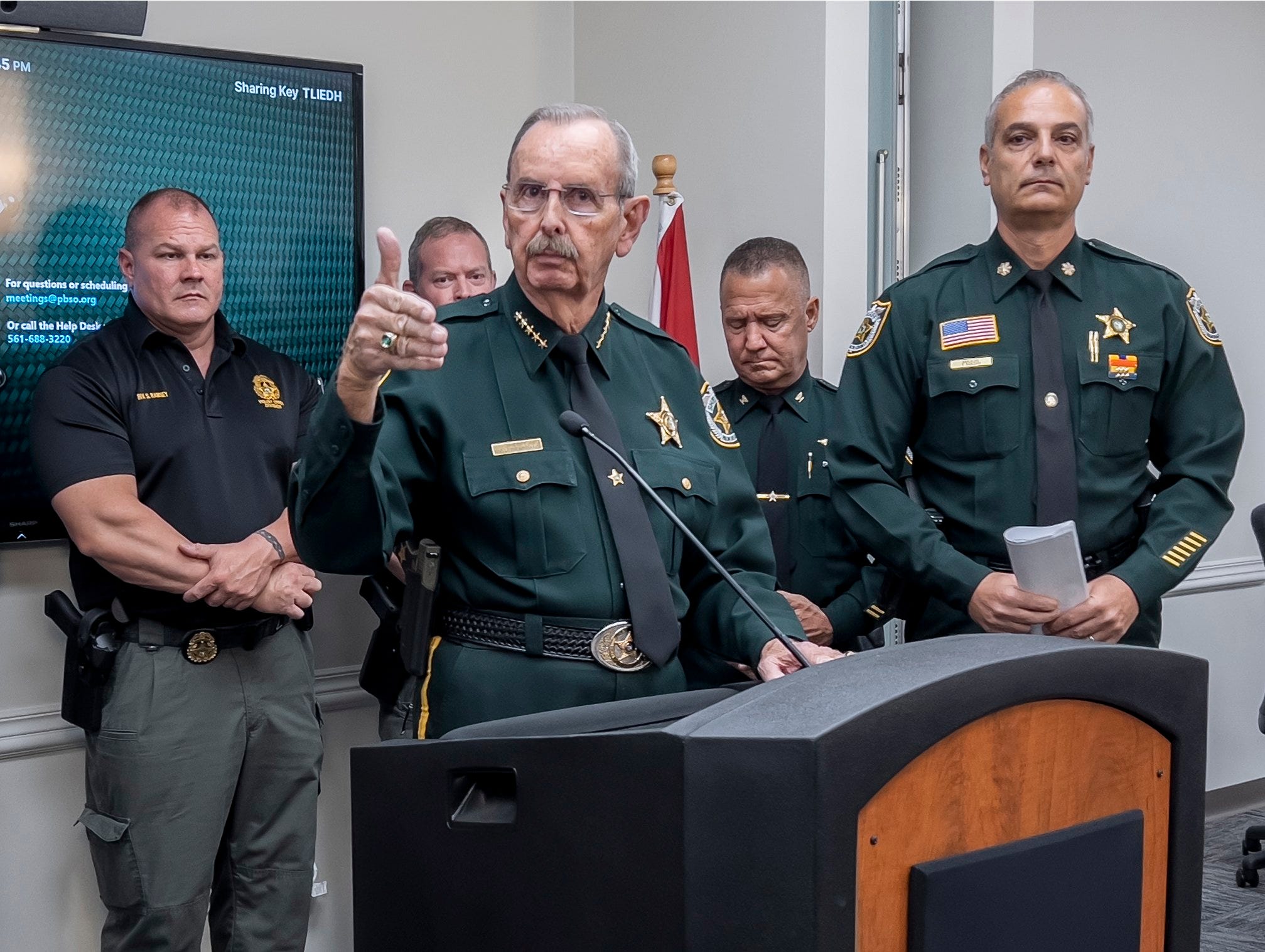
As Palm Beach County commissioners question the continued growth of PBSO's $1.2 billion budget, a study by The Post revealed that several of the agency's highest-ranking executives receive salaries and taxpayer-funded retirement benefits that far exceed the total pay given to those in comparable positions in police departments in New York City, the nation's largest police department, as well as Chicago and Philadelphia.
The contrasts in compensation are striking.
NYPD's
33,000-member police force patrols more than 300 square miles and serves more than eight million residents. PBSO employs roughly one-tenth as many law enforcement officers and serves about 900,000 residents. PBSO patrols the unincorporated areas of the county and several municipalities that have contracted with it for police service.
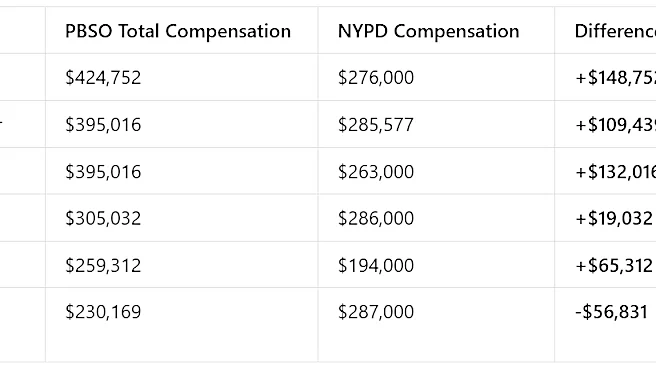
The Post review found that the top six law enforcement executives at PBSO pocket a collective $2.009 million in total compensation. That's roughly 25% more than the comparable top six positions at the NYPD, which pay $1.5 million altogether.
Chicago's top cops also earn far less than their PBSO counterparts. At PBSO, for example, the compensation for more than 100 PBSO employees tops $200,000 a year. In Chicago, only the police superintendent, the first deputy superintendent, the deputy superintendent, the chief and deputy chief earn that much.
The salary structure is similar in Philadelphia, another major metropolitan police department.
The police commissioner there earns $340,000, which is more than what PBSO Sheriff Ric Bradshaw earns but less than what Bradshaw's top assistants earn. However, the top deputies in Philadelphia earn less than $250,000 a year, a figure that is much less than the 10 highest paid employees at PBSO.
How PBSO pay compares with New York City
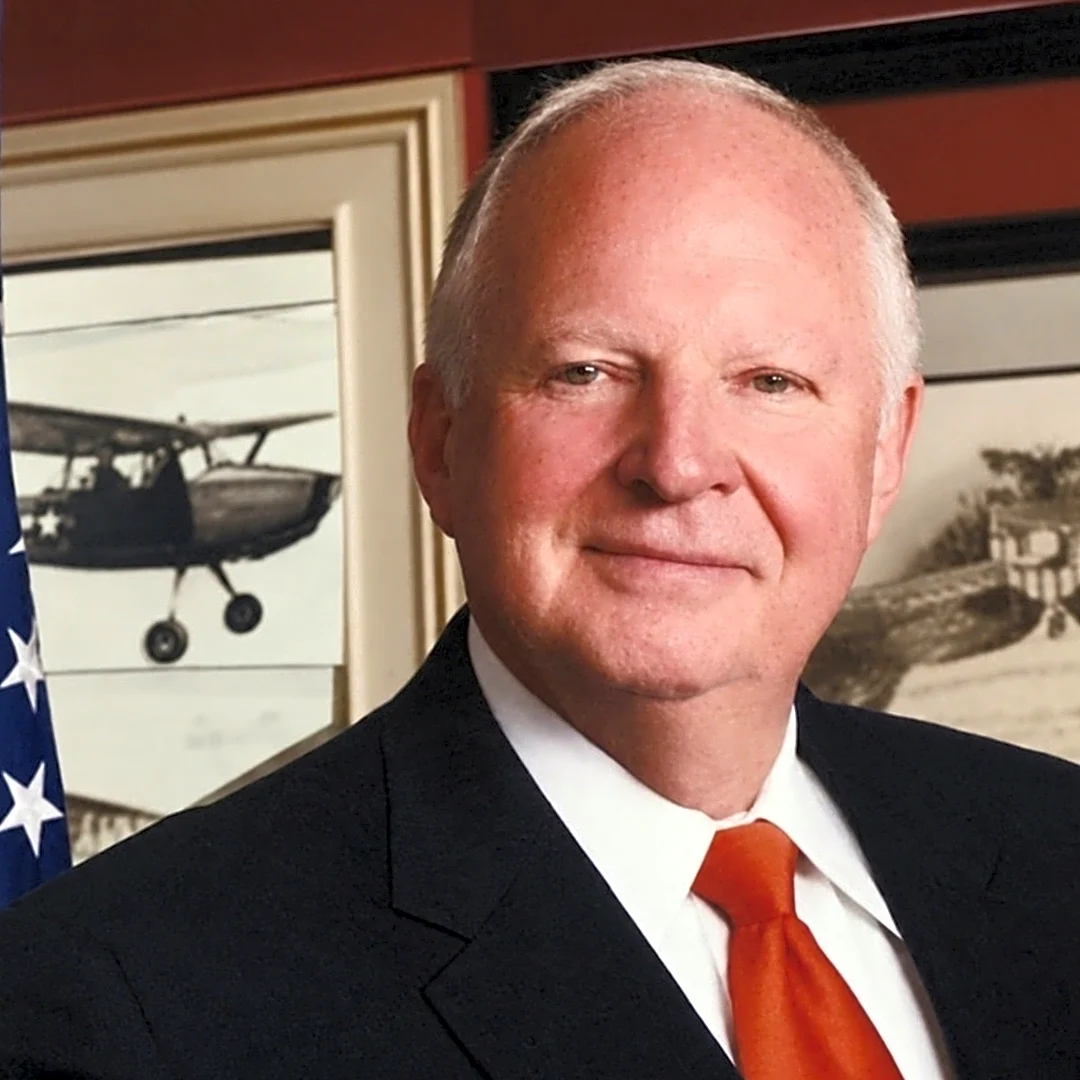
PBSO Chief Deputy Robert Allen receives total annual compensation of $424,752, including a taxpayer-funded retirement contribution of about $72,000. NYPD's first deputy superintendent, a comparable position, earns $276,000 a year. NYPD has a pension plan but also offers its top executives a 401(k)-type plan that is 100% funded by taxpayers.
The highest-paid PBSO employee is a civilian, Chief Operating Officer George Foreman. He does not oversee law enforcement officers. His annual salary of $352,752 rises to $424,752 after a taxpayer-funded 401 (k) type contribution. New York City's top cop, Jessica Tisch, the police commissioner, earns $287,000 a year.
PBSO also offers all employees a 401(a) retirement account which is the government employee equivalent of the 401(k) accounts for those who work in the private sector, The Post has previously reported.
The 401(a) plan at PBSO, which is in addition to the Florida Retirement System pension plan, is highly unusual in that it is 100% taxpayer funded. As much as 20% the base salary is deposited into the 401(a) plan. That amounted to $72,000 this year for the top executives at PBSO.
Under the Florida Retirement System pension plan, a law enforcement employee can retire after 20 years at 50% or more of their salary. NYPD has a similar retirement plan but does not have a 100% funded 401(k) type plan.
Unlike Palm Beach County, New York City caps salaries below the police commissioner’s pay, preventing subordinates from earning more than the department’s top official.
However, as many as 20 employees at PBSO earn more than Bradshaw, who earns an annual salary of $230,169, and 24 earn more than the NYPD's Tisch. With salaries so high throughout PBSO, the cost to fund pensions and PBSO's special 100% funded 401(a) program grows even greater.
The lucrative executive salaries is a reason why an independent watchdog group says that PBSO’s budget has grown faster than the inflation rate for years. The result: Palm Beach County administration and commissioners to devote an increasing share of county revenues to PBSO at the expense of other county departments.

The findings were presented to PBSO spokeswoman Theresa Barbera for comment. She emailed the following statement:
"We know that your story is already written, and we know that no words will change what you are determined to write."
Palm Beach County commissioners have requested a more detailed breakdown of the sheriff's spending plan, while taxpayer advocates argue that executive salaries, enhanced retirement benefits and participation in Florida's Deferred Retirement Option Program, known as DROP, are reasons why the budgets have increased well above the rate of inflation in recent years.
The Post has examined the escalating costs of executive compensation.
As the Post previously reported, Bradshaw created the taxpayer-funded 401(a) retirement plan for top executives, with taxpayers covering the full cost.
The special benefit, which is not available to rank-and-file deputies, has cost Palm Beach County taxpayers more than $6.3 million over the past six years.
Like other top PBSO executives, he benefited as well from the 401(a) plan he created. From 2021 through 2024, the payments raised his annual compensation to more than $300,000.
The PBSP 401(a) retirement plan comes long after many private sector companies phased out pension plans and reduced matching 401(k) contributions to their employee plans.
The Post also recently reported that PBSO has rehired high-salaried employees after they retired,rather than allowing others whose salaries would be lower to be promoted and move up the ranks. Nearly 40 former employees returned to PBSO, some to newly-created positions. Others were rehired at salaries higher than those they had earned before retiring.

A critic points to pensions and retirement perks
According to David Jaye, founder of TripleDipper.com, a watchdog group that monitors pension payouts throughout the state, the PBSO pension payouts cost taxpayers millions of dollars. County taxpayers currently pay a 22% pension contribution and fund a 7.7% Social Security match every year.
Jaye recently reported that 104 PBSO employees are scheduled to receive pension bonuses totaling more than $1 million, with four expected to receive more than $2 million.
Reporting by The Post on payroll spending at PBSO prompted TripleDipper.com to focus on PBSO’s participation in the state’s Deferred Retirement Option Program, known as DROP. The program is part of the Florida Retirement System and is available to eligible public employees, including many law enforcement officers, firefighters, teachers, and government workers. DROP allows an employee who has reached retirement eligibility to:
- Officially retire for pension purposes.
- Continue working for a limited period.
- Have their monthly pension payments deposited into a DROP account instead of being paid directly to them.
- Accumulate those pension payments, plus interest, while still collecting a regular paycheck.
Jaye noted that once enrolled in DROP, the already “retired” public employees receive their full salaries while their monthly pension payments accumulate in DROP accounts. Bradshaw, like other administrators, does not have to allow an employee to participate in DROP.
Jaye calls it triple dipping: Public employees collect a paycheck and a pension for the same job at the same time, without paying the standard 3% of salary to the retirement system, shifting that cost to taxpayers.
“The cherry on top is that county employees can cash out unused hours at the final highest pay, not at the wage when the hours were earned — spiking the last-year salary, which is what the DROP pension bonus and annual pension are based on,” Jaye said.
According to Jaye, the average individual pension bonus payout at PBSO is $937,646, with the highest single payout expected to be made to Allen, 69, the chief deputy, topping $2.3 million. It will be one of the highest payouts ever made in Florida. PBSO's DROP payments are among the highest in the state, according to Jaye.
Mike Diamond is a journalist atThe Palm Beach Post, part of the USA TODAY Florida Network. He covers Palm Beach County government. You can reach him at mdiamond@pbpost.com. Help support local journalism. Subscribe today.
This article originally appeared on Palm Beach Post: PBSO executives out-earn leaders at NYPD | Exclusive