







A crop slaughtering invasive specieshas spread to 25 Florida counties in five months, sucking the life from sugarcane and threatening an ecosystem decay as pasturelands succumb to its stealthy assault.
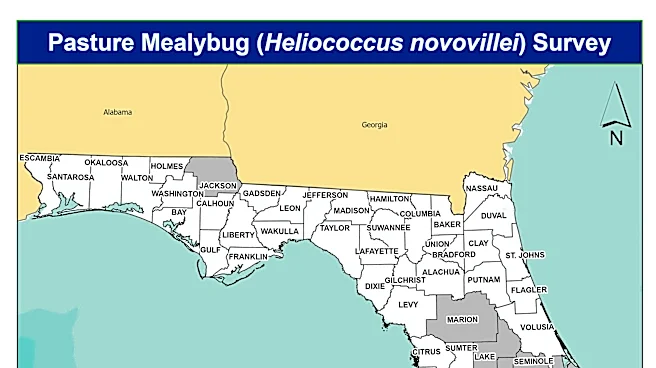
The pasture mealybug, which was first discovered in May in St. Lucie County now infests areas from the southern reaches of Florida to its very northern boundary in the Panhandle county of Jackson.
It’s potential widespread destructionof food crops, cattle grasses and millions of residential lawns triggered a Sept. 15 addition of pasture mealybug to a state emergency declaration signed by Gov. Ron DeSantis. The declaration supports a coordinated response to mitigate the pest’s impact.
“The destruction caused by mealybug is not only threatening production
on farms statewide, but it’s also putting our economy, local businesses and real jobs at risk,” wrote Florida Ag Coalition Chairman Tripp Hunter in a Sept. 21 letter, thanking DeSantis.
Pasture mealybug prefers grass-like plants. That means sweet corn, sugarcane, rice, limpo grass for cattle, sod farms, golf courses, and Bermuda, Bahia and St. Augustinegrass are all vulnerable.
Marcelo Wallau, a University of Florida forage extension specialist and agronomist said South Florida has been hit particularly hard, including Palm Beach, Martin and St. Lucie counties.
“People are really losing a lot of money,” Wallau said. “And think of all the other services pastures provide; water filtration, deer grazing, an environment for birds and insects. It’s a whole big ecosystem and extremely important for wildlife and land conservation.”
There are no current long-term solutions Wallau said.
Pasture mealybug is turning Florida sugarcane brown
In July, pasture mealybug was in 15 counties and hadn’t yetdone notable damage to Palm Beach County’s sugarcane crops.
That has since changed.
Keith Wedgworth, who manages 10,000 acres of sugarcane and rice in Palm Beach County for Wedgworth Farms, said the pasture mealybug is feeding most successfully on crops planted in more sandy soils than those rooted in the Glades’ famous black muck, although it's not clear why.
Wallau said it’s possible that the sandy soils have fewer nutrients, leaving the plant more vulnerable to infestation, but that’s just a best guess at this point.

“The cane is turning brown and actually there have been fields that have been completely lost,” said Wedgworth, who is also president of the Western Palm Beach County Farm Bureau. “What we don’t want to happen is to be the next citrus industry that has been devastated over the past 20 years with citrus greening. It could be that bad if we don’t’ get this figured out.”
Sugarcane is the most extensively grown crop in Florida with 440,000 acres in the Everglades Agricultural Area in Palm Beach County. It's also grown in Hendry, Glades and Martin counties.
University of Florida scientists, the Florida Department of Agriculture, the Florida Ag Coalition and the Florida Farm Bureau have rushed to find solutionsto stop or at least slow the pest including petitioning for, and receiving, an emergency exemption to test a specific pesticide not previously approved for use on the grass-like crops preferred by the pasture mealybug.
“For sugarcane, this is the biggest mobilization since sugarcane rust in 2007,” said Ron Rice, University of Florida / IFAS Palm Beach County extension department director. "And that changed the industry."
But the insect, which is no larger than a match head, is proving a formidable opponent.
Why is the pasture mealybug so hard to kill?
Because they can burrow as deep as 30 inches underground, the pasture mealybugs are not as affected by freezing temperatures and can avoid topical treatments that don't penetrate the soil.
Mostly they live on the undersides of leaves. In groups, their fuzzy white appearance can resemble laundry lint or talcum powder or a dusting of white mold. But their wooly-looking texture is actually a spiky wax coating that protects them from predators.
In a 24-hour period, females can produce nearly 100 offspring that slurp juices out of plant leaves and inject a saliva that helps the babies increase their nutrient uptake but is toxic to the plant.
Leaves are left looking toasted, dried out or reddish in color.
“I’m surprised at how quickly it spread,” Rice said. “But it is quite mobile.”
Nationally, the pasture mealybug was discovered in Texas and Louisiana in 2025 and has recently been confirmed in 70 Texas counties, according to a July 13 article in Farm Progress.
They can attach to everything from tractors to trouser legs, making them adept travelers. Texas is also looking at whether they can be dispersed by winds, which could account for the pest's rapid expansion in the Lonestar State.
At 10 a.m. on a Friday in mid-September, Wallau said he had already fielded three calls about the pasture mealybug. While it’s been confirmed in 25 counties, he said there may be more that aren’t official yet.
He encourages people to fill out a special pasture mealybug report form if they think they have it. There is no penalty to report it, but Wallau cautions that there are many types of mealybugs. Mealybugs on fruit, aren’t pasture mealybug.
Wallau said researchers are looking at treating the pest with everything from insecticides and biological products to natural predators and changes in mowing practices. A new campaign targets landscape crews to be on the lookout for pasture mealybug.
“In the pasture world, this is the hardest thing I’ve found so far,” Wallau said about pasture mealybug. “The challenge is it is advancing so quickly and research does not advance as quickly.”
Kimberly Miller is a journalist for the USA TODAY NETWORK FLORIDA. She covers weather, the environment and critters as the Embracing Florida reporter. If you have news tips, please send them to kmiller@pbpost.com. You can get all of Florida’s best content directly in your inbox each weekday by signing up for the free newsletter, Florida TODAY, at palmbeachpost.com/newsletters.
This article originally appeared on Palm Beach Post: Florida races to stop tiny pest ruining sugarcane, lawns | Exclusive