






Boot, trunk. Lift, elevator. Flat, apartment. That's just an example of British words vs. American words in the English lanaguage.
But have you heard of this one? "British Summer Time" vs. "daylight saving time."
How about "clocks go back" vs. "fall back?"
Like "chips vs. french fries," those phrases essentially mean the same thing, they just have a different label.
With daylight saving time coming to an end in the States and across the pond, we're providing info about "fall back" and "spring forward" in America vs. "autumn change" and "spring change" in England and parts of the United Kingdom.
Twice a year, the age-old practice of setting clocks back by one hour on the Sunday after Halloween or forward by one hour on the second Sunday in March generates
grumbles around the world − except for in areas, provinces, states or countries that do not observe daylight saving time.
Daylight savings deals, products from Walmart
Below is information about daylight saving time, commonly referred to as "daylight savings," why we change clocks twice a year and when to fall back and spring forward, or "autumn change" and "spring change," in England and parts of the United Kingdom.
What is daylight saving time?
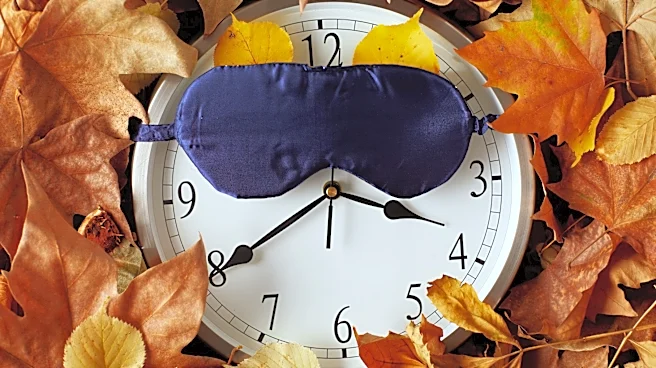
Daylight saving time is the period of the year when clocks are moved one hour ahead, or "spring forward," according to the National Institute of Standards and Technology, to create "more sunlit hours in the evening during months when the weather is the warmest." We move clocks back one hour or "fall back" when we return to standard time. "The transition from ST to DST (standard time to daylight saving time) has the effect of moving one hour of daylight from the morning to the evening. The transition from DST to ST effectively moves one hour of daylight from the evening to the morning," the NIST site explains.
Daylight saving time, commonly (and incorrectly) referred to as "daylight savings," was formally introduced in the U.S. in 1918.
When does daylight saving time end in the US in 2026? When is daylight savings in 2027?
Daylight saving time "ends" at 2 a.m. ET Sunday, Nov. 1, 2026 (Halloween weekend!), for "fall back."
Daylight saving time starts (again) at 2 a.m. ET Sunday, March 14, 2027, for "spring forward."
Daylight saving time then "ends" at 2 a.m. ET Sunday, Nov. 7, 2027, for "fall back."
What is daylight saving time called in England and the UK?
Daylight saving time (DST) in America has another name in England and the United Kingdom. British Summer Time (BST) begins on the last Sunday in March, and Greenwich Mean Time (GMT) is on the last Sunday in October.
In Florida and the States, daylight saving time ends Nov. 1, 2026. In England and the UK, Greenwich Mean Time ends Oct. 25, 2026.
Next year, it will be British Summer Time on March 28, 2027, and back to Greenwich Mean Time on Oct. 31, 2026, or Halloween.
In the States, we typically say fall back and spring forward. In England, "clocks went forward" at 1 a.m. the last Sunday in March, and "clocks go back" at 2 a.m. the last Sunday in October. In addition, clocks move forward from 1 a.m. to 2 a.m. for "spring change," and clocks move back from 2 a.m. to 1 a.m. for "autumn change," according to gov.uk. British Summer Time and Greenwich Mean Time was first introduced in the United Kingdom in 1916.
Like daylight saving time, "the period when the clocks are one hour ahead is called British Summer Time (BST) because there’s more daylight in the evenings and less in the mornings," the UK government site states.
Daylight savings to end in 2026. What are some of the most famous clocks in the world?
Since we're covering daylight saving time in England, it's interesting to note that one of the most famous clocks in the world is located there. Big Ben in London, England, is likely regarded as the most famous clock in the world. Though the clock is referred to as “Big Ben,” its name comes from the bells housed in the clock tower, renamed the Elizabeth Tower. Big Ben is a four-faced chiming clock.
In addition to Big Ben, the photo gallery below features some well-known time pieces and the most famous clocks in the world.
- Prague Astronomical Clock in Czech Republic
- Grand Central Terminal in New York
- The World’s Largest Cuckoo Clock in Sugarcreek, Ohio
- Allen-Bradley Clock Tower in Milwaukee, Wisconsin
- World’s largest ceiling clock at Lexington Central Public Library in Lexington, Kentucky
- NASCAR grandfather clock trophy from Martinsville Speedway in Martinsville, Virginia
- Marriott Boston Customs House, commonly referred to as the Boston Clock Tower in Boston, Massachusetts
Sangalang is a lead digital producer for USA TODAY Network. Follow her on Twitter or Instagram at @byjensangalang. Subscribe to the free Florida TODAY newsletter.
This article originally appeared on Palm Beach Post: Daylight saving time soon ends in the US. What it's called in England
Our editors independently choose our recommendations. Some content is produced with paid support from a third party, however our editorial decisions remain independent. If you buy through our links, the USA TODAY Network may earn a commission. Prices and availability may change.