


Summer ended in meteorological terms on Aug. 31 with most of the Sunshine State suffering througha season ranking in the top 10 warmest on record with several areas breaking century-oldhigh temperature benchmarks.
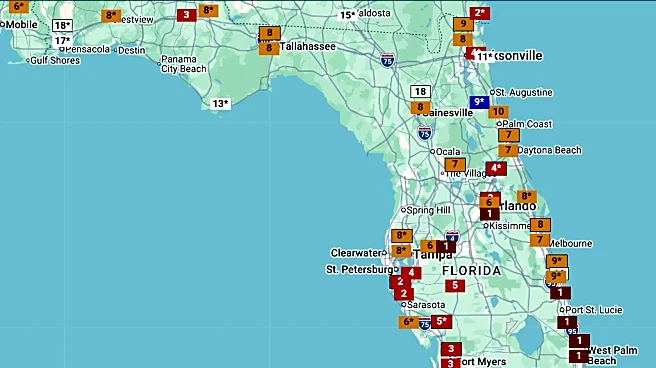
In southeast Florida, from Fort Pierce to Homestead, dailyaverage temperatures from June through August soared to No. 1 in the history books, according to data from the Southeast Regional Climate Center (SERCC).
West Palm Beach and Fort Lauderdale both broke summer heat records dating back more than 100 years with averaged temperatures that were about 2.4 degrees warmer than normal. West Palm Beach had 81 days of temperatures at or above 90 degrees, which is above the normal total of 55 days.
Lakeland, Orlando and Port St. Lucie alsosimmered
through summer 2026 as their hottest on record. Miami tied 2023 for its hottest summer.
“Quite simply, it was an unusually hot and dry summer across South Florida,” said National Weather Service Meteorologist in Charge Robert Molleda in a report released Tuesday, Sept. 1. “While no single weather feature can be attributed, our region experienced trends similar to those observed over much of the Caribbean region, a common feature during El Niño episodes in the summer.”
El Niño, which results from a periodic warming of sea surface temperatures in the equatorial Pacific Ocean, can create a prevailing strong area of subtropical high pressure near or over Florida and the northern Caribbean Sea, said Molleda, who is based in Miami.
The high pressure led to sinking air which warms and dries as it falls, zapping away clouds, increasing sunshine and reducing the chances for cooling rain showers.

This year’s El Niño is forecast to grow to a “historic event” that could surpass the strength of previous El Nionos dating back to 1950, according to the Climate Prediction Center. The Center will release its next El Niño forecast Sept. 10.
“In South Florida, a dry summer usually results in a hotter than normal summer, and 2026 certainly stands out in that respect,” Molleda said.
Many Florida cities had summers that ranked high for summer heat
Bradenton ranked second warmest with an average summer temperature a full 2 degrees warmer than normal. Fort Myers experienced its third warmest summer. Jacksonville Executive Airport at Craig had its fourth warmest summer.
Tallahassee felt its 8th warmest summer in 129 years of records, according to the SERCC. Gainesville, Tampa and Melbourne also saw summer heat rank in 8th place.
While El Niño contributed to some of the summer heat, other factors also played a role.
Choking bouts of Saharan dust and persistent westerly winds that pushed back cooling sea breezes on the east coast also contributed to temperatures as high as 100 degrees in Miami on Aug. 18.
And what the mercury readings don’t consider is the humidity, a point Florida Climatologist Emily Powell noted in mid-August as consecutive heat advisories based on heat index or"feels like" temperaturesmounted statewide.
The heat index is a combination of the temperature and dew point temperature — a measure of the amount of water vapor in the air. Warmer air can hold more water vapor, which inhibits the ability of the body to cool itself because seat doesn't evaporate as efficiently as it does in drier air.
"For August so far, we're not seeing a lot of record high temperatures, but we are seeing a lot of heat advisories and heat watches because the humidity is going up," Powell said in an August interview. "Right now, this time of year, we expect to see temperatures in the low 90s but the heat index is over 100 degrees and up to 110 in some places."
The National Weather Service in Miami issued 37 heat advisories for Miami-Dade and Broward counties June through August. Twenty-seven advisories were issued in Palm Beach County.
“Those looking for relief from the summer-long heat and humidity typically have to wait until early or mid-October for the first noticeable cold front to bring cooler and less humid air into the region, with more substantial lowering of temperatures into the 50s not normally observed until late October or November,” Molleda said. “This means that summer-like heat and humidity often linger will into October.”
Meteorological fall begins Sept. 1 but astronomical fall won't start this year until the autumnal equinox on Sept. 22.
Kimberly Miller is a journalist for the USA TODAY NETWORK FLORIDA. She covers weather, the environment and critters as the Embracing Florida reporter. If you have news tips, please send them to kmiller@pbpost.com. You can get all of Florida’s best content directly in your inbox each weekday by signing up for the free newsletter, Florida TODAY, at palmbeachpost.com/newsletters.
This article originally appeared on Palm Beach Post: Florida just had its hottest summer on record in several major cities