





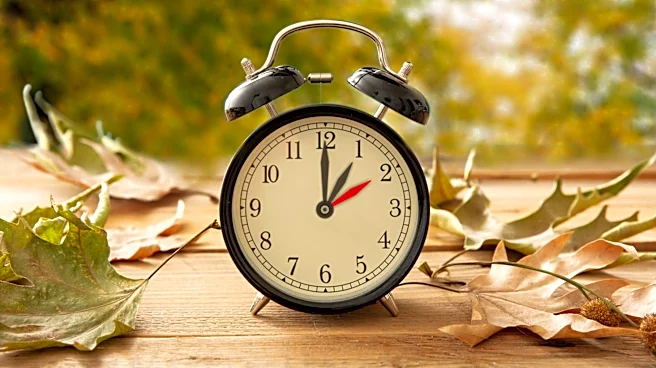
You can’t go back in time. You can’t freeze time. You can’t speed up time. But you can prepare for the effects of a time change.
This is especially true for daylight saving time. But why do the clocks (wall clocks and almost all electronic devices) change at 2 a.m.? And why is it always 2 a.m. on a Sunday in the fall and spring?
While there have been many attempts to permanently end daylight saving time over the years, there hasn't been attempts to change what time fall back and spring forward would occur.
Let us explain.
Daylight savings deals at Walmart
When do we change clocks for daylight savings 2026?
Daylight saving time "ends" at 2 a.m. ET Sunday, Nov. 1, 2026 (Halloween weekend!), for "fall back."
Daylight saving time starts (again) at 2 a.m. ET Sunday, March 14, 2027, for "spring forward."
Then, daylight saving time "ends" at 2 a.m. ET Sunday, Nov. 7, 2027, for "fall back."
Who’s in charge of daylight saving time?
Daylight saving time became a national standard in 1965 when President Lyndon B. Johnson signed the Uniform Time Act, which was established as a way to continue to conserve energy. The thinking was, if it’s light out longer, that’s less time you’ll need to use lights in your home.
The U.S. Department of Transportation oversees the nation’s time zones and the uniform observance of daylight saving time, according to transportation.gov. The oversight of time zones was assigned to the DOT to help keep track of transportation. The DOT manages daylight saving time and cites energy reduction and reduced crime as reasons for the time change.
Why do we change clocks at 2 a.m. Sunday for daylight saving time?
At 2 a.m. Sundays, most people are asleep, and that timeframe seems to be the least disruptive − and has been since the late 1800s, early 1900s. The early days of the railroad industry played an important role in timekeeping in the U.S.
While daylight saving time is a means to conserve energy and use more sunlight, DST plays a big role in transportation (see who's in charge of daylight saving time, above).
According to loc.gov: On Nov. 18, 1883, North American railroads switched to a new standard time system for rail operations, called Standard Railway Time. This helped create the four standard time zones we know today: Eastern, Central, Mountain and Pacific. Though tailored to the railroad companies' train schedules, the new system was quickly adopted nationwide. Then, in 1918 daylight saving time was introduced.
A 2019 story in Time magazine explains why the changes occur at 2 a.m., "When the country first experimented with daylight saving time in 1918 during World War I, there were actually no trains that left New York City at 2 a.m. on a Sunday. Universally, that timeframe made the most sense − changing the clocks at 2 a.m. would not be disruptive. While there have been many attempts to permanently end daylight saving time over the years, there hasn't been attempts to change what time fall back and spring forward would occur.
Which states don’t observe daylight saving time? Does daylight savings still affect them?
Arizona and Hawaii do not recognize daylight saving time. There's also no need to change the clocks in Puerto Rico, the U.S. Virgin Islands, American Samoa Guam and the Northern Marianas.
While these areas in the U.S. don't observe daylight saving time, they are affected by the time change, specifically for transportation and scheduling.
Countdown clock to end of daylight saving time
Sangalang is a lead digital producer for USA TODAY Network. Follow her on Twitter or Instagram at @byjensangalang. Subscribe to the free Florida TODAY newsletter.
This article originally appeared on Palm Beach Post: Like clockwork, daylight savings always ends, starts Sunday. Why?
Our editors independently choose our recommendations. Some content is produced with paid support from a third party, however our editorial decisions remain independent. If you buy through our links, the USA TODAY Network may earn a commission. Prices and availability may change.