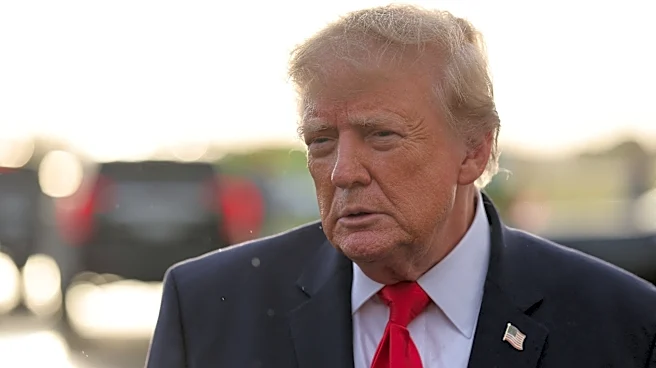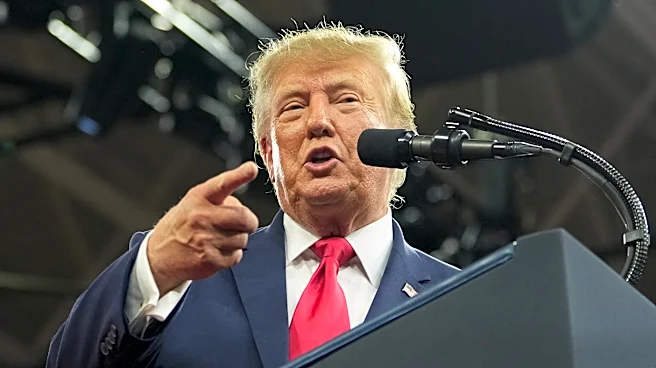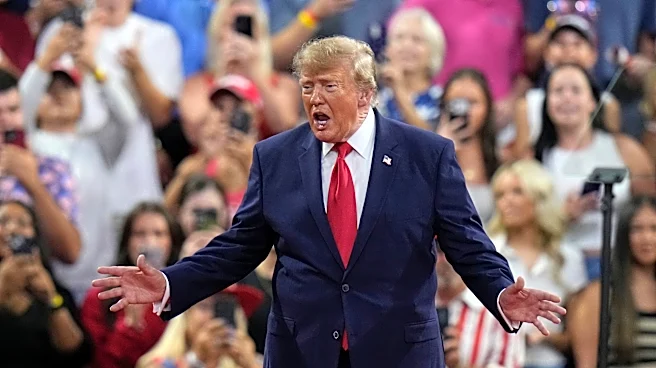



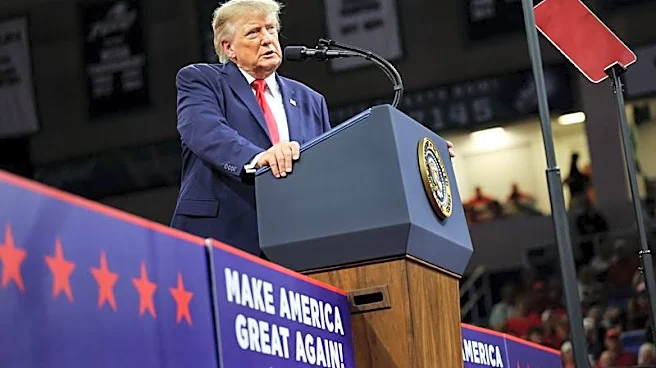
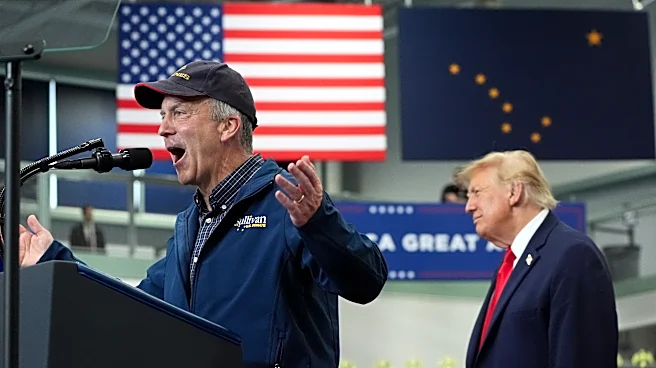

Wild things occupied President Donald Trump's attention last month as he crossed four time zones to a midterm campaign stump.
On Oct. 13, a day slated for a 3,400-mile trip to a rally in Alaska, the president posted three videos on social media. In one artificial intelligence-generated clip, Trump was seen wrestling, and then hugging, a tiger. A second one spliced together snippets of lions attacking humans. The third of showed a tiger and a man rough-housing.
The strange missives lacked explanation and context, except for the caption on the latter video.
"Don't mess with nature!" it stated.
It's Trump, however, who is messing with nature, according to environmental and wildlife advocates.
From South Florida to Alaska, they say there isn't a corner
of the American landscape not being eyed for an oil derrick, lumberjack axes and builder hammers. Organizations championing voiceless wildlife and landscapes say the Trump administration has embarked on an all-out assault to exploit — and spoil — the natural treasures in the country's remaining wild frontier.
"The framing of this as an attack on the wild is really right," said Kristen Boyles, an attorney with Earthjustice. "I have been doing this kind of work for my entire career and I've never seen anything like it. This is a no holds barred attack."
American wildlife, including iconic species, seemingly under assault
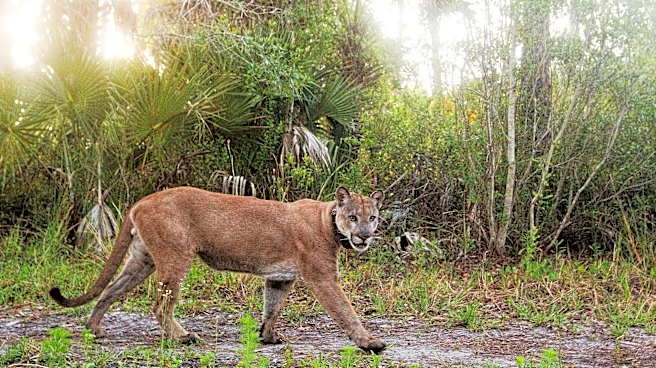
In Florida, the Center for Biological Diversity is concerned about the opening of 5,000 acres adjacent to a Florida panther habitat for housing and commercial development.
The Sea Turtle Conservancy is worried federal regulators will be less stringent on enforcing protective measures on nesting beaches and fishing gear.
The Wilderness Society is ringing alarms about a plan to strip protections from 45 million acres of pristine U.S. forests, as well as oil and gas drilling in Alaska's Western Arctic region.
Humane World is demanding a stop to the slaughter of wild horses.
Some 1.2 million acres in Utah's Bears Ears National Monument are slated for mining exploitation.
In Montana, American Prairie project is legally challenging the seemingly petty eviction of nearly 1,000 iconic American buffalo from a grasslands restoration initiative so ranchers' cattle can feed on those federal lands instead.
In September, Trump signed an executive order to "delist" grey and Mexican wolves from federal and state protective status in order to allow ranchers to arbitrarily kill them.

Is US Fish and Wildlife gutting Endangered Species Act?
Most chilling, conservation groups say, is a rule change announcement by the U.S. Fish and Wildlife Service in July.
Officials said they were eliminating the Endangered Species Act's so-called "blanket rule" protecting threatened species by offered them endangered-like status.
The federal agency also revised how it applies the “critical habitat” classification to "consider the economic, national security and other relevant impacts following the designation" of land or waterways as vital to a species. Now, territory that at-risk animals and plants require for sustainability will not be protected if their loss will not directly result in a specie's extinction.
“For too long, the Endangered Species Act has been weaponized to stop almost any new project in America, driving up costs for families, weakening our competitiveness, and undermining our national security,” said Interior Secretary Doug Burgum.
Earthjustice is among the various conservation advocacy groups that immediately filed lawsuits to block the change.
Boyles said the Endangered Species Act precisely was passed to protect "the places where threatened and endangered species live, eat, raise young, rested, sheltered" to protect them.
"That was a fairly bold assertion and counter to what the Endangered Species Act says," she said.
Equally as bad, Boyles added, are reported efforts within Fish and Wildlife to not consider adverse impacts from human action on any endangered or threatened species unless the person doing the damage "meant to intentionally cause" harm.
"That is even more extreme," she said. "It's pretty much gutting the prohibitions under the Endangered Species Act."

Conservation advocates: Trump is no Teddy Roosevelt
Starting with Theodore Roosevelt 125 years ago, the American presidency adopted a posture valuing the nation's flora, fauna and majestic landscapes as treasures to protect.
Recognizing the excesses of the 19th century, from deforestation to the near extinction of the buffalo, the U.S. government was to serve as a regulator, balancing the needs of the human and natural worlds.
That has apparently hit a wall in the anthropocentric presidency of Donald Trump.
A case in point was the Sept. 4 executive order allowing ranchers to gun down wolves.
"These hardworking Americans ensure that our country has a reliable domestic source of high-quality animal protein products, and a secure, plentiful domestic ranching industry vindicates this country's food security," the executive order stated.
Beyond that, Trump, a developer, has had his gaze firmly fixed on 640 million acres of federal land dating back to the start of his first White House term nearly a decade ago.
On the campaign trail in 2024, Trump vowed that the country's natural resources would be exploited and deployed as the antidote to inflation and the cost of living struggles.
Energy prices would be slashed by coupling a laissez-faire "drill, baby, drill" approach.
Candidate Trump specifically called for expansive drilling in the Arctic National Wildlife Refuge, one of the last tracts of pristine wilderness in the United States. The refuge's forest, taiga, and tundra regions are home to polar, grizzly and black bears — plus moose, caribou, wolves, red and Arctic fox, Canada lynx, wolverine, pine marten, American beaver and North American river otter.
Trump's plan to reduce housing costs, vaguely spelled out in the GOP 2024 platform, was to open "portions of Federal Lands to allow for new home construction."
Once in office, Trump issued executive orders clearing the way for the logging and timber industry to cut forests to boost "underdeveloped" wood production and unleash U.S. mineral production to restore "American dominance."
Other orders to expand oil and natural gas drilling have, since January 2025, led to all-time records in U.S. energy production. Still, the administration has failed to lower the cost of living for Americans. Fuel costs have surged way higher since he took office, home ownership remains unaffordable and inflation, tariffs increased the cost of some consumer goods and wholesale price reports in October showed sharp upticks.
When the president does speak about wildlife, it is in fantastical terms.
In criticizing electric vehicles, Trump mulled in speeches whether it was better to die by electrocution on a sinking boat versus being eaten by a shark. Trump joked about immigrant detainees having to run in zig-zag formation to avoid iconic alligators if they escaped the now-defunct Alligator Alcatraz immigration facility in the unique landscape of the Big Cypress National Preserve.
The end result, wildlife advocates say, is that America's nature, its gems, iconic species and majestic lands are at risk of permanent loss and despoliation simply to satisfy profiteers.
"It is all about the grift, it is all about the service of the industries, which are bankrolling this administration," said Boyles. "It's not about the wild, the people who care about the wild places, the wild animals themselves, or our natural treasures."
Panther habitat, housing demand clash in Southwest Florida
Unchecked, the administration's pursuit of lands for exploitation and its defanging of rules protecting species' could be devastating, advocates fear.
In Florida, sea turtles would be at risk if, say, commercial fishermen no longer need to employ devices in their fishing gear to prevent inadvertently killing a sea turtle in a net. Keystone populations of salmon in the Pacific Northwest could be impacted if rules against poisoning their waters are weakened.
"It's hard to pinpoint a place which wouldn't be impacted," Boyles said. "It is biological and logical nonsense to believe that you could harm the habitat for a species and not actually harm the species itself."
In Southwest Florida, the Center for Biological Diversity is concerned about the West Development Project on privately-owned tracts.
The 10,000-acre project will bring thousands of homes onto the market in a booming part of the peninsula precisely at the moment that home prices are central to the state's cost of living equation.
The eastern borders of the project, however, are just miles from the Florida Panther National Wildlife Refuge in the Big Cypress region of the Everglades, said Jason Totoiu, the Florida policy director at the center.
"That area is really the last remaining core habitat for the panther, for the breeding population," he said.
The 200 panthers in the area have lost more than 30,000 acres of habitat since 2009, Totoiu said, adding the population is "treading water" numerically.
The Center is challenging the federal government review of that project under the Endangered Species Act arguing that Fish and Wildlife failed to fully scrutinize how the housing development would impact the panther population. Totoiu said the agency tends to evaluate a project's impact "in a vacuum" without assessing how incremental habitat loss has affected the population.
"The federal government is not carefully examining just how much habitat loss is too much and what is that straw that's gonna break the camel's back," he said. "It's kind of like a death by a thousand cuts, where not any one project is going to make the panther extinct tomorrow. But there's going to come a point, and we might be at it at this point, where the population is just unable to recover without some sort of really drastic human intervention."
The "drastic" measure could require establishing a wildlife corridor of contiguous land preserves to the north to facilitate panther movement rather than boxing them in a shrinking zone.
"They're simply running out of room at this point down there," he said.
Wildlife advocates believe there is popular support for their position..
"What I've noticed is that people are more accepting of wildlife and even predators," said Totoiu. "So, yes, there is this constant development pressure, but at the same time, we have these overwhelming bipartisan and community supported efforts."
A survey released Oct. 21 by the Public Opinion Research Lab at the University of North Florida found 61% of Floridians who were asked said that protection of the environment should be given priority, even at the risk of curbing economic growth and development. Just 26% said the opposite.
"I think we all understand how connected we are to the natural world," said Boyales at Earthjustice. "The endangered species act is really an amazing statue. It's just that view is not a view shared by this administration."
Antonio Fins is a politics and business editor at The Palm Beach Post, part of the USA TODAY Florida Network. You can reach him at afins@pbpost.com. Help support our journalism. Subscribe today.
This article originally appeared on Palm Beach Post: Trump, US Fish Wildlife rule changes 'gutting' Endangered Species Act?