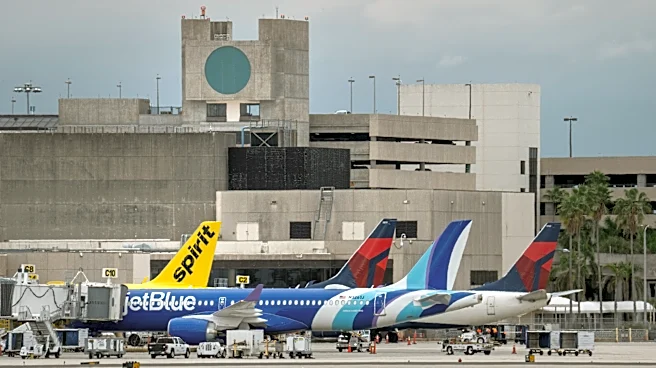






President Donald J. Trump International Airport is growing faster thanSouth Florida's other large airports, setting passenger records and exceeding its own forecasts. Yet despite the growth, the airport faces roadblocks to becoming the region's next Miami International Airport.
The holdup is capacity, but there are plans to increase the ability to serve a growing region.
The irony, of course, is the same population boom that has resulted in maddening roadway and highway snarls for commuters in Palm Beach County presents a sky's-the-limit of opportunity at the rebranded DJT.
Which begs the question of the newly renamed airport: What can be done for DJT to develop as a major regional aviation hub drawing travelers from the communities, and counties,
around it?
Plenty, officials say.
Positioning, population growth present opportunity at DJT
DJT is geographically well-situated in the middle of the county, roughly 20 miles from both the Broward and Martin county lines. The facility is accessible by major thoroughfares.
The airport, 3 miles west of the president's Mar-a-Lago residence and club, is bordered by Interstate 95 to the east. The sprawling aviation complex is framed to the north by Belvedere Road, and to the south by Southern Boulevard. Not far west is Florida's Turnpike, another highway that opens paths to passenger access.
All told, the number of people calling the Palm Beaches home has boomed in the past four decades from the 576,758 figure recorded in the 1980 U.S. Census to the 1.49 million in the most recent decennial count.
The 2020 U.S. census number, however, doesn't factor in the mass migration that has taken place in the aftermath of the global pandemic six years ago.

Meanwhile the Treasure Coast to the north of Palm Beach County has seen a boom in residents, too. More than 700,000 people call Martin, St. Lucie and Indian Rivers counties home, with one estimate projecting the population of the three counties will swell to 825,000 by 2024.
The airport has seen its passenger traffic skyrocket as well.
A record 8.7 million passengers used the airport in 2025, exceeding projections made by the 2014 master plan by roughly 800,000 travelers. DJT was the only South Florida airport to experience growth in 2025.
"We continue to see growth while others are seeing limited growth or none at all," said Airports Director Laura Beebe. "There has been significant population growth not only in Palm Beach County but also in the counties to our north, which is our service area. This all feeds into the growth at the airport."
Since 2022, passenger traffic at the former Palm Beach International Airport has grown by nearly a third. Over the same period, passenger counts increased less than 2% at Fort Lauderdale-Hollywood International Airport and about 9% at Miami.
Even so, both South Florida airports remained far larger than PBI in traffic counts in 2025: Fort Lauderdale handled nearly four times as many passengers, while Miami processed more than six times as many.
Runway configuration, capacity present growth constraints
That is the opportunity. Then there are the constraints.
DJT operates with a layout that limits aircraft movements because of intersecting runways that prevent simultaneous landings and takeoffs, according to the airport's master plan.
The runway layout also increases the risk of incursions, slowing aircraft movements because controllers must ensure planes have sufficient separation when crossing intersecting runways.
DJT's major rival airports in Broward and Miami-Dade do not have intersecting runways.
The runway configuration is a key factor in capping departures and arrivals at Trump International. Total DJT aircraft operations — including commercial airliners and private jets — are projected to hit the airport’s 220,000-operation capacity sometime between 2028 and 2032.
DJT's 1,900-acre site is also hemmed in by residential, commercial, and industrial development. The lack of available land surrounding the airport also limits important facilities, from customs operations to warehouse space to additional runways or terminal capacity.
There are no plans to have the airport expand beyond its current boundaries for more runway space.

Future growth can only be realized through modernization and more efficient use of existing facilities, according to its master plan. Eric Trump, son of President Trump, said as much to The Palm Beach Post in an interview on July 9, the day the airport officially renamed for his father.
"You want modern technology, you want modern (Air Traffic Control), you want your concourses to be stunning and beautiful," Trump said.
Even as its passenger explodes, Eric Trump said the airport retains a hometown comfort.
"It's kind of got this mom-and-pop feel to it, which we all love," he said.
How can DJT maximize its assets?
One project that will make more efficient use of existing space is a plan to connect all three concourses, creating what airport officials call "a seamless post-security experience for travelers."
Currently, passengers moving between concourses often must leave the secure area and then pass through security a second time. Once the connector concourse project is completed, that will no longer be necessary.
The terminal upgrade will also expand security screening areas to improve flow and reduce wait times. It will include space for passenger lounges, restaurants and entertainment spaces.
DJT is one of the busiest airports in the country for private jet traffic. But part of that plan is to shift some of that demand to other Palm Beach County airfields.
The county expects a runway expansion at North Palm Beach County General Aviation Airport to help lessen airport traffic.
Known as North County Airport, the airfield is a general aviation facility near Palm Beach Gardens designated as a reliever for DJT by accommodating small, private jets. The plan is to redirect some business-jet service to North County to free up capacity at DJT.
The capacity improvement projects to address terminals and private jet traffic cannot come soon enough for DJT. The airport has been attracting new service but it is often of a seasonal nature, and the service is not always daily.

Starting in November, United Airlines will launch a nonstop route between West Palm Beach and San Francisco — but only on Saturdays. New service will also soon be offered to Denver, Los Angeles and Atlantic City.
By the end of the year, nonstop service will also be offered to Grand Rapids, Michigan; Cincinnati; Wilmington, Delaware; Toronto; Montreal; Columbus, Ohio; and Atlantic City, New Jersey. Some of those flights will be seasonal, at least for the time being.
Beebe said flights often begin either as once a week or seasonal but often expand once airlines are convinced that they can fill their planes, noting that happened with Chicago.
"We now have several flights a day," she said.

DJT and the runway question
Just as the population has boomed in the Palm Beaches, so is their rising demand for more variety and options at DJT.
Jerry Mitzner, a resident of Boynton Beach, says he loves President Donald J. Trump International Airport.
"It is so much easier to get into and exit," he said. "And the parking is so convenient. But I just can't seem to find those longer distance flights I often seek, like Denver and LA. But when I find the destination I need, I always choose the Palm Beach airport. Driving to Fort Lauderdale adds a good 40 minutes one way to my trip."
The question on the minds of so many travelers is whether DJT will ever offer nonstop flights to Europe, for example. At the moment, nearly all of its flights, 98%, are domestic with international flights mostly limited to The Bahamas and Canada.
That percentage could change, said Beebe, adding she envisions flights to London happening within five years.
However, she said the impediment to cross-Atlantic flights "is not a runway issue," adding that the current "long runway we have is long enough to handle" European flights.
"It is a demand issue," Beebe said. "The airlines need to be convinced that they can fill their flights. We believe it will only be a matter of time. And we are working with the airlines to see that it happens."
A problem that must be addressed at DJT is that its two primary runways intersect with one another, limiting the airport's ability to handle arrivals and departures independently, said Anton Radchenko, CEO of AirAdvisor, a company that helps travelers seek compensation from airlines.
“There are longer taxi times, tighter connections and often more time stuck at the gate," he noted. "One operation often must wait for the other, creating bottlenecks that passengers experience as delays."
Beebe acknowledged the airport needs to address the intersecting-runway issue, noting that the current configuration often results in delays, especially during the busy winter season.
"The demand is growing, and we need to meet that demand," she said.
Air traffic, she said, is getting close to the point where the airport may begin planning for what could be a $200 million-plus project to address the criss-crossing runway dilemma.
Under consideration is the elimination of the smaller intersecting Runway 14/32. Then, runway 10R/28L, which is 3,214 feet long and which parallels the main runway, would be extended to 8,000 feet, allowing it to be used by commercial jets.
Currently, the runway is so short that it can only accommodate small jets.
"What you have now is, in effect, a one-runway airport," said Radchenko.

DJT's three runways are:
- Runway 10L/28R (main commercial runway): 10,001 feet by 150 feet.
- Runway 10R/28L (general aviation runway): 3,214 feet by 75 feet. It would be lengthened to 8,000 feet, allowing it to handle commercial jets and would parallel the main runway.
- Runway 14/32 (crosswind runway): 6,931 feet by 150 feet. It intersects with the main runway; plans call for its elimination.
One of the problems, though, with building parallel runways is that nearby communities may likely object as it will change flight patterns, creating new noise issues.
But Beebe said a benefit would be that planes would land and take off closer to schedule, reducing the number of early morning and late-night flights that West Palm Beach-area residents so often complain about.
What are the planned Concourse B improvement?
For the time being, the county is focused on projects that include renovating and enlarging Concourse B to add boarding bridges, update concessions and improve aprons, a paved area where aircraft are parked and serviced between flights.
Two new gates will be added as well. And during the next five years, DJT is expected to see more than 50 projects undertaken totaling nearly $400 million.

One of those includes a $200 million-plus Consolidated Rent-A-Car facility on 20 acres off Belvedere Road, which would simplify car rentals. The project would house rental-car operations into a single location that could accommodate nearly 2,400 vehicles.
How to make it easier to get to and from the airport
A California transit company is also mulling a tram that could revolutionize how people get to and from the airport.
The transit developer Glydways is expected to appear before the county commission this year with a proposal to use family-sized, battery-electric vehicles on dedicated guideways to transport people along a 4-mile route between the airport and downtown.
“Think of it as an elevator,” said Brian Gettinger, a senior Glydways’ vice president. “You pick the floor, and it goes nonstop to it. That is how this would work.”
The self-driving cars would whisk commuters along a dedicated circuit with stations at the airport, the county convention center and several downtown sites. A similar system is being built in Atlanta.

The elevated paths that Glydways uses are about the width of a bicycle lane. The fact that the county’s airport is just a few miles southwest of downtown makes constructing elevated roadways more feasible than in many similarly sized cities, according to Goettinger.
A passenger would board a self-driving car at a station. The car would then take its passengers directly to their selected station, using dedicated pathways to cruise over or around regular traffic. As many as 10,000 people a day are projected to use the system in West Palm Beach.
One major obstacle is the cost. While fares are expected to cover its operating costs, building the project could cost as much as $600 million. Much of that funding, though, Gettinger said, could come from federal and state sources.
Mike Diamond is a journalist atThe Palm Beach Post, part of the USA TODAY Florida Network. He covers Palm Beach County government. You can reach him at mdiamond@pbpost.com. Help support local journalism. Subscribe today.
This article originally appeared on Palm Beach Post: DJT Airport is booming. With only so much room to grow, what's next?