



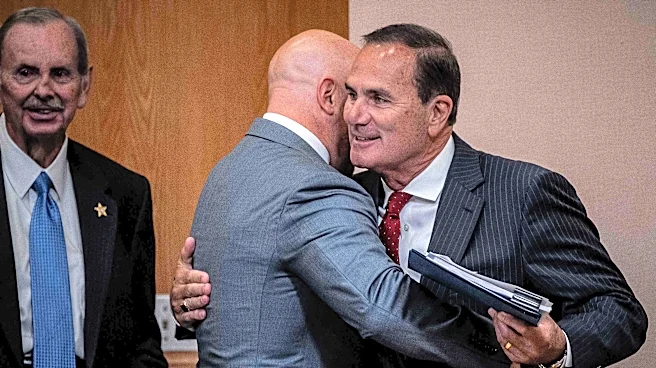
Palm Beach County Administrator Joseph Abruzzohas warned that several municipalities across the Palm Beaches could become insolvent if voters approve Amendment 3, a statewide ballot measure that would dramatically expand Florida's homestead exemption and reduce local property tax revenue.
If that happens, Abruzzo said, Palm Beach County could be forced to assume responsibility for the municipalities' debts and operations. "The fiscal impact would be enormous," he noted.
The county administrator said it would not be appropriate at this time to identify the towns but he said his staff's analysis indicates that as many as 10 municipalities could go under.
"The issue is whether these towns would have enough revenue to pay their bills and the debt that
they have accumulated over the years," Abruzzo told The Post in an interview. "We need to prepare for the possibilities that they will not."
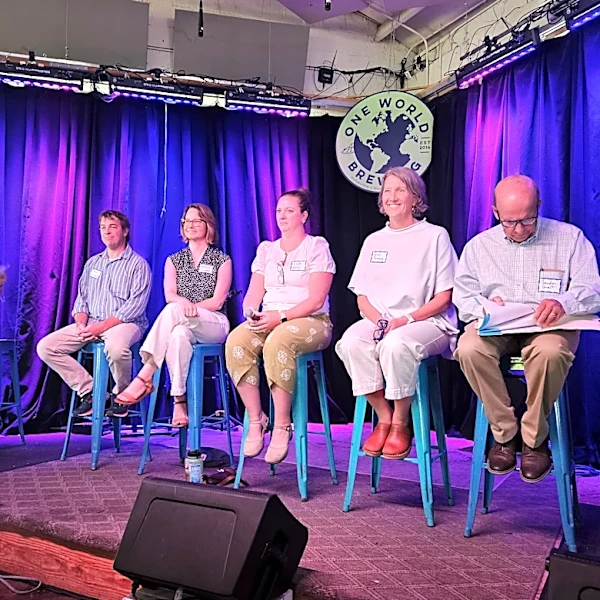
He initially aired his concerns on Wednesday, Aug. 19, during a panel discussion on Amendment 3 sponsored by the Coalition of Boynton West Residential Associations, known by the acronym COBWRA. Abruzzo's assertions were based on an assessment of the loss of property tax revenue and the inability of certain towns to make up for the loss of that revenue.
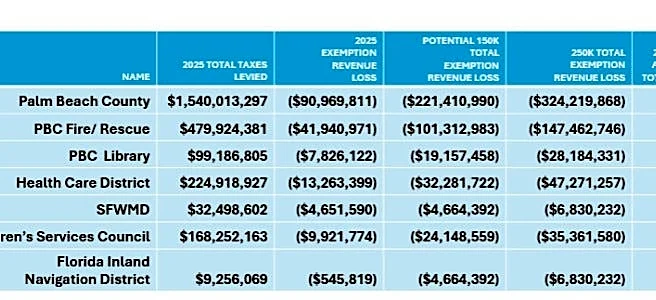
Voters will decide in November whether to approve the constitutional referendum that would increase the homestead exemption from its current level of $50,000 to $150,000 in 2027 and then to $250,000 in 2028. Many analysts see Amendment 3 as one of the most decisive policy decision ever put before Florida voters, potentially shaping the Sunshine State for years to come. To approve the amendment, 60% of voters will need to vote yes.
The amendment would shift costs onto renters, small businesses, and shoppers. And it would further erode home rule, according to the Florida Association of Counties.
The Glades city of South Bay, according to the Florida League of Cities, would lose much of its tax base.
A five-year Florida residency is required before homeowners qualify for the expanded exemption. And, to blunt the expected shifting tax burden, the measure would cap increases in assessments on non-homestead properties, like second homes and commercial real estate, from the current 10% to 5%.
The panel spoke to COBWRA, an influential coalition of homeowner associations in south and central Palm Beach County. Panel members also included Property Appraiser Dorothy Jacks, Tax Collector Anne Gannor, state Sen. Lori Berman, D-Boynton Beach, and state Rep. Anne Gerwig, R-Wellington.

Jacks noted that millage rates throughout the county can be expected to increase. She added that owners of high-priced homes will also feel the impact of those higher millage rates. “The first $250,000 would be exempt, but anything above that could be taxed at a much higher millage rate,” she said. “Everyone is going to be impacted by this.”
Earlier this year, Jacks questioned whether municipalities with older housing stock and limited commercial tax bases could survive the revenue losses projected under Amendment 3. She said Haverhill, Palm Springs, Lantana and Hypoluxo are that could be especially vulnerable to the loss of property tax revenue.
Haverhill Town Administrator Tracey L. Stevens discussed the impact of Amendment 3 on the town's finances with Town Council on Aug. 13. She said Haverhill would ultimately sustain a property tax loss of 53%, and that "a loss of this magnitude could require the Town to reconsider service levels, funding priorities, capital plans, and the structure of recurring revenues and expenditures."
Stevens, though, did not mention "bankruptcy" as an option that would be explored.
Efforts to reach town officials in Palm Springs, Lantana and Hypoluxo were unsuccessful.

State law limits millage rates for municipalities to $10 per $1,000 of assessment
Abruzzo said he has already had to defer hundreds of millions of dollars in county capital improvement projects to prepare for the possibility of major cuts in property tax revenue. Abruzzo noted that state law limits a town’s millage to $10 per $1,000 of assessed value. Some towns are already close to that $10 cap, Jacks noted.
The panel discussion at the COWBRA also noted that many towns could not raise millage rates enough to make up for the lost revenue, even if they wanted to. The millage rate in Mangonia Park is $9.90; in Boynton Beach, $7.75; and in Riviera Beach, $8.35.
Berman, a Democrat, criticized the Republican-controlled Legislature for putting Amendment 3 on the ballot without first assessing its financial impact.
Gerwig, a Republican, said she was concerned that the South Florida counties may be called on to assist counties elsewhere in the state that could struggle to operate.
“To me this is socialism," Gerwig said. "Part of that state money would come from Palm Beach County.”
Gerwig, nonetheless, said she supported putting the amendment on the ballot so voters could decide its fate. She said homeowners have seen substantial increases in their property tax bills in recent years because of rising property assessments, questioning whether local and county governments are doing what they can to control spending.
She noted that state government has been reducing its spending in recent years. Municipal and county governments need to be doing the same, she added.
Mike Diamond is a journalist atThe Palm Beach Post, part of the USA TODAY Florida Network. He covers Palm Beach County government. You can reach him at mdiamond@pbpost.com. Help support local journalism. Subscribe today.
This article originally appeared on Palm Beach Post: County chief warns tax amendment could drive towns into insolvency